



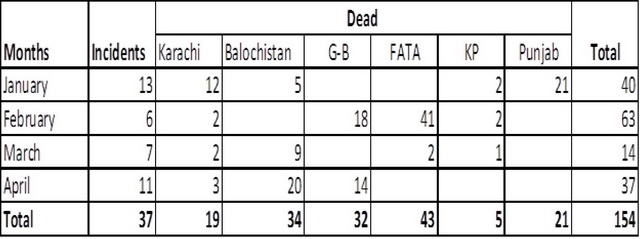
Violence continues to stain the security landscape of Pakistan, in one form or the other. The latest addition to it is a surge in the target-killings of the minority Shia Muslims, particularly in the southwestern Balochistan province, where several dozen shia Muslims have fallen to various acts of terrorism. Since early this year, sectarian terrorists, presumably sunni radicals, have been preying on Shia minority populations across the country. Statistics collected through different sources (CRSS Balochistan Monitor , Pakistan Conflict Tracker and South Asia Terrorism Portal and) suggest that sectarian violence has eaten up 154 people till April 15, 2012 (For details see chart below) across Pakistan.
Sunni Muslims constitute about 70 percent of Pakistan population, while the minority Shia population accounts for about 20 percent. [1] Among the Sunnis, Deobandi sect is thought to be the main promoter and driver of extremist violence in the country and sectarian militant organizations like Lashkar-i-Jhangvi (LeJ), a formidable militant wing of the rabidly anti-shia Sipah-e-Sahaba Pakistan (SSP), and Lashkar-i-Islam in case of tribal regions are the main proponents of the anti-Shia campaign. Meanwhile, Sipah-e-Muhammad, a militant organization that had emerged in reaction to the sunni outfits, is also involved in the tit-for-tat killing of Sunni Muslim.
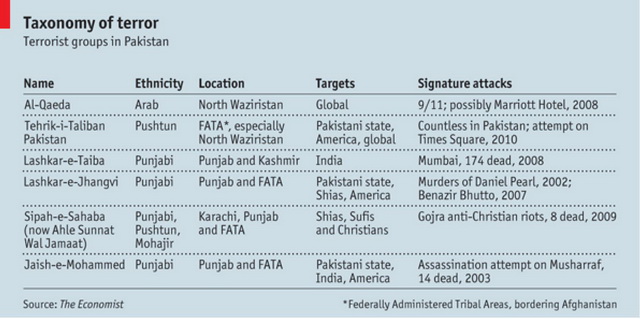
All these outfits, headquartered in Pakistan most populous province Punjab, were banned in January 2002 but continue to loom large under different names.. Moreover, retrospective study of sectarian violence in Pakistan suggest that the phenomena took root inside Pakistan in early 1980s during former President Zia rule, whereby the ruler tried to Islamize the politics to legitimize his military rule. But during the post-9/11 era, LeJ, once the local sectarian outfit has developed nexus with the regional and/or global terrorist organizations like Al-Qaeda, Tehrik-i-Taliban Pakistan (TTP), Afghan Taliban, Lashkar-e-Taiba (LeT), etc.
Source: http://www.economist.com/node/18488344
Likewise, the ideological turf war between Iran and Saudi Arabia to the backdrop of Iranian revolution in 1979 also played out badly in Pakistan. Both the ideological arch-rivals funded their respective violent sectarian outfits in Pakistan to expand their influence. Thus the inter-sectarian clashes in Pakistan which erupted in early 1980s reached peaked in the mid 1990s. Data compiled by the SATP, depict that since 1989, 3821 people have been killed in 2601 different incidents of sectarian violence in the country.[2] And most of the dead belong to the minority Shia sect.
The most recent wave of sectarian violence, unlike the past when southern Punjab was the killing field, is spread to a different geographical zone. A concise look into the unfolding territory of sectarian violence suggests that the major portion of violence is engulfing Quetta (Balochistan), Kurram Agency (Federally Administered Tribal Areas, FATA), Karachi and Gilgit-Baltistan (G-B) regions. As shown in pie chart below, 28 percent of the total dead as a result of sectarian violence belong to the Kurram Agency and especially Parachinar, where there are going on frequent clashes between militants of Lashkar-i-Islam (Sunni) and militants belonging to Touri tribes of Shia origin. Next on the ladder of ferocity of sectarian violence lies Quetta, Balochistan. In Quetta, there is residing large number of Shia people belonging to the defenseless Hazara community and suspected militants of LeJ are preying upon them. Pie chart shows that 22 percent (34 out of 154) of the total killed, so far during the current year belong to Quetta and 32 among these are from Hazara community.
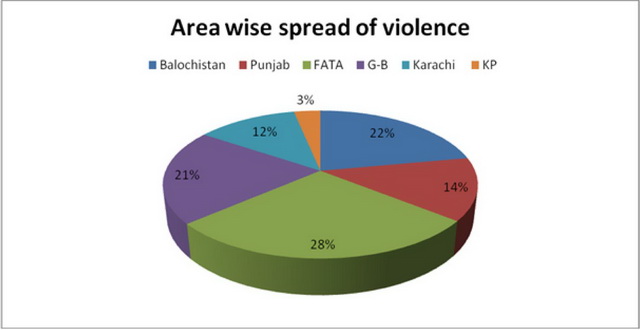
Furthermore, the province of G-B which is among the top most volatile regions of Pakistan in terms of sectarian fragility boiled over again during the start of current year. And different cycles of violence in 2012 have cost 32 lives so far in the area. In order to quell the violence security forces have clamped down curfew in Gilgit city, the provincial headquarter. Therefore, its return to normalcy is yet to be ascertained, while there are ample chances that the ferocious cycle of violence which has gripped the area will not go away so easily, and will potentially spill more blood in coming days.
Meanwhile, sectarian violence also visited familiar terrain, southern Punjab with the inception of the current year, whereby 21 people belonging to Shia minority were butchered during a religious sermon in Rahim Yar Khan in January. Also in case of Karachi, where shades of all kind of violence continue to blot the security landscape, 19 people (12 percent the total dead in sectarian violence) were slaughtered in first three and half months of the year. The data and terrain of sectarian violence underlines that it is getting vicious in intensity and spreading geographically.
The relentless wave of sectarian killing from the southwestern Balochistan to the northern-most regions of Gilgit-Baltistan represents a formidable challenge to the Pakistani security establishment, which remains beset with organizational weaknesses. A daring Taliban attack on a jail in Bannu, a southern district of the Khyber Pakhtunkhwa province that resulted on April 15 in the escape of almost 400 prisoners, also underscored the deficiencies in the security mechanisms around sensitive installations. It also pointed to a massive security as well as intelligence failure. Most incidents of shia killings have also remained traceless, most probably because of the organsiational weaknesses and lack of coordination among various civilian and military security institutions.
[1] Alastair Lawson, ‘Pakistan evolving sectarian schism’, BBC News, October, 4, 2011, available at http://www.bbc.co.uk/news/world-south-asia-12278919
[2] ‘Sectarian Violence in Pakistan’, South Asia Terrorism Portal, available at http://www.satp.org/satporgtp/countries/pakistan/database/sect-killing.htm