



Introduction
Pakistan recorded a significant decline in violence in the year 2016, continuing a two-year trend. Terrorism began losing its sway soon after the launch of Operation Zarb-e-Azb in the tribal areas. The results of the kinetic operations are now quite evident and manifest in the improved security situation. However the root cause threats of extremism still linger.
The militants, facing the onslaught of the military operations and the tightening of the law enforcement noose around their necks, began fleeing the country and evolved new strategies. They targeted geographical areas and population centers that were softer, least protected, and unprecedented. In addition, they deployed a wider array of improvised explosive weapons and suicide bombers despite strong resistance by the security personnel.
Another major change observed was the escalation of fatalities from violence in those provinces that earlier experienced a decline while an inversely opposite trend was observed in other provinces. Violence in Balochistan spiked, while in the Federally Administered Tribal Areas (FATA) and Sindh, it declined significantly.
A large number of high profile Pakistani militants hiding in the bordering areas of Afghanistan were killed in US drone attacks during 2016. Some Pakistani as well as foreign-born descendants of Pakistani nationals, under the influence of the Islamic State (IS), took up arms in foreign countries, as a result of which they were either eliminated or arrested during security operations in their adopted countries.
The assessment and reviews of all these incidents of violence are discussed in detail in this report based on the data CRSS has collected during the year from open sources, i.e., national print and electronic media. CRSS endeavors to ensure that the data is as accurate as possible within the available sources. However, it does not rule out errors and omissions, which are always a possibility in handling and working on statistics. Such mistakes, nevertheless, do not grossly affect the overall outcome and conclusions of this report.
Readers can approach CRSS for information related to this report. Alternately, you may want send your queries to mail@crss.pk, directly to Mohammad Nafees, Senior Research Fellow, CRSS, who authored this report (mohammad.nafees@yahoo.com) or Zeeshan Salahuddin, Senior Research Fellow (zeeshan@crss.pk), the editor.
Acronyms
99Casualties of Violence in the Country
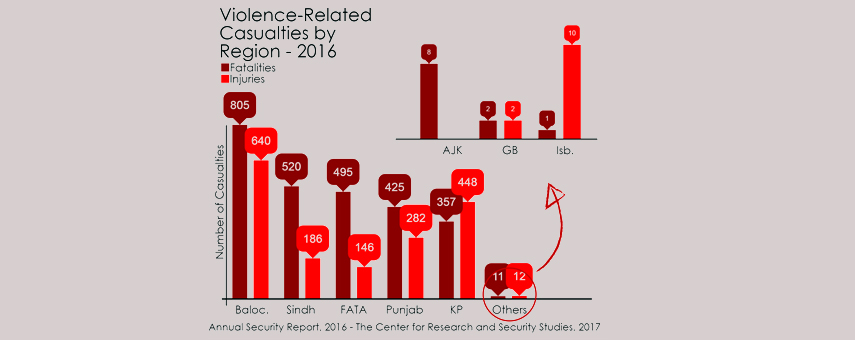
Violence-related fatalities saw an almost 45% reduction in the year 2016 following a continued trend of reduction from 2014 onward. Since 2014, the overall reduction in violence-related fatalities has been nearly 66%. In comparison to 6,572 casualties (4,647 dead and 1,927 injured) reported in 2015, the figures declined to 4,327 (2,613 dead 1,714 injured) in 2016 (table 01). This is primarily because of the kinetic operations across the country by security forces, both military and civilian.
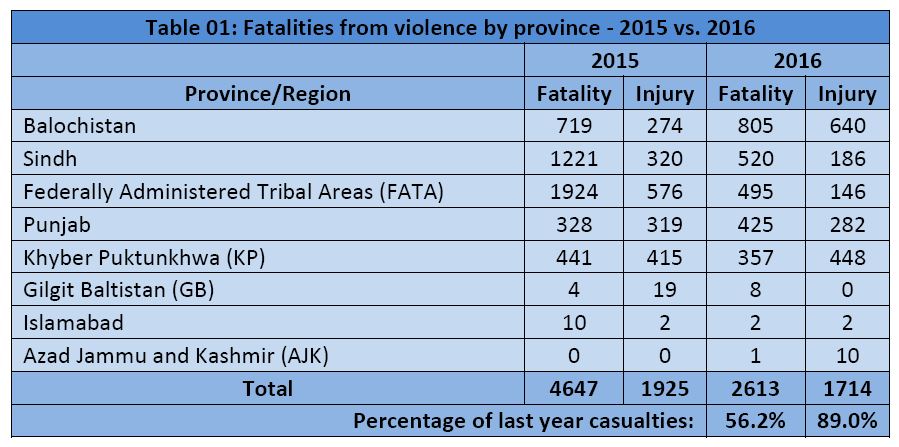
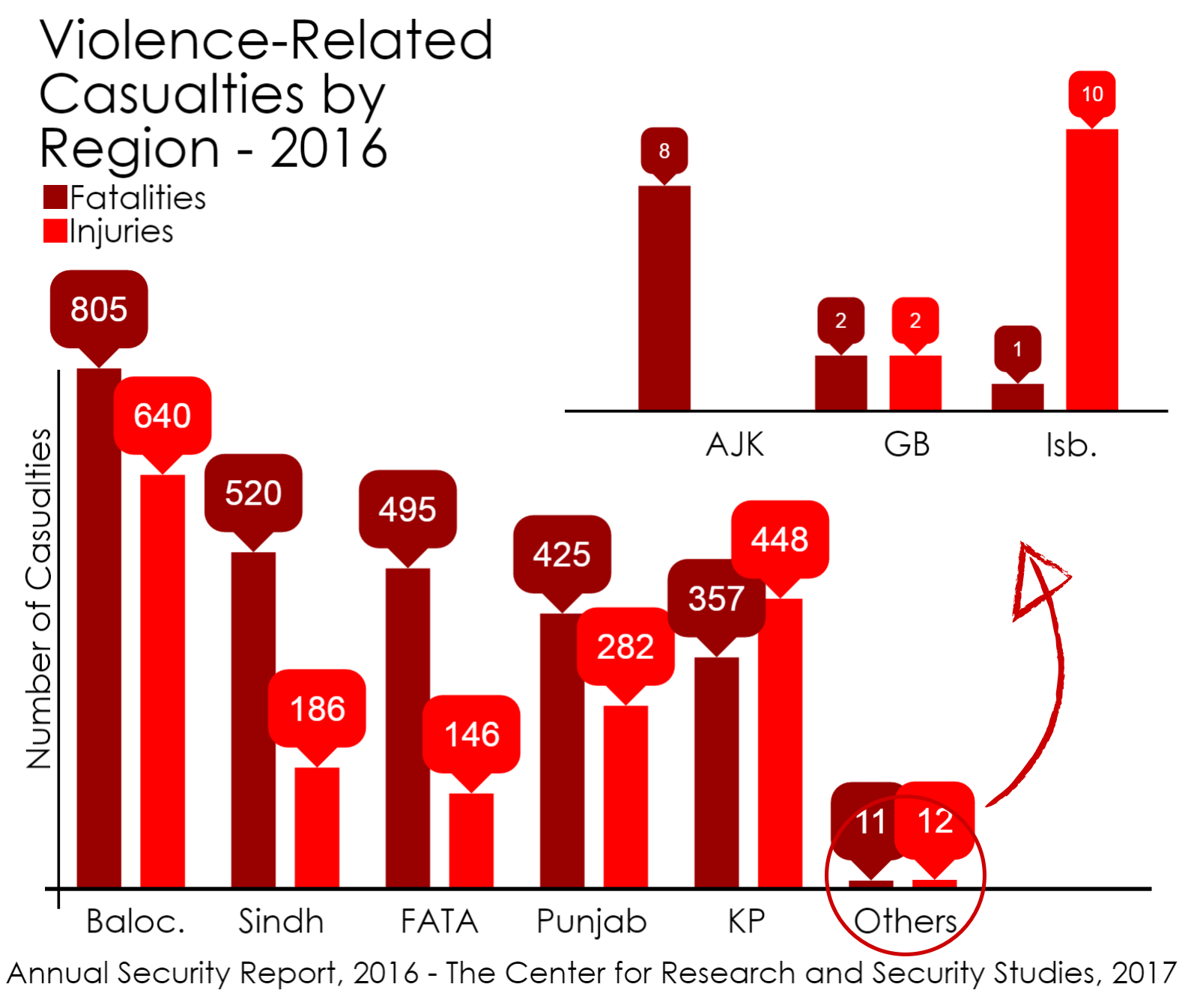
Regionally, there were some exceptions to this trend. Punjab and Balochistan had a marginal increase in violence this year. Fatalities from violence in Balochistan increased from 719 in 2015 to 798 in 2016, an upsurge of nearly 10%. Punjab lost 424 persons to violence during in 2016 which is the highest number of fatalities in the province in the last four years. Both provinces were major targets of suicide attacks thus increasing the casualty count. Balochistan suffered seven suicide attacks, leaving 220 persons dead, including 61 police trainers, 52 lawyers, and 62 pilgrims at a Sufi Shrine while Punjab had one suicide attack in Gulshan Iqbal Park, Lahore that left 74 persons dead of whom 29 were children.
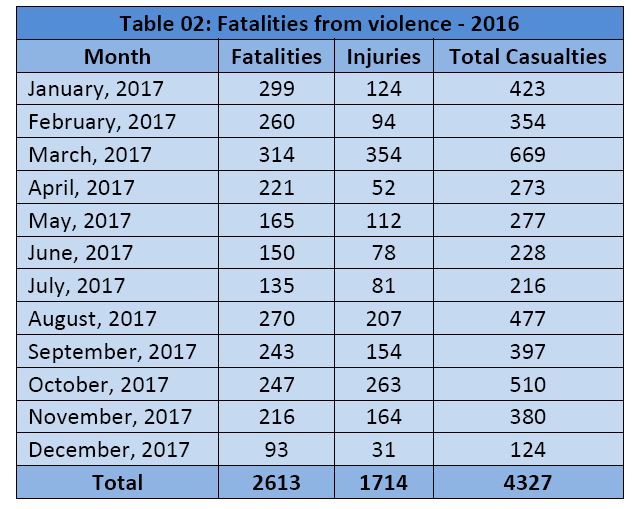
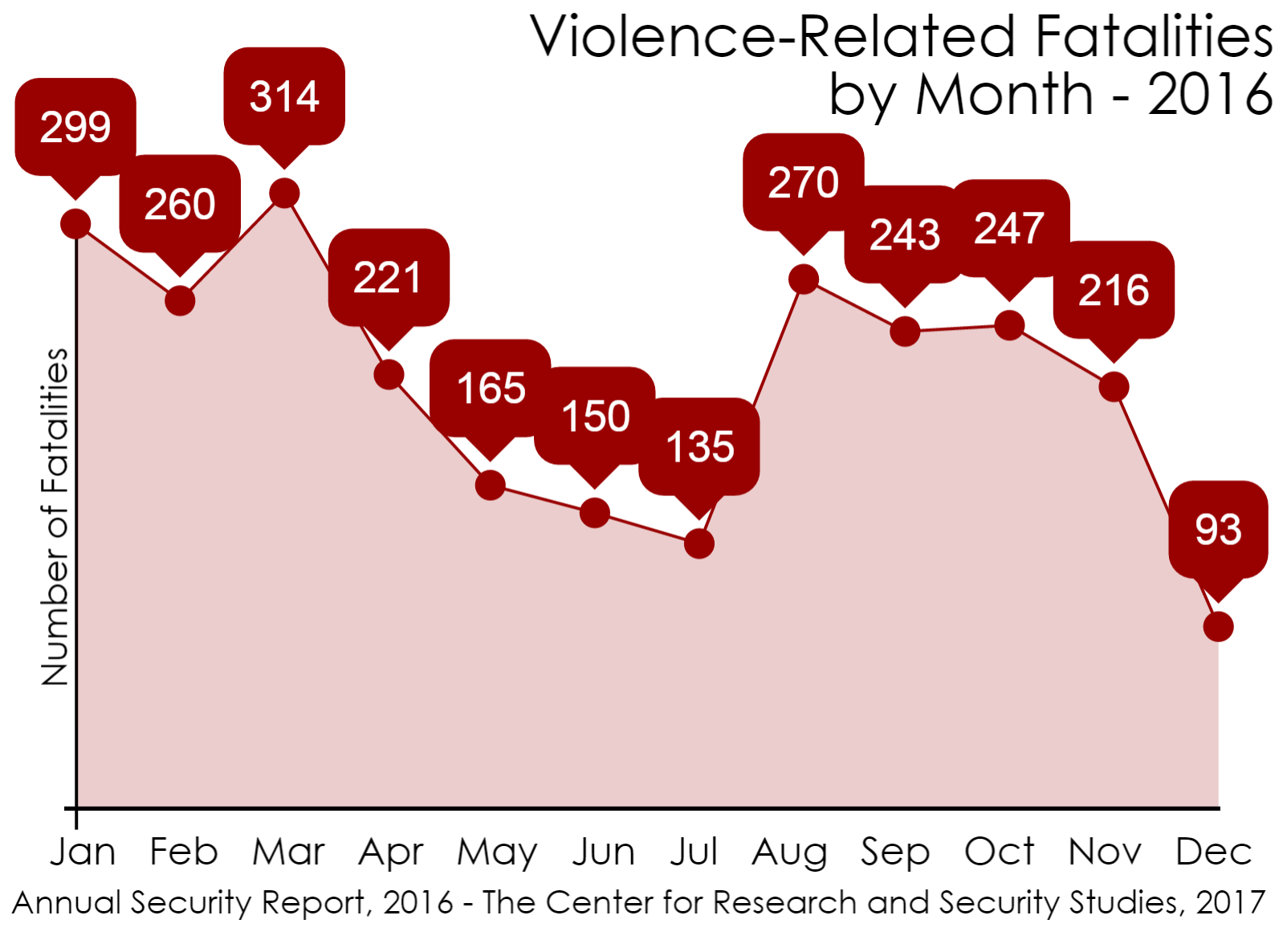
All these attacks, by and large, were indicative of change in the tactics of militants targeting the highly vulnerable sections of society and executing their attacks even in areas as remote as Noorani Shah’s shrine in Khuzdar. However, a review of the last two years data on violence reflects that the downward trend in fatalities continued through most of the year, with December seeing the lowest fatality counts. August to October experienced a surge in fatalities (table 02).
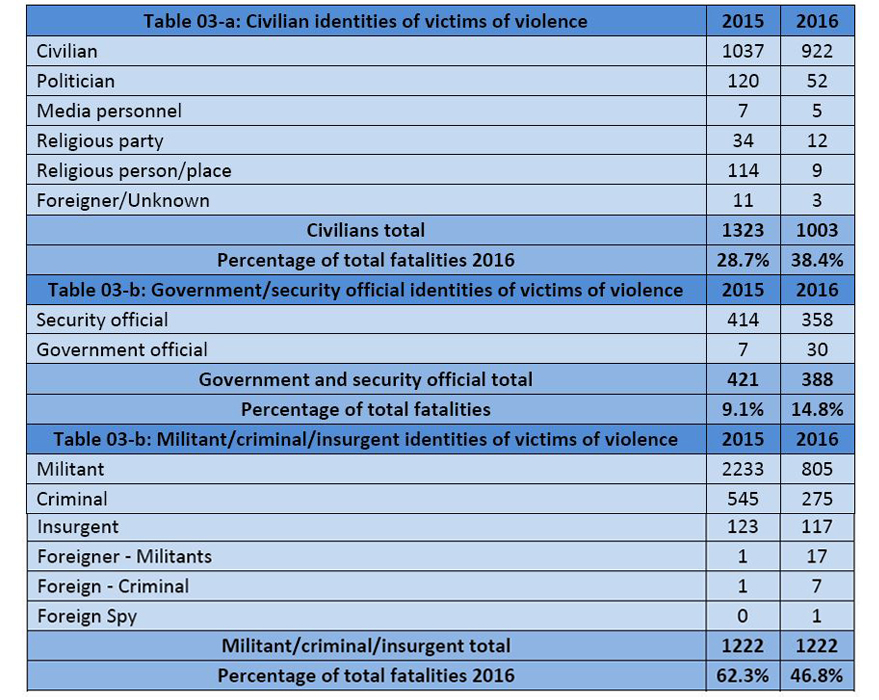
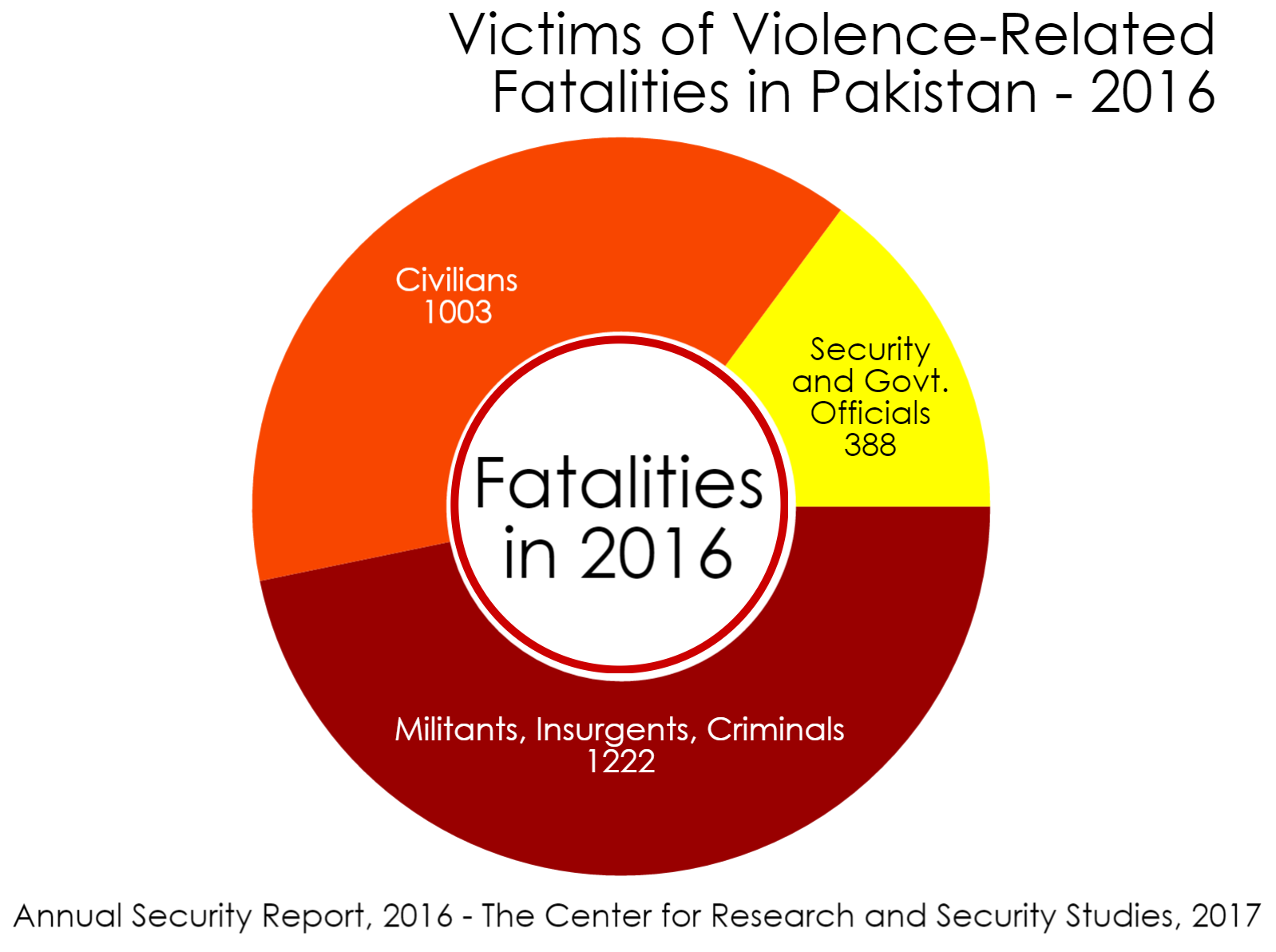
Despite significant decline in the fatalities from violence, the percentage of civilian and security personnel’s fatalities still stood comparatively higher than the fatalities of militants and criminals – from 38% in 2015 the percentage increased to 53% in 2016 – a rise of 15% (table 03). The reason for this rise will be discussed separately in the section titled “Nature and Methods of Violence Used.”
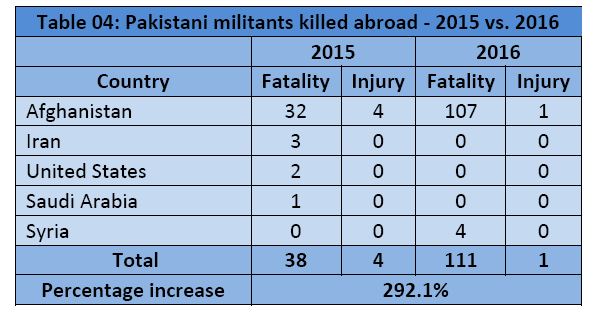
During the last two years, some incidents of militancy occurring in other countries had a link to Pakistan. In Afghanistan, as many as 139 Pakistani militants were killed by US drone attacks. Among them were some very high profile militants belonging to Tehreek-e-Taliban Pakistan (TTP) and Lashkar-e-Islam (LI). Four Pakistani militants affiliated with Islamic State (IS) were killed in Syria.
IS was extremely successful in luring a large number of Muslims around the world within the last couple of years. From Pakistan, at least 163 persons were found to be influenced by the group. Around 50 Pakistani citizens with no documented history of militancy were arrested in Pakistan who wanted to go to Syria and join IS. Surprisingly, all of them were from Punjab and some of them were planning to take their families with them.[1],[2] Nine Pakistanis, affiliated with Jamaat-ud-Dawa (JuD), were arrested in Sialkot who wanted to go to Syria and join IS.[3] Punjab police was reported to be looking for three local recruiters for IS.[4] Nearly 115 Pakistani citizens, including some men, women, and children are reported to have moved out and joined IS in Syria.[5],[6]
It must be said that this is a low number, as the New York Times reported in 2015 that nearly 30,000 foreign fighters had their home countries left to join ISIS in Syria, including 250 Americans.[7]
Victims of Violence in Pakistan
Fatalities of Civilians
Polio Workers
Eradication of polio from Pakistan is an uphill task for the government and polio teams in the country. The risks involved in accomplishing this task are many, ranging from lack of access, to mindsets that believe the vaccination campaign is a front for the Central Intelligence Agency (CIA). In 2015, 12 persons associated with polio eradication program lost their lives to violence[8]. The figure went up to 31 in 2016. While Balochistan suffered the highest fatalities of polio workers, other parts of the country also witnessed attacks (table 05).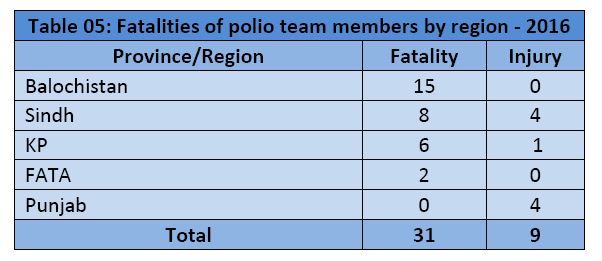
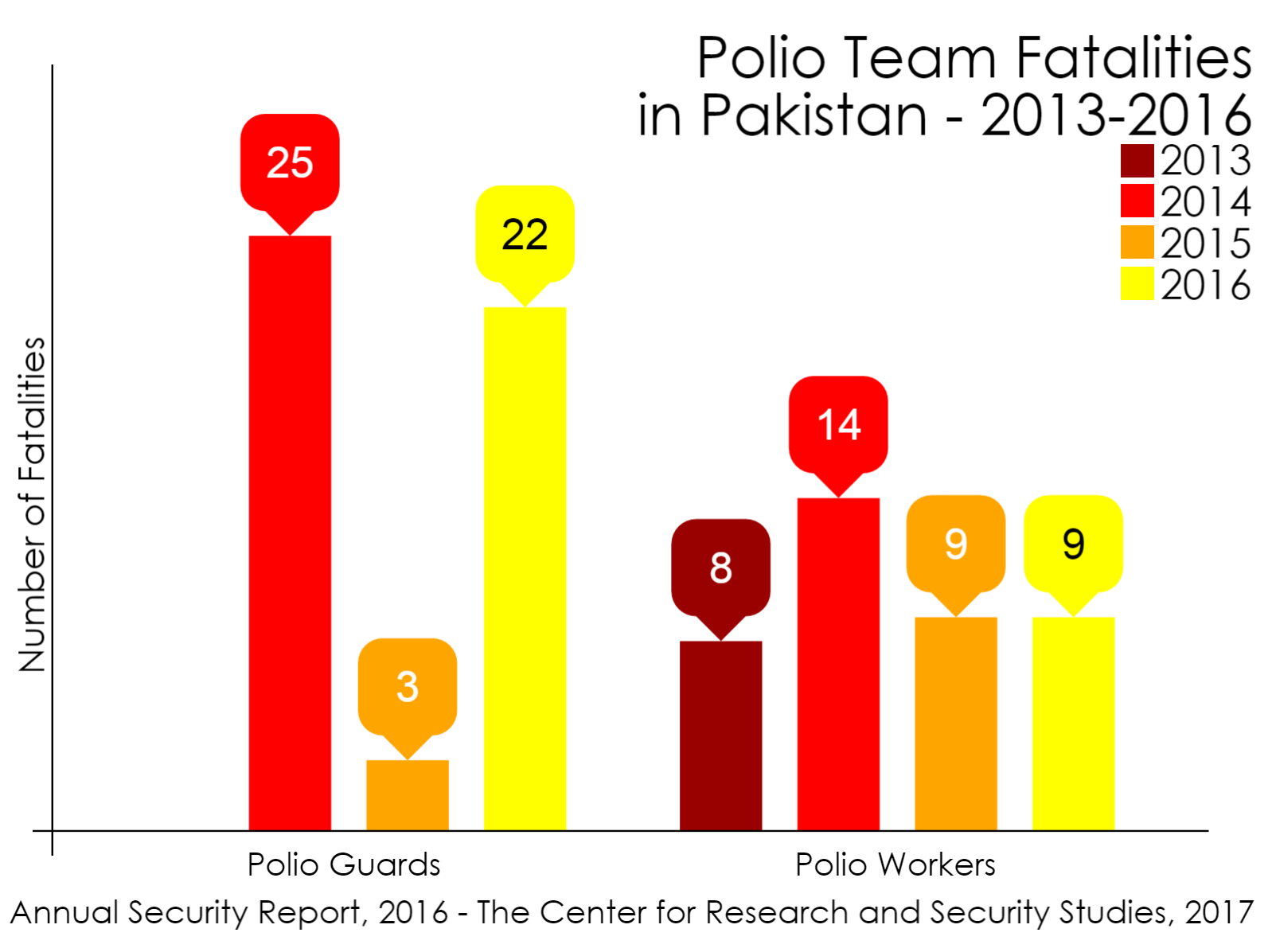
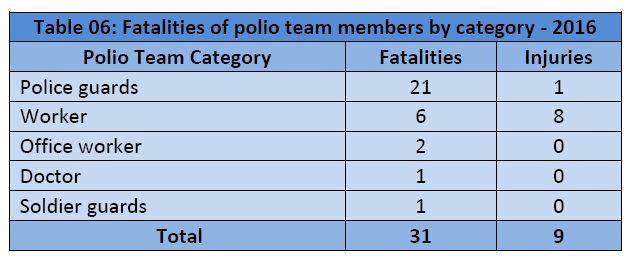
Among the victims, the highest count was that of security personnel. As a security measure, the law enforcement agencies arrested nine persons accused or suspected of committing attacks against the polio teams (table 06).
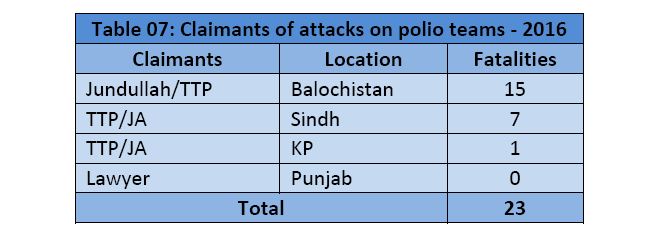
The splinter groups of TTP like Jundullah (TTP-J) and Jamat-ul-Ahrar (JuA) claimed to have carried out most of the attacks against the polio team (table 07). The largest fatalities of polio team in Balochistan were claimed by Ahmed Marwat, who identified himself as a commander and spokesman for Jundullah, and said in January 2016, “[W]e claim the bomb blast on the polio office. In the coming days, we will make more attacks on polio vaccination offices and polio workers.”[9] By the end of the year, 13 additional members of polio teams had lost their lives. A lawyer, Abdur Rehman, in Faisalabad physically attacked and beat up members of the polio team when his call for stopping the vaccination in the area was ignored.[10]
Professionals
The lawyer community suffered a large-scale attack on August 9, 2016. A suicide attack at Civil Hospital Quetta killed 73 people, most of them lawyers and journalists, and injured 100. A spokesman of JuA, Ehsanullah Ehsan claimed responsibility of the attack and vowed to carry out more attacks “until imposition of an Islamic system in Pakistan”, while Balochistan Chief Minister Sanaullah Zahri blamed Indian spy agency RAW for involvement in the suicide attack implying that JuA is supported by RAW. Besides JuA, TTP and IS were also claimants of this attack.[11] Two days later, a roadside bomb explosion targeted police personnel escorting a Federal Shariat Court Judge Zahoor Shawani that left 17 persons injured including 4 security personnel.[12] On September 3, 2016, a suicide attack took place at district courts in Mardan killing 14 people including three lawyers.[13]
At least 13 people, including three policemen, three lawyers and a local leader of the Awami National Party (ANP), were killed and 52 others sustained injuries in a suicide attack at the district courts in Mardan in September 2016.
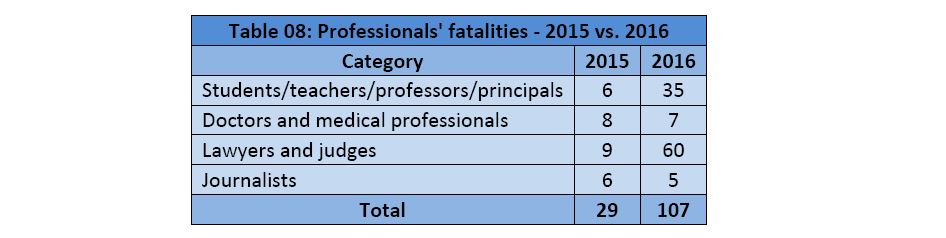
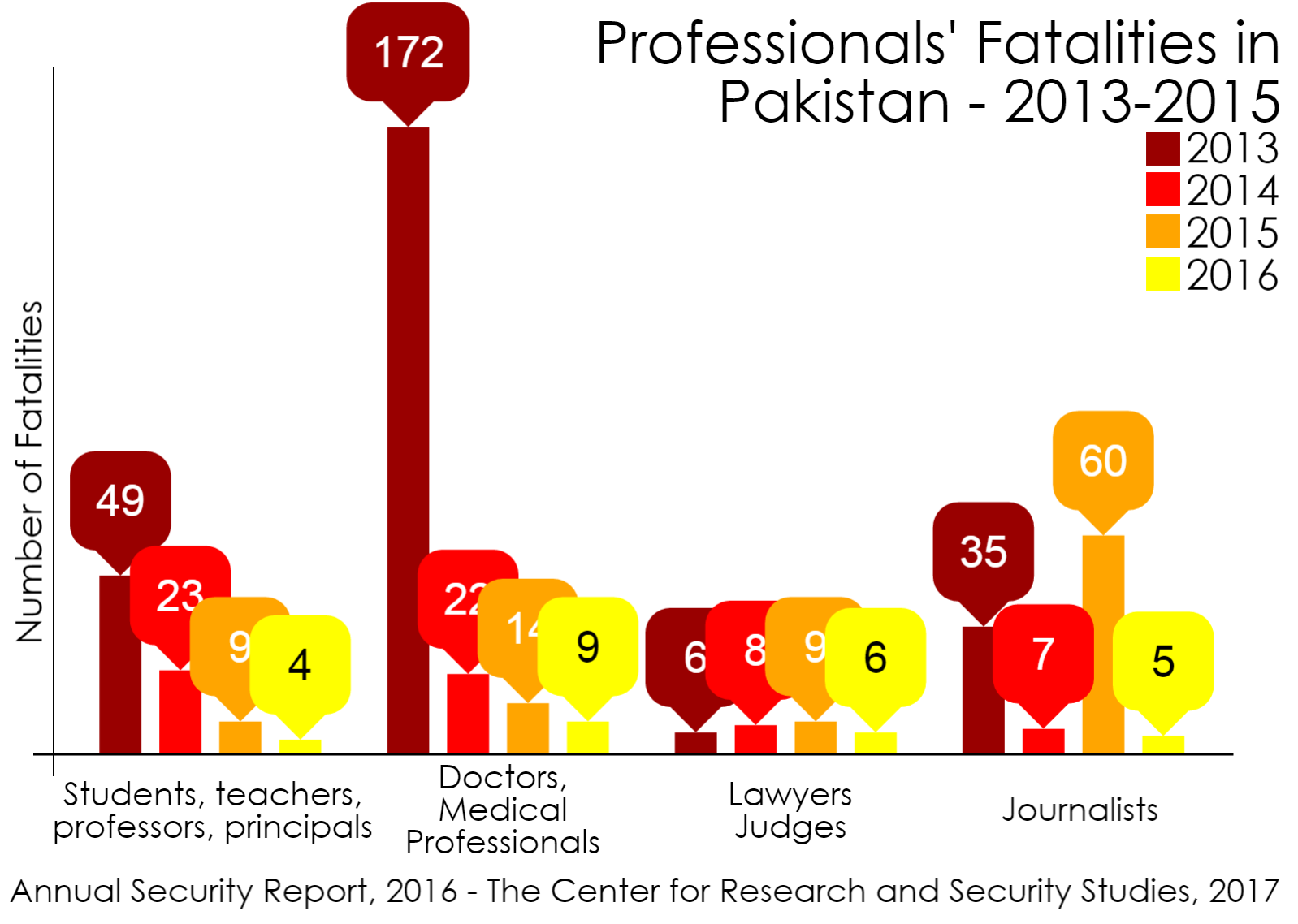
Another professional community that came under attack was the education sector. On January 21, 2016, four gunmen opened fire inside Bacha Khan University (BKU) in Charsadda leaving 25 persons dead and 30 injured (including 17 students and teachers, 4 security guards, and 4 militants).[14] This was a major attack on students and teachers nearly one year after the atrocious attack at the Army Public School in Peshawar Cantonment on December 16, 2014. The TTP claimed the responsibility for the attack[15], however no official statement was issued by the government identifying foreign involvement. The identity of four militants that were killed at the university remains unknown.
Businessmen
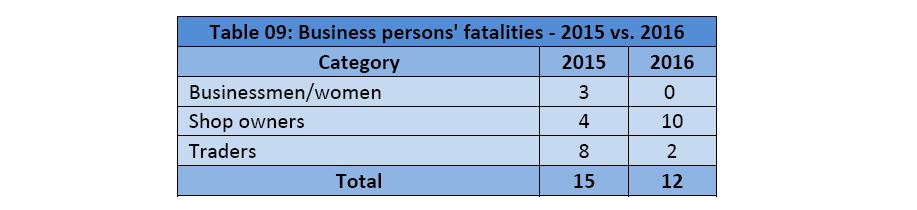
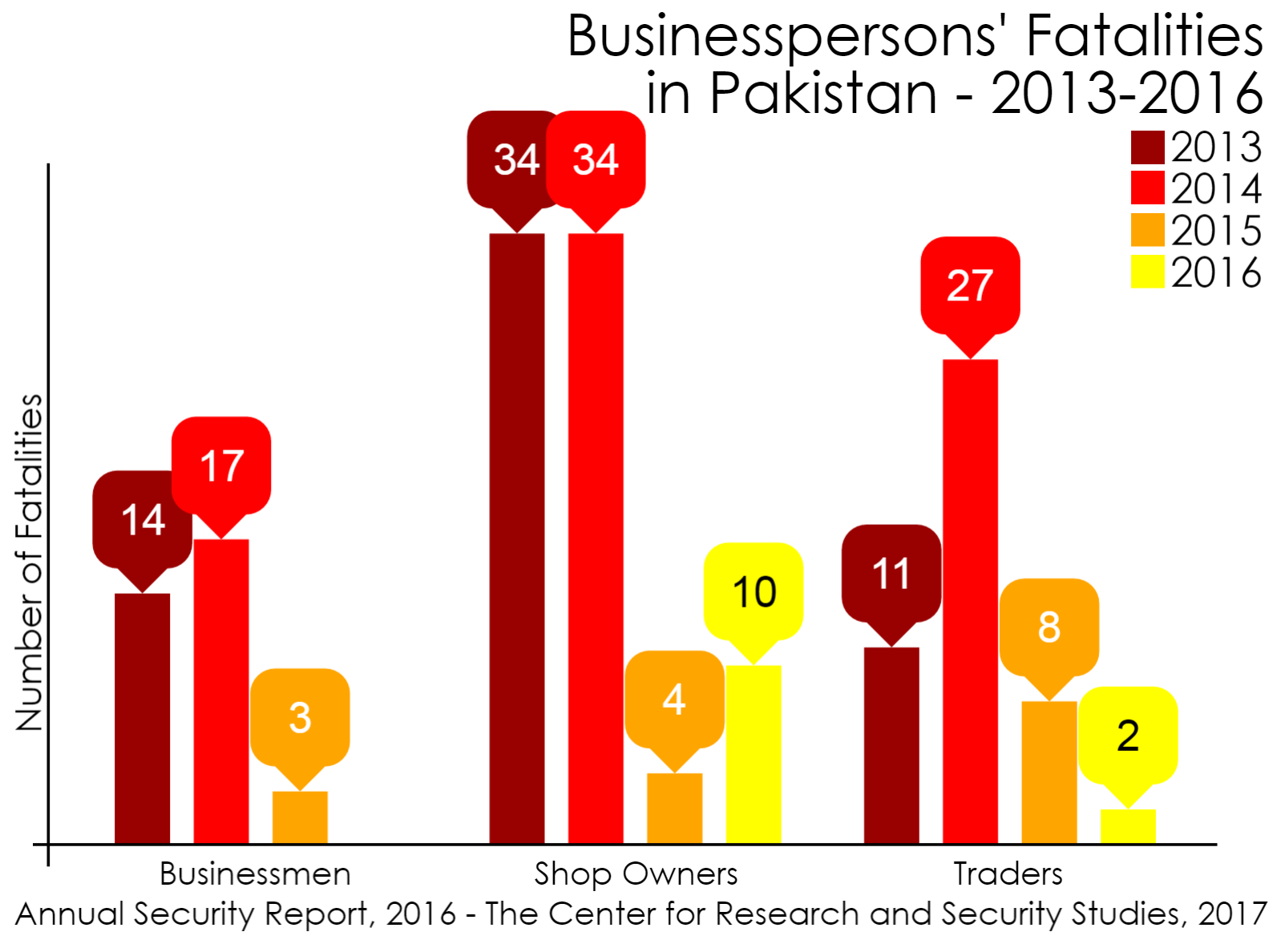
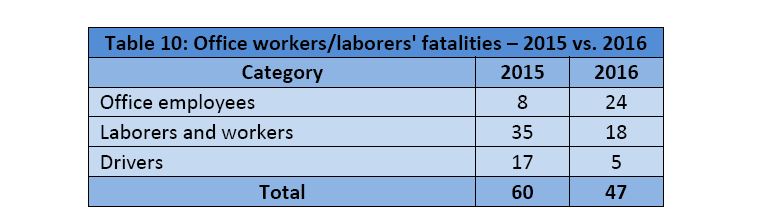
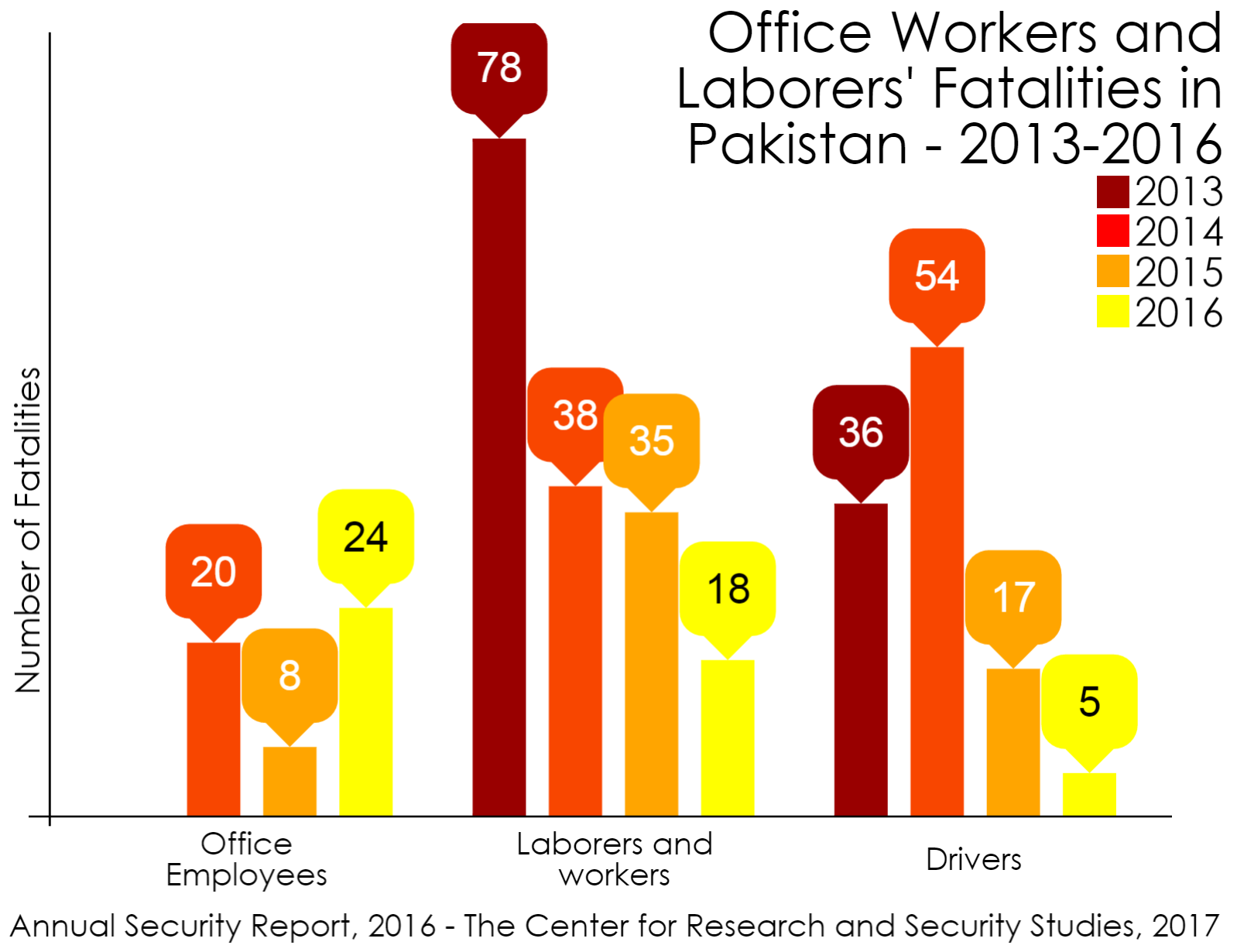
The businessmen and traders had a relatively peaceful time this year, with the exception of shop owners who were killed in robberies. Fatalities of office employees went up to three times this year compared to the last year (tables 09, 10). On March 17, 2016, a large number of low cadre government office employees lost their lives when an IED planted on a bus carrying them to their workplace exploded at Sunehri Masjid Road near the West Cantonment Police Station in Peshawar. Sixteen persons, including government employees, were killed and 53 others sustained injuries in the incident. LI claimed the responsibility for the attack.
Fatalities of Political and Religious Party Activists
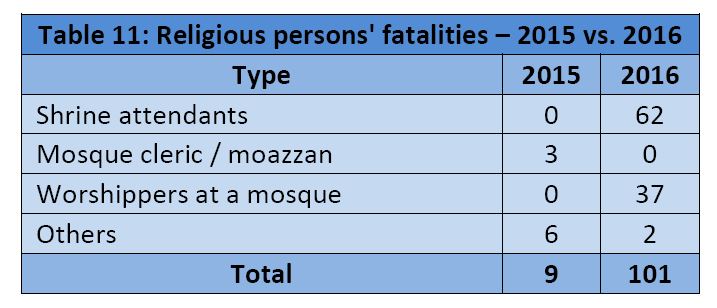
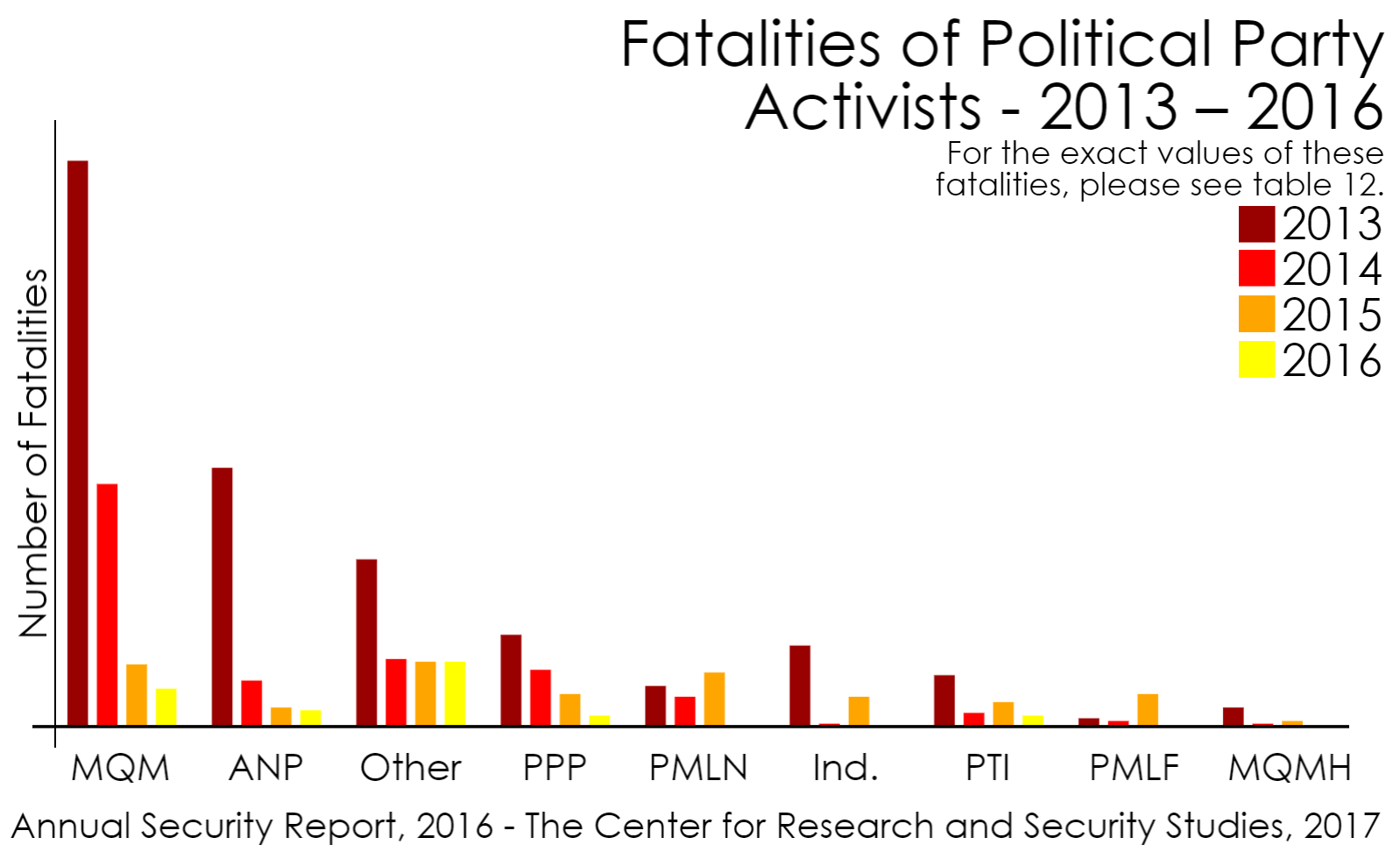
A large number of civilians performing their religious duties were targeted by militants dramatically increasing the number of fatalities from 9 last year to 101 this year (table 11).
The losses of activists from political and religious parties remained higher in both 2015 and 2016, with the exception of PML-N. Among the political parties that lost the most number of activists, Muttahida Qaumi Movement (MQM), Awami National Party (ANP), Pakistan People’s Party (PPP), and Pakistan Tehrik-e-Insaaf (PTI) remained on top. Some regional parties like National Party (NP), Sindh Muttahida Mahaz (SMM), and Jeay Sindh Tehreek (JST) had zero fatalities last year compared to 4, in total, this year.
The Local Governing Body (LGB) councilors also became victims of target killings this year. The assassination of PTI minority Member Provincial Assembly (MPA), Sardar Soran Singh, on April 23, 2016 was falsely claimed by TTP[16] while a notable politician of ANP, Arshad Khan, was among the 14 victims of a suicide attack at a district court in Mardan on September 3, 2016 whose responsibility was claimed by JuA.13 The insurgent group Balochistan Liberation Army (BLA) also claimed the responsibility of a hand grenade attack at the bungalow of the Balochistan Irrigation Minister, Nawab Changez Khan Marri, in Defence Housing Authority Phase II, Karachi on January 26, 2016.[17]
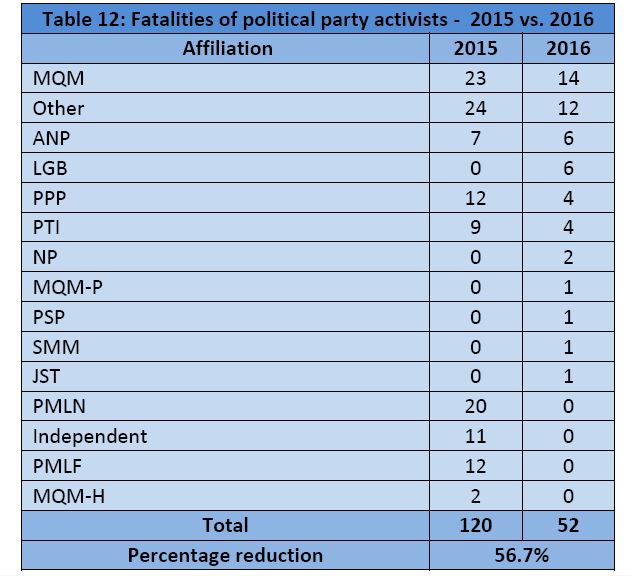
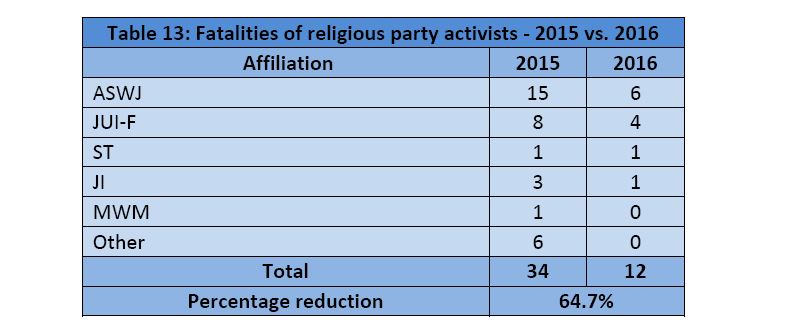
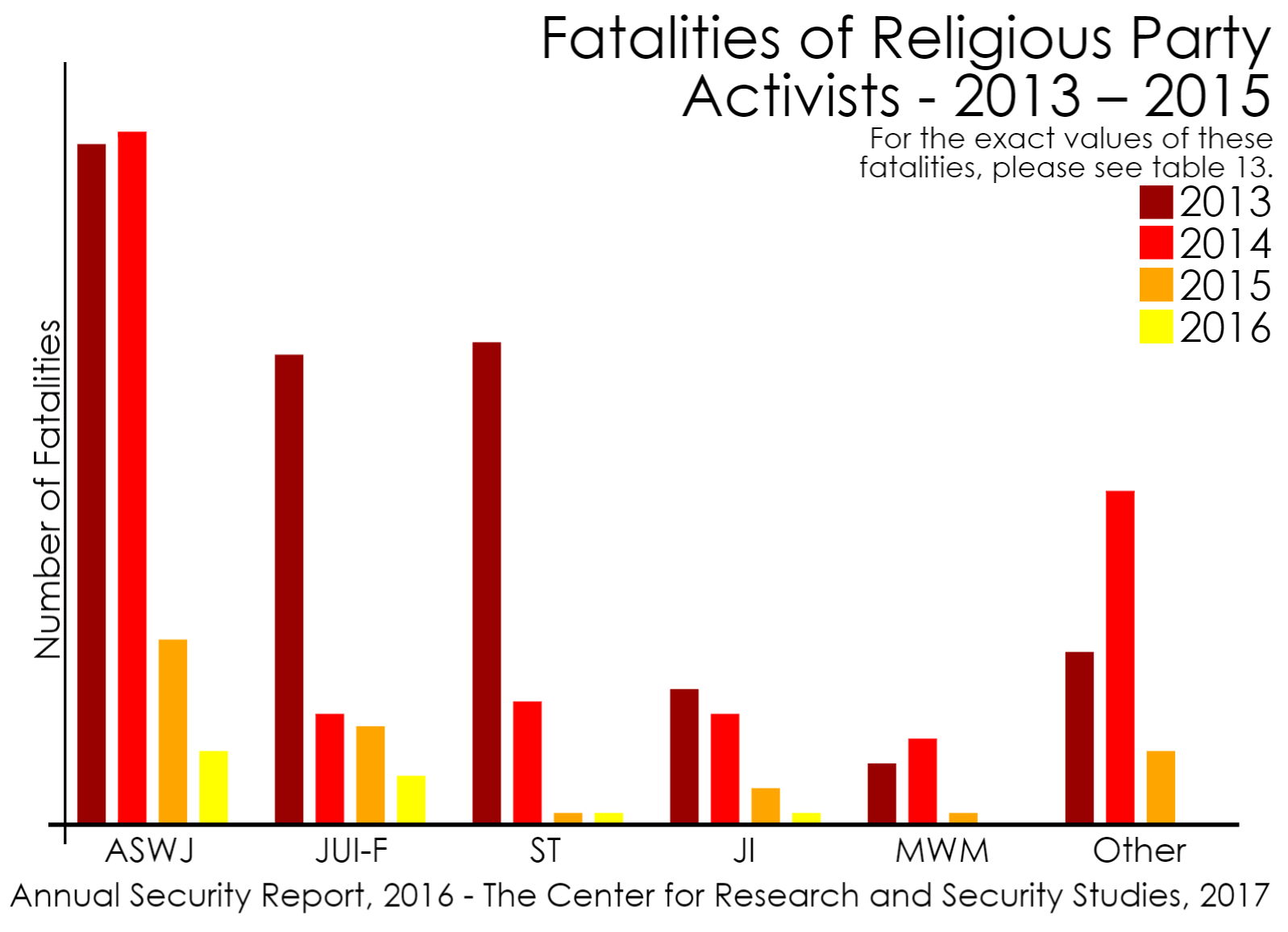
A significant decline in the number of fatalities of religious party activists was observed during this year – from 34 in 2015 to 12 in 2016. All religious party activists were victims of target killings but none succumbed to terror attacks. No militant outfit claimed responsibility for these killings and no statement was issued by the government officials or the religious parties pin pointing local or foreign involvement in these killings. Most of the religious party activists, belonging to Alhe Sunnat Wal Jamaat (ASWJ), Sunni Tehrik (ST), and Jamaat-e-Islaami (JI), were targeted in Sindh while four of them, affiliated with Jamiat-e-Ulema-e-Islam, Fazl-ur-Rehman group (JUI-F), were targeted in KP and Balochistan.
Fatalities of Security Officials
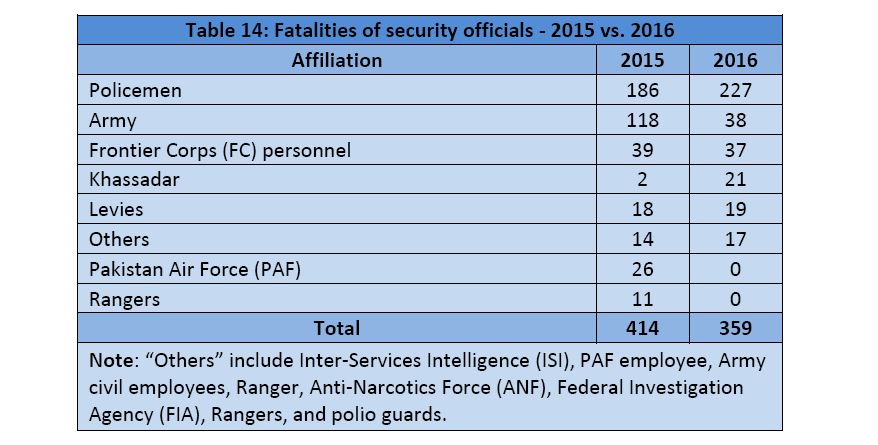
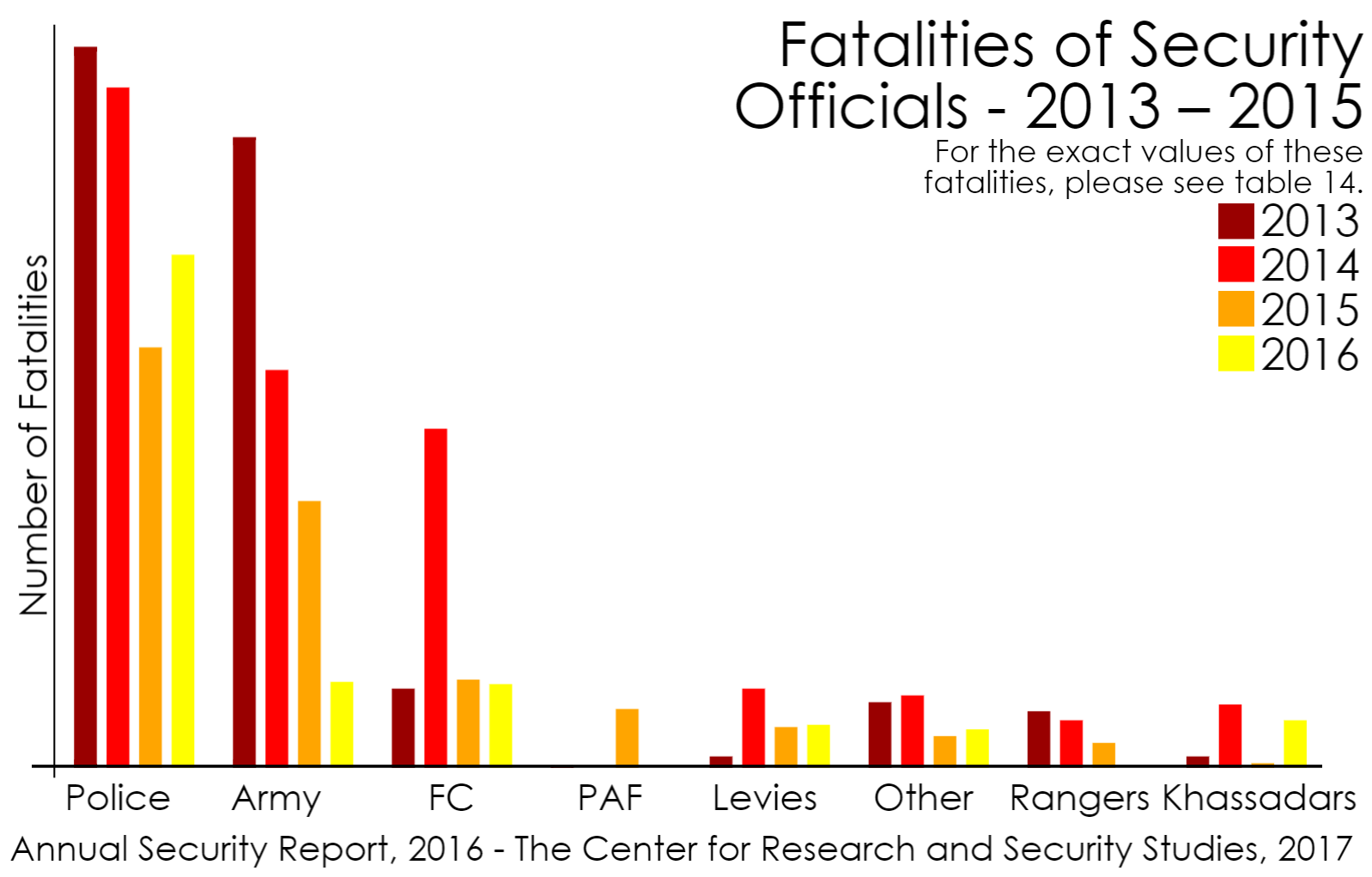
There was a slight reduction in the number of fatalities of the security officials this year, though the police and khassadars suffered more losses than all other security forces (table 14). The vast majority of them were victims of target killings, suicide bombings, armed attacks, Improvised Explosive Devices (IEDs), bombs, and landmine explosions.
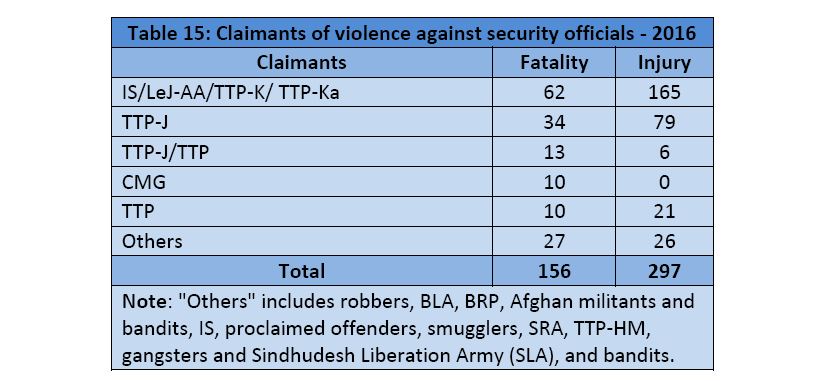
Banned militant organizations like IS, TTP, TTP-J, Lashkar-e-Jhangvi-Al-Alami (LeJ-AA), TTP-Khorasani (TTP-K), Chotu Mazari Gang (CMG) as well as insurgents claimed responsibility for attacks targeting security forces in the country in the year (table 15). The highest number of casualties occurred in Quetta when heavily-armed militants wearing suicide vests stormed a police academy on October 25, 2016 killing at least 62 persons and wounding 165, mostly young police recruits that were inside the center at the time of attack.[18] Four militant outfits LeJ-AA, IS, TTP-Karachi (TTP-Ka) and TTP-Hakeemullah Mehsud (TTP-HM) claimed responsibility for the attack which is also helpful in understanding that all of them, despite different names and locations, carry the same agenda. [19]
 Security personnel were targeted in all provinces and the highest casualties were reported from Balochistan and KP during this year followed by FATA, Sindh, and Punjab.
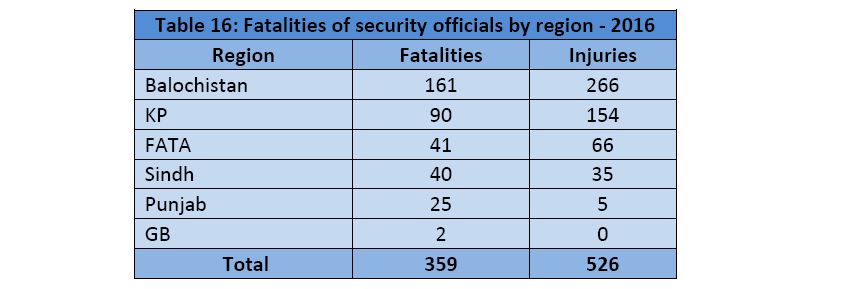
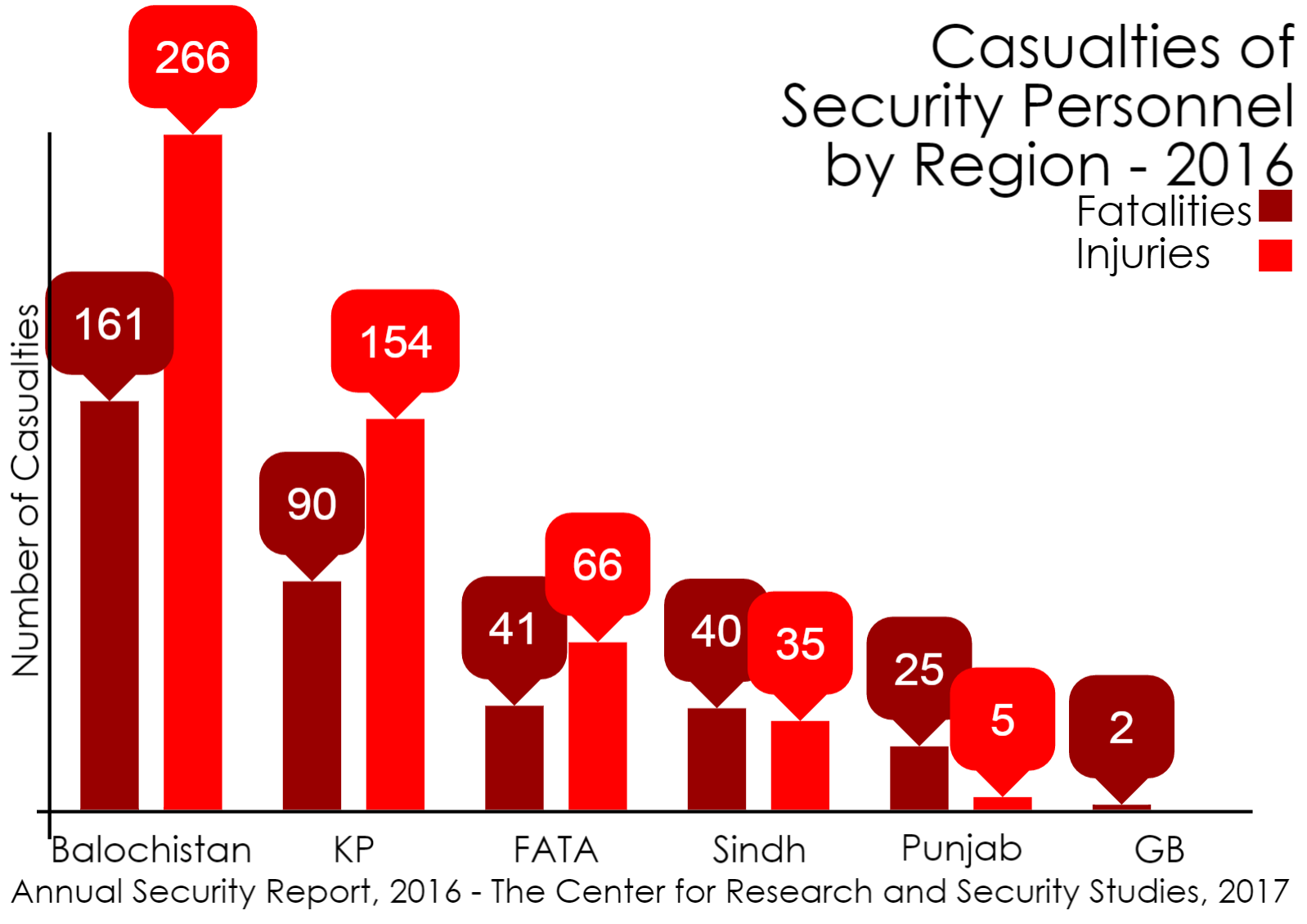
Of 526 casualties (dead and injured) of security personnel, 377 (or 71%) were policemen. In all provinces, the percentage of policemen was on a similar scale.
In two suicide attacks, one at an Imambargah in Shikarpur[20] and the other at a district court in Mardan[21], the policemen guarding the area arrested one of the suicide bombers and in the process lost four policemen when the suicide bombers detonated their vests.
Two officers of Bomb Disposal Unit (BDU) lost their lives while 11 sustained injuries while defusing explosive devices.[22] According to reports, 15 BDU officials have lost their lives while performing their duties during last seven years and as many as 6,000 bombs have been defused by them since 2009.[23]
Fatalities of Militants, Insurgents and Criminals
Militants
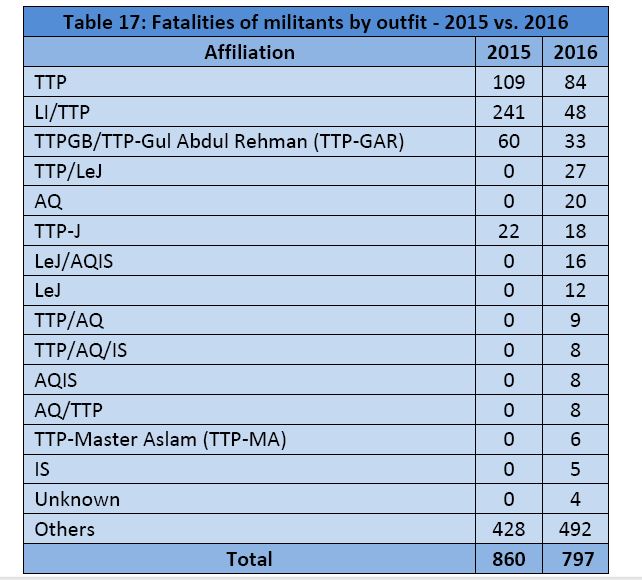
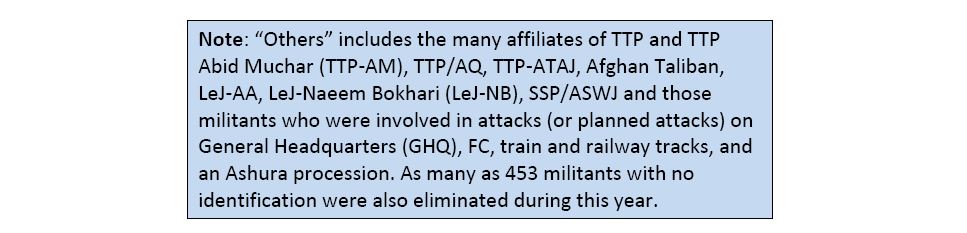
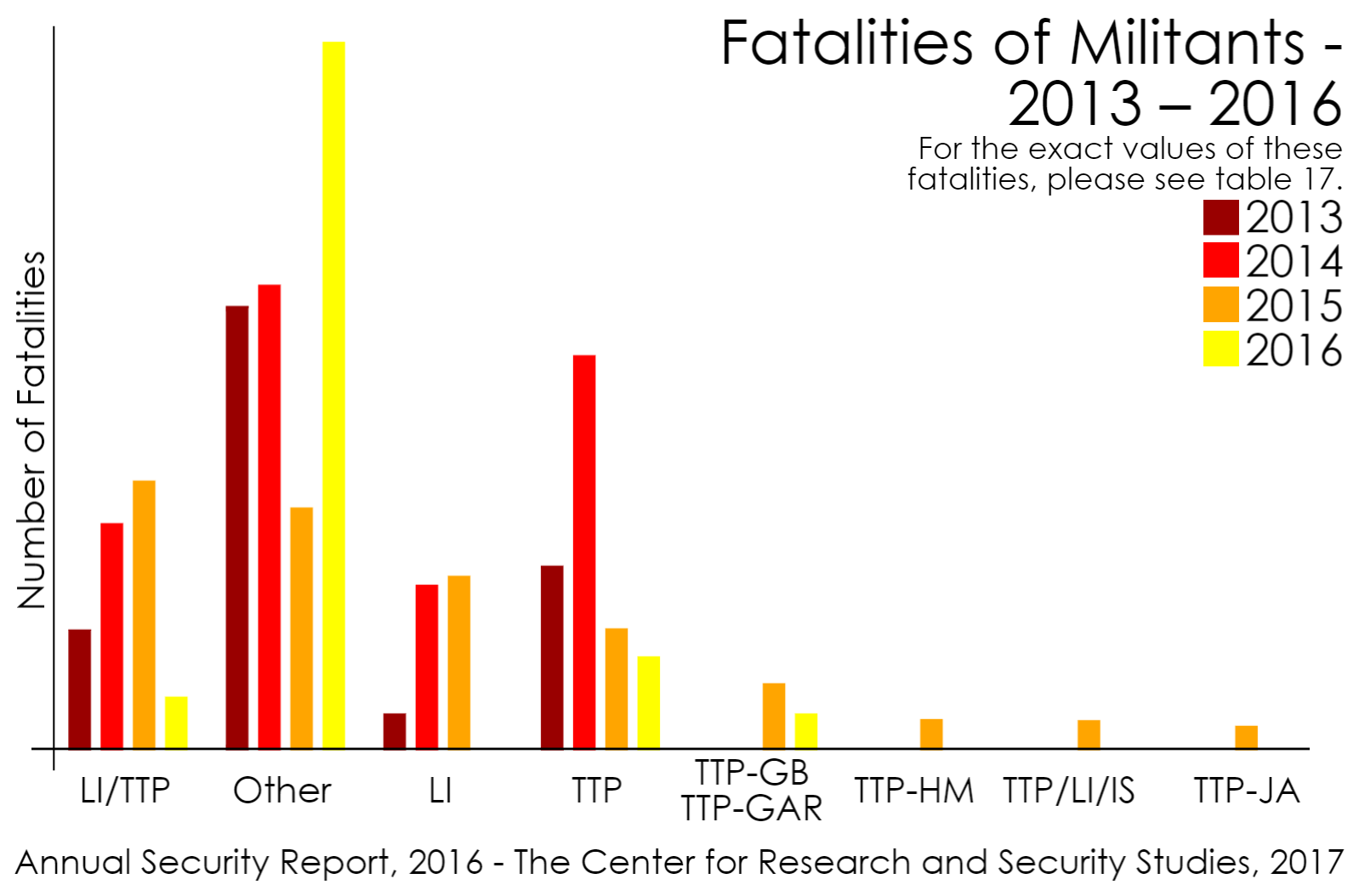
Militants belonging to various banned outfits were eliminated during security operations in the country this year. The highest number of militant fatalities belonged to TTP, followed by TTP-Gul Bahadur (TTP-GB), Al-Qaida (AQ), Al-Qaida Indian Subcontinent (AQIS), and Lashkar-e-Jhangvi (LeJ). Many of the fatal militants had two or more identities like from LI/TTP and TTP/AQ/IS. This was partly due to their multiple affiliations and partly because of presence of multiple outfits at one location (table 17). Surprisingly, a number of militants who were eliminated this year suffered no fatalities in the previous year. Even the militants affiliated with IS lost their lives in counter violence operations this year though the direct presence of IS in Pakistan has always been denied by the government.[24] Sixteen Afghan militants were also killed during this year.
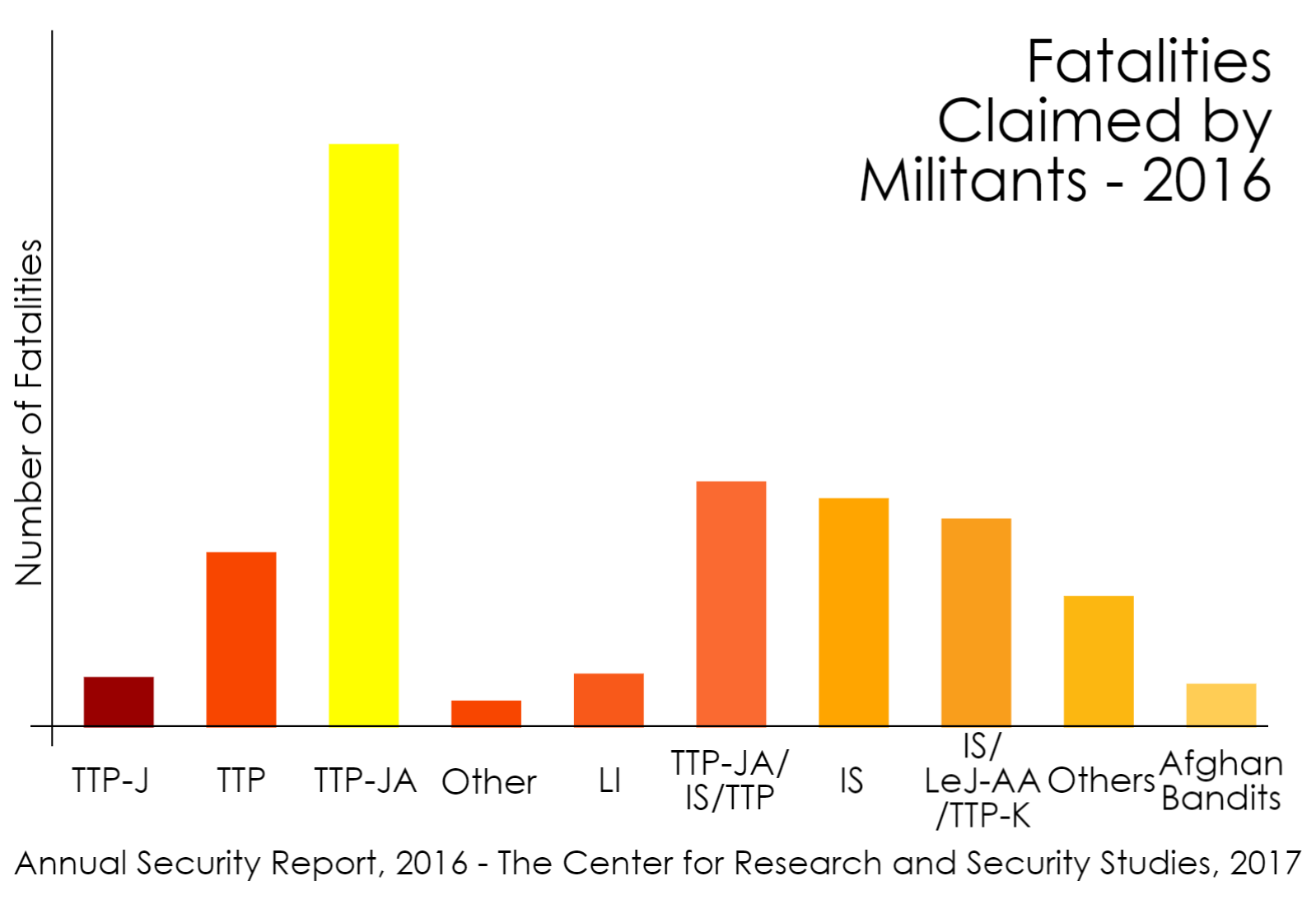
 The number of fatalities (civil and security personnel combined) claimed by the militant outfits is more than the number of the militant-activists they lost this year (table 18). Although it is difficult to verify the claims of militant outfits, the security operations carried out against them soon after their attacks and the reports claiming the elimination of their activists by the security agencies confirm their presence and involvement in those acts of violence.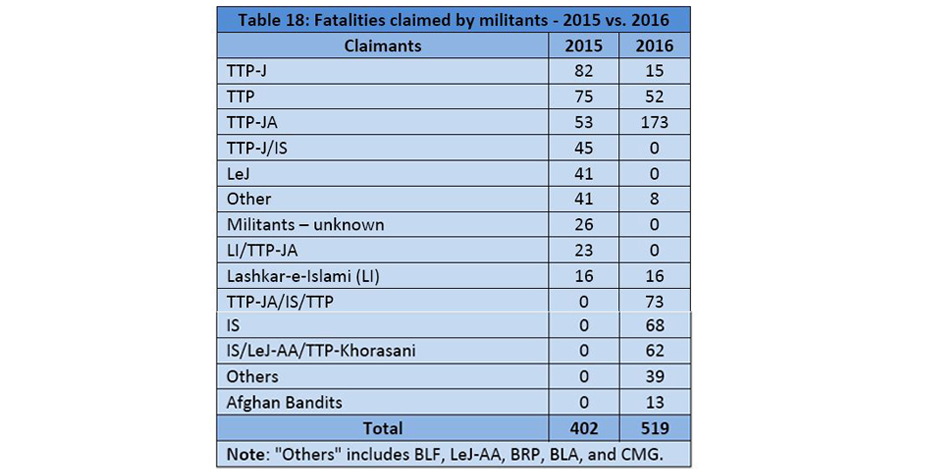
Insurgents
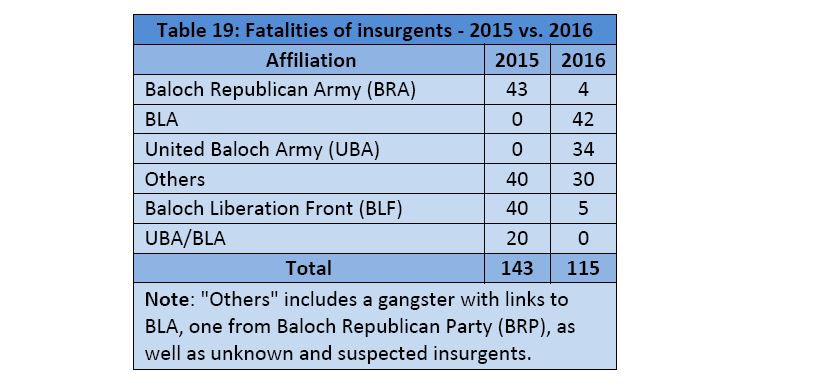
A marginal drop in violence and counter-violence with/against insurgents was recorded this year (table 19).
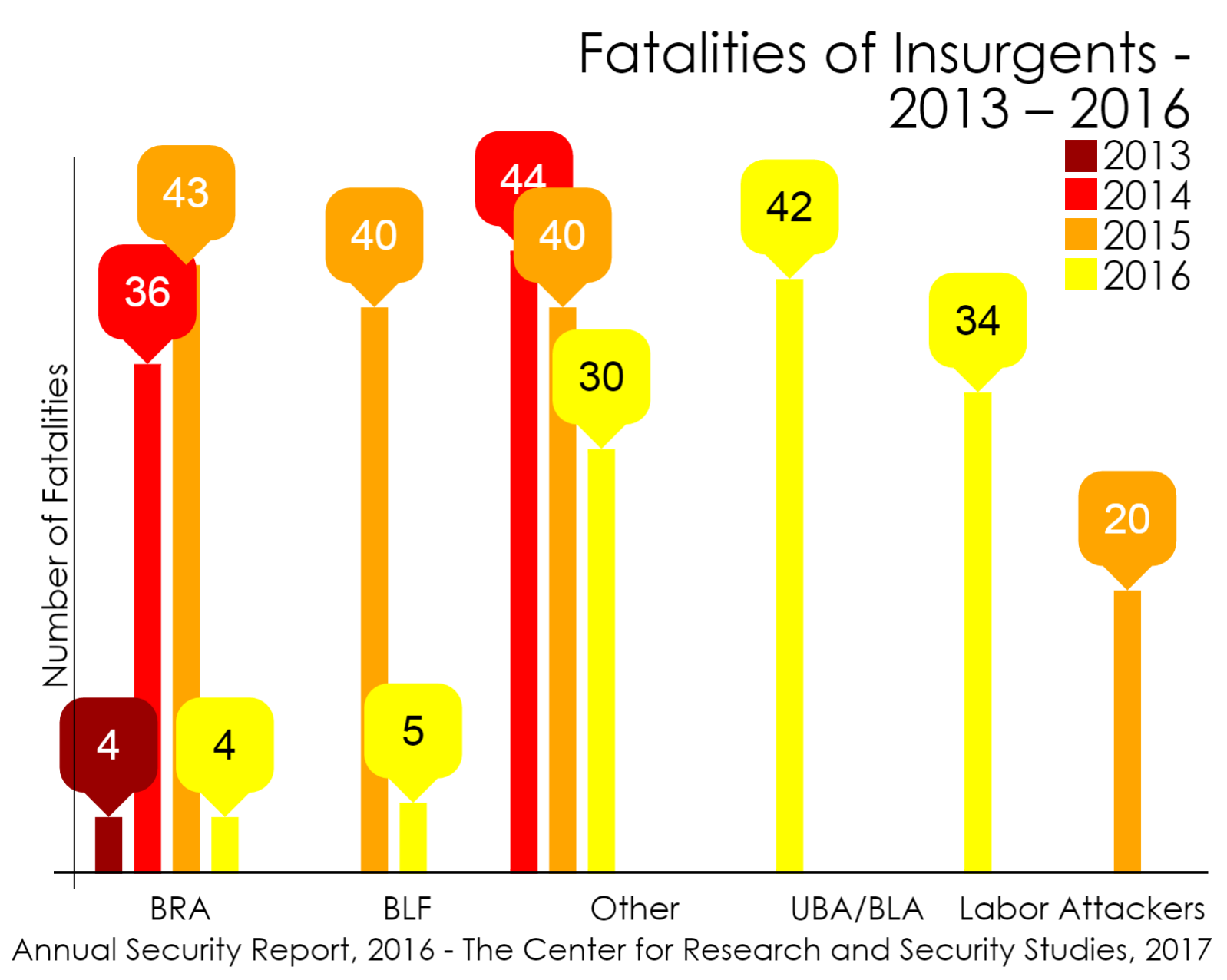
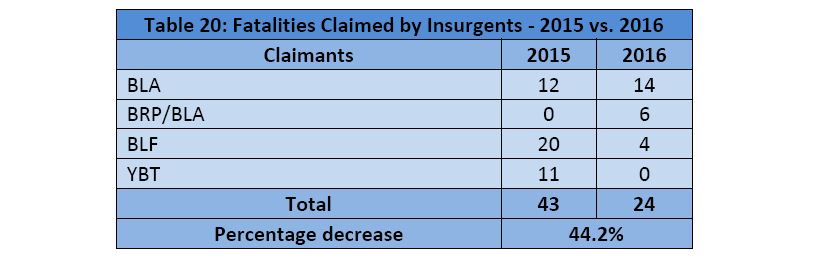
In comparison to militancy, the insurgency in Balochistan is lesser fatal and destructive based on the number of fatalities claimed by the insurgents and the number of insurgents eliminated during the last two years (table 20).
Criminals
The fatalities of criminals (target killers, gangsters, and robbers) were down to 274 in 2016 compared to 546 reported in 2015, a drop of almost 45%. In addition, eight Afghan criminals (robbers[25] and smugglers[26]) and an Afghan spy[27], whose identity was not disclosed, were also eliminated during this year. Among the criminals the highest fatalities were of the robbers (103), followed by kidnappers (17), Lyari gangsters (11), Baba Ladla gang (10), Uzair Baloch gang (10), Andhar gang (7), CMG (7), and many others.
Nature and Methods of Violence Used
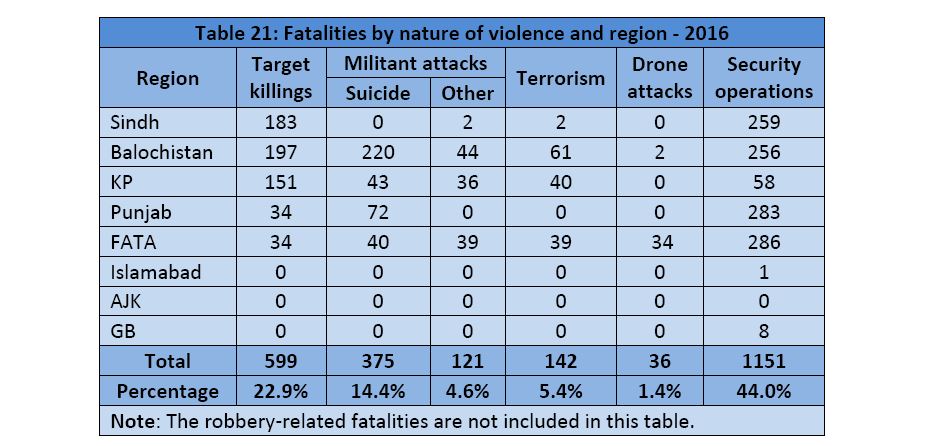
Table 21 provides a glimpse of what forms and methods of violence were the causes of fatalities during the year and which provinces were more affected. This report categorizes four basic forms of violence (i) target killings[28], (ii) militant attacks[29], (iii) terrorism[30], and (iv) drone attacks. The term “security operation” denotes all operations carried out by the armed forces and civilian law enforcement agencies against the criminals. Balochistan, KP, and FATA, were experienced nearly all forms of violence and counter operations this year while Sindh and Punjab fared comparatively better. Islamabad, GB and AJK had no report of violence, though security operations were carried out in the former two. 56% of the fatalities occurred as a result of violence carried out by the outlaws while 44% of the fatalities were the result of security operations.
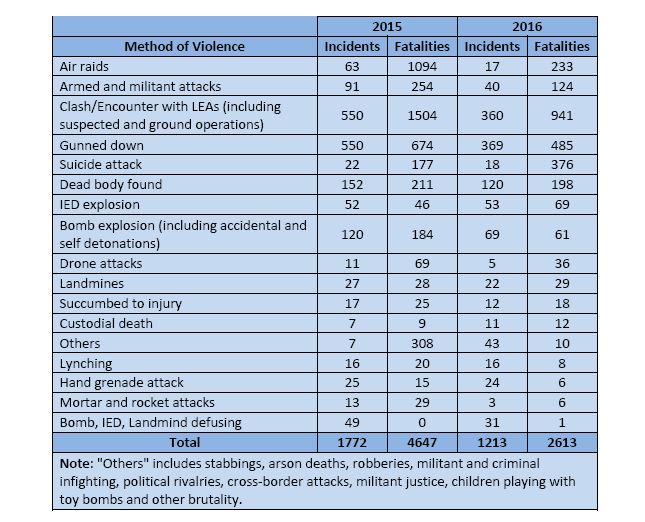
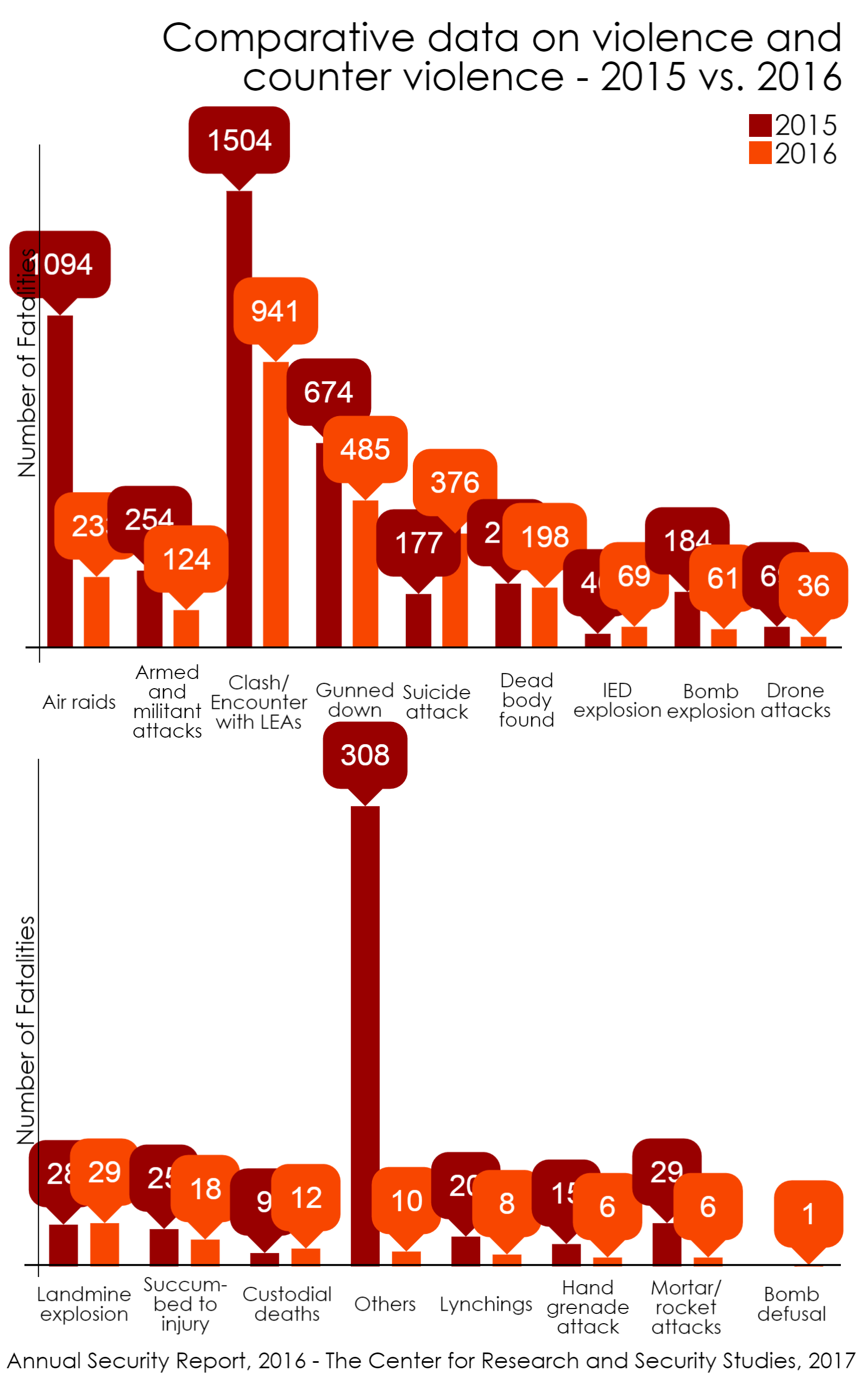
The reason for the upsurge in the percentage of civilian and security personnel’s fatalities can be found in the following comparative data on violence and counter-violence operations for the years of 2015 and 2016 (table 22). Last year, 1,094 militants lost their lives from the air raids carried out by the security forces in FATA regions while in 2016 there were only 233 fatalities of militants from similar operations. Another reason is the use of IEDs and suicide attacks on concentrated public spaces. Of 18 suicide attacks this year, the number of fatalities was 376 in comparison to 177 fatalities from 22 suicide attacks last year. The number of IED explosions though lesser than last year, bore 25% more fatalities.
Accidental explosions and self-detonations left 19 militants dead.
Some of the encounters carried out by the security agencies were alleged to have been against innocent people and are now going through judicial scrutiny. Both years witnessed a similar number of lynching attempts but the number of fatalities from such incidents was lesser in 2016. Deaths of suspects while in the custody of security or law enforcement agencies increased by 33% in 2016.
Please also see the associated infographic on the next page.
Key militants, criminals, politicians, foreign agents, and others arrested in 2016
To understand the nature of crimes and their causes, this report also correlates the number of lawless persons arrested, locations they were apprehended, and links to banned outfits. Table 23 below is an effort to understand correlation of the rise of violence in one location and fall at another.
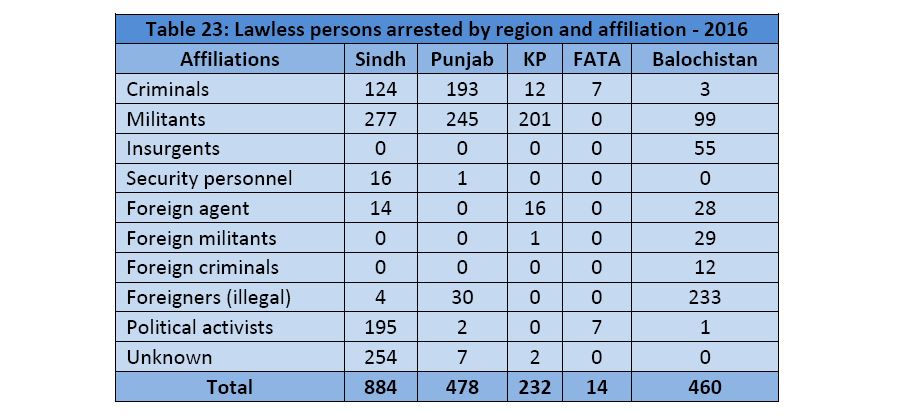
As reflected in the table, Sindh and Punjab topped all other provinces and regions in the country in apprehending the most number of suspects arrested (880 and 448 respectively), followed by Balochistan (363), KP (232), and FATA (14). To make another point, let’s look at the ‘nature of crimes’ these persons were arrested for and their ‘locations’. The highest number of alleged militants were arrested from Sindh (277) followed by Punjab (245), KP (201), and Balochistan (99).
Foreign agents were arrested from Sindh, KP, and Balochistan while Punjab and FATA had no such reports. There is no scope for the assumption that the militants, criminals, and foreign agents have migrated from FATA to the neighboring country since incidents of highly fatalistic violence are still being reported from the area. Interestingly, most of the foreign militants, foreign criminals, and illegal foreigners were arrested from Balochistan.
Casualties of Violence in Balochistan
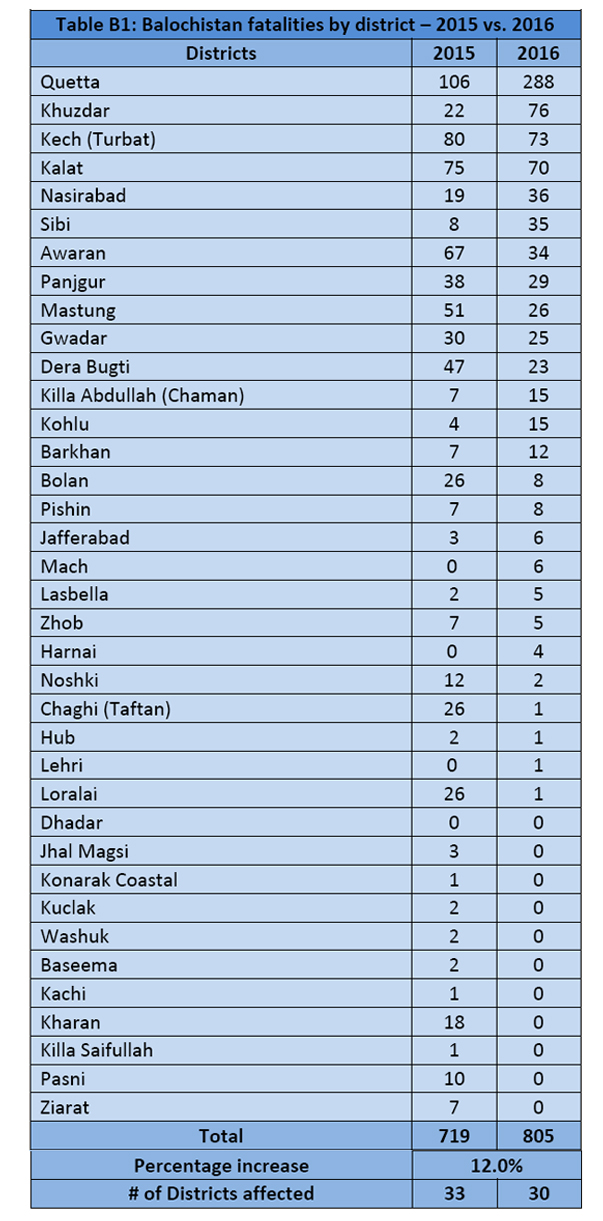
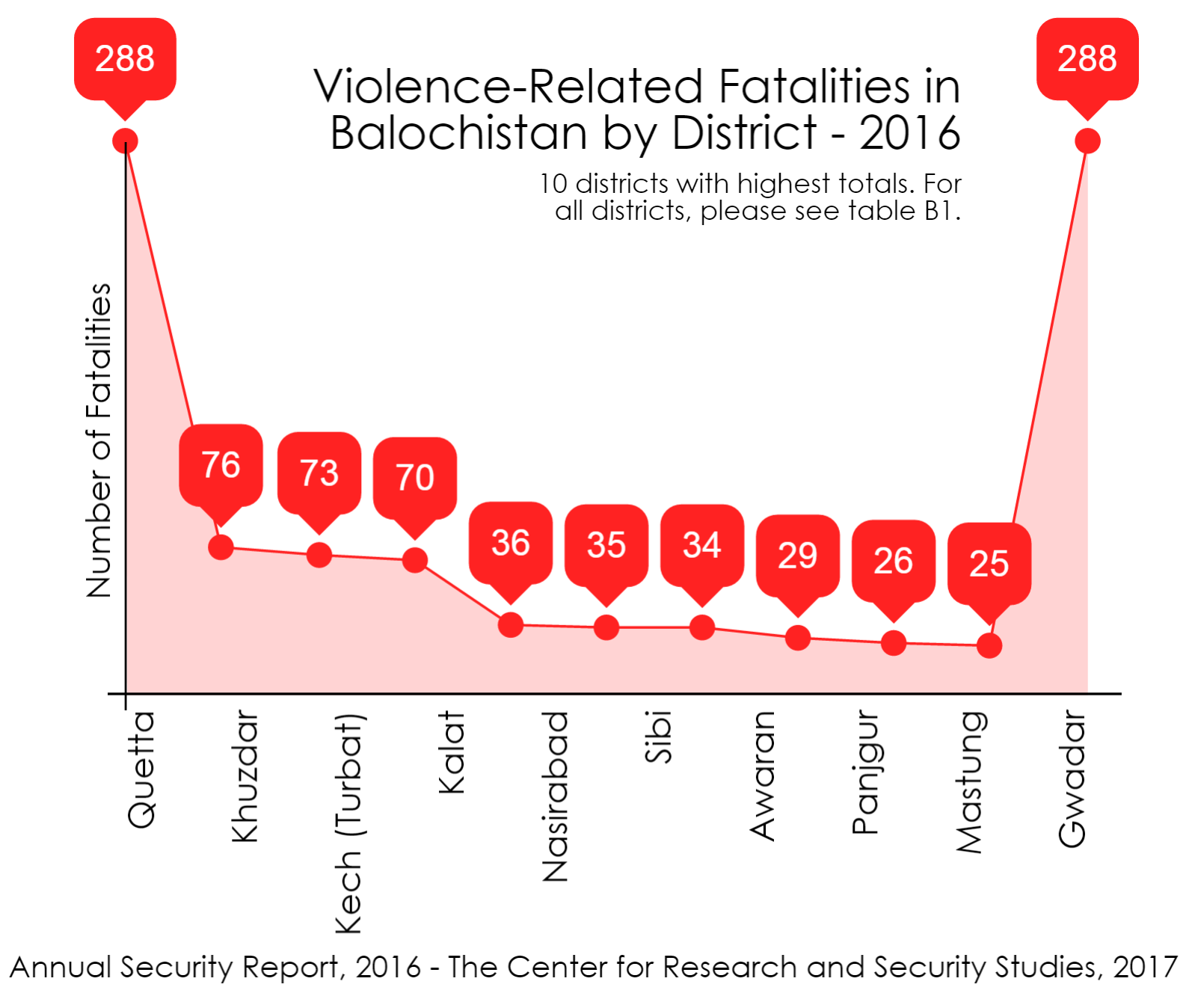
Quetta, the capital of Balochistan, lost the highest number of human lives to violence – 288 in 2016 versus 106 in 2015, an increase of over 171%. Other districts that suffered higher fatalities from violence were Khuzdar, Kech, Kalat, Nasirabad, Sibi, Awaran, and others (table B1).
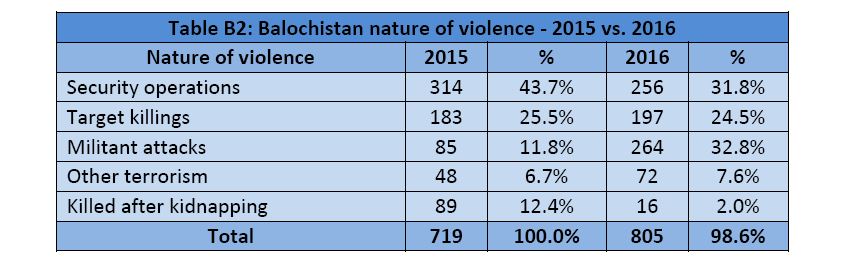
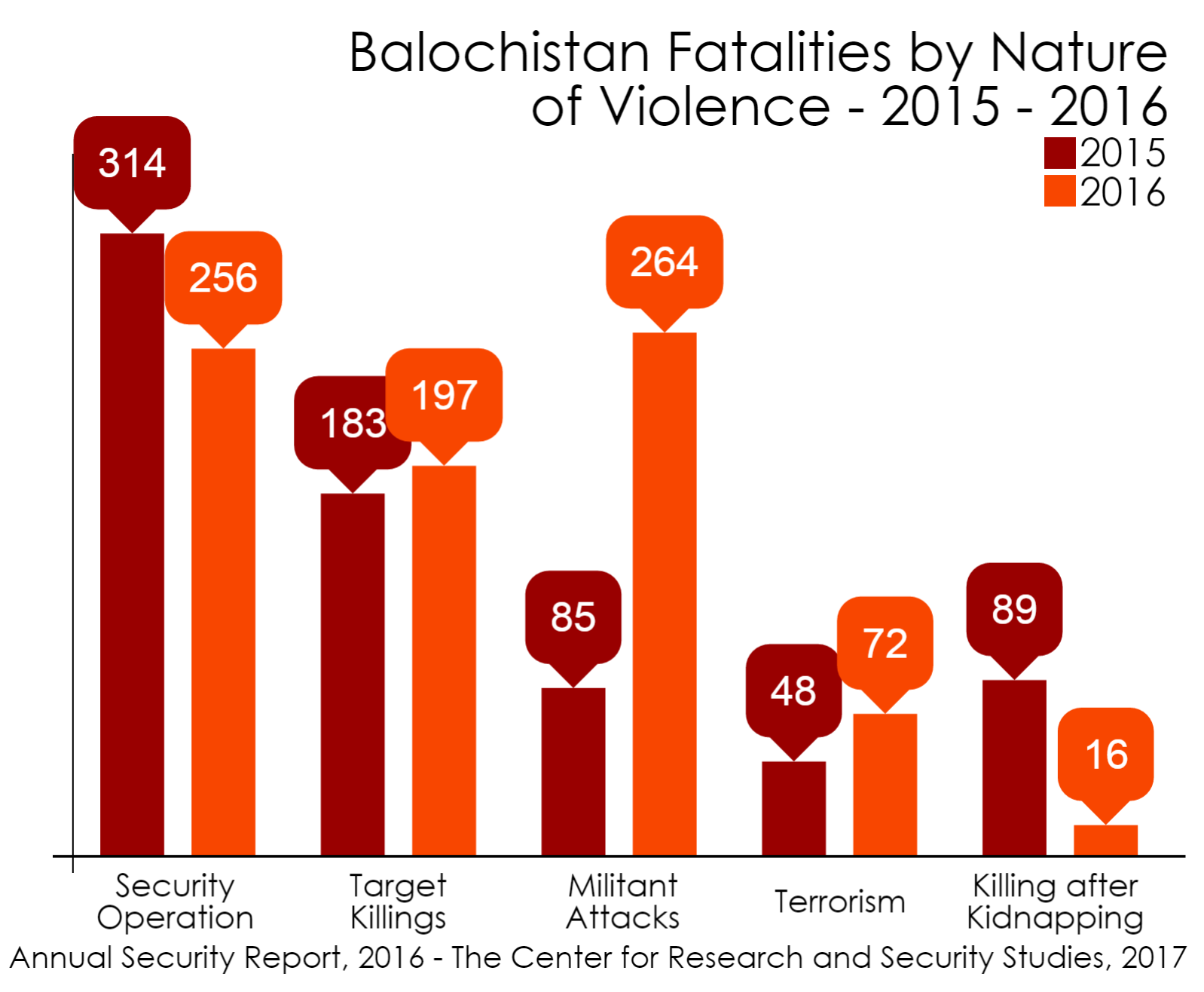
Overall, Balochistan witnessed a marginal rise in violence in the country this year. The majority of the fatalities resulted from terror attacks while fatalities from counter violence operation were nearly 32% of the total fatalities (table B2). The causes of this rise in violence are discussed separately in another chapter.
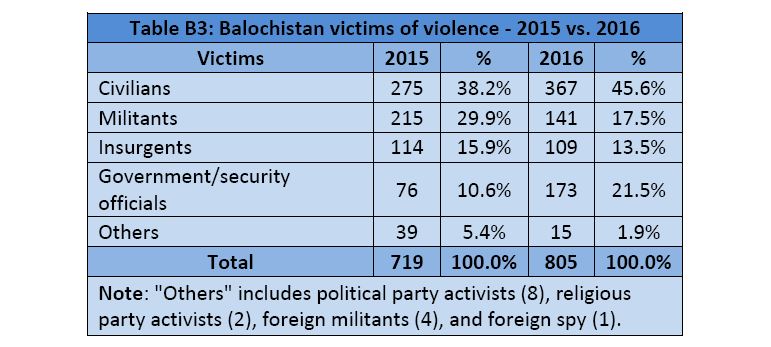
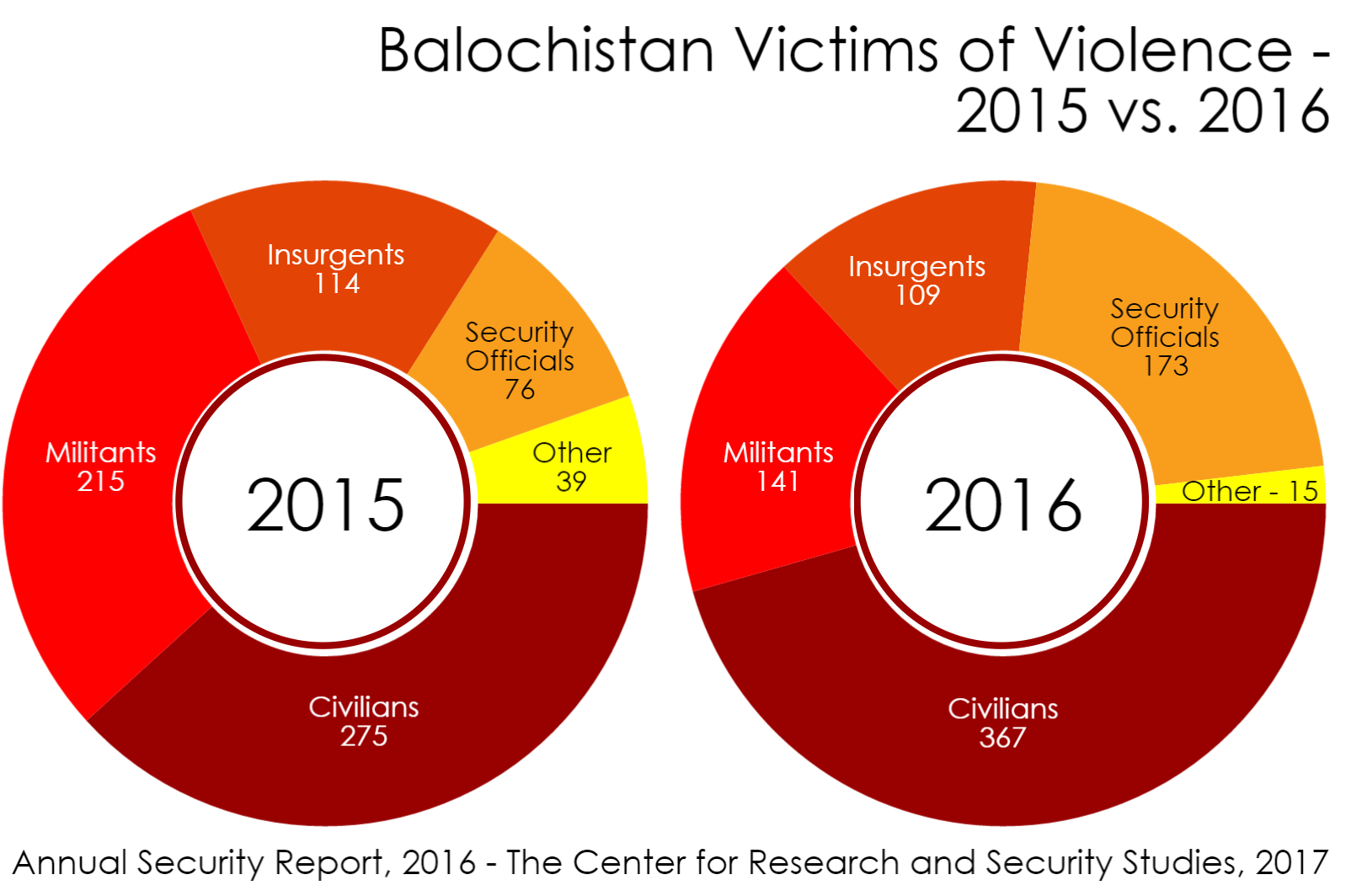
More than 45% of the victims of violence were civilians while fatalities of militants and criminals were less than that. Militants and insurgents accounted for just over 31%, while government and security officials accounted for a little over 21% (table B3).
Among civilians, the majority of the victims were common people while 10 of them were political and religious party activists. Four militants from Afghanistan were eliminated in Pakistan this year; one of them was victim of a US drone attack while the remaining three were killed in encounter with security forces or internal fight of the militant groups. For the first time, a US drone attack was carried out in Balochistan, an area communicated to the Obama administration as a no-go zone[31] for drone strikes. The target was the Afghan Taliban chief, Mullah Akhtar Mansur. Prior to his elimination, three senior commanders of Afghan Taliban were also eliminated in Pakistan. The following are the names of all Afghan militants that died in Pakistan this year:
Date Commander’s Details
January 9, 2016 Maulvi Muhammad Alam, loyal to Mullah Akhtar Mansoor[32]
January 16, 2016 Yunus and Hanif Kulanchi, killed in an encounter[33]
May 22, 2016 Mullah Akhtar Mansur, killed in another US drone attack[34]
Mullah Akhtar Mansur, was found to have all official documents (Computerized National Identity Card (CNIC), passport, and electoral number) in his name from Pakistan and the person who replaced him, Haibatullah Akhundzada, had been living in Kuchlak near the city of Quetta for more than 15 years before becoming the new Afghan Taliban chief.[35]
Of the 18 suicide attacks countrywide, 7 occurred in Balochistan, leaving 220 persons dead and 405 injured. Five suicide attacks targeted security personnel, two attacks targeted civilians (lawyers, and shrine attendants). Armed attacks, indiscriminate firing, landmines, bomb, and IED explosions caused 101 deaths. Some of these terror attacks were well-planned in selection of their targets, locations, and execution.
The suicide attack on lawyer’s community was planned to be executed when a large number of lawyers and some journalists had gathered at the civil hospital of Quetta following target killing of Bilal Anwar Kasi, president of the Balochistan Bar Association the same morning[36].
Two attacks were carried out at places that were least protected: one at the Sufi Shrine of Noorani Shah in Khuzdar[37] and the other at the Police Training Center in Quetta.[38] The attack on the Police Center was the most brazen as three armed-men went on a killing spree and then self-detonated when cornered by the security forces.
There were at least 51 incidents of landmine, IED, and bomb explosions in Balochistan that left 29 persons dead and 152 injured. In one case of landmine explosion, an officer of the Bomb Disposal Squad (BDS) was killed while he was trying to defuse it in Naseerabad.[39]
As many as 86 dead bodies were found in the province of Balochistan during this year. The majority of them were of civilians with unknown identities while a few of them were identified.
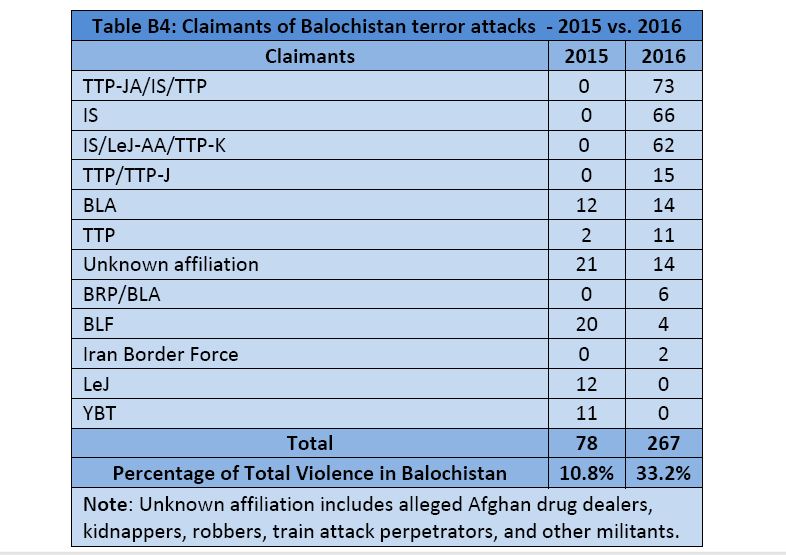
Most of the claimants of terror attacks in Balochistan belonged to militant outfits while insurgents claimed very few terror attacks (table B4). TTP, IS, and TTP-J were militants outfits that made most of the claims.
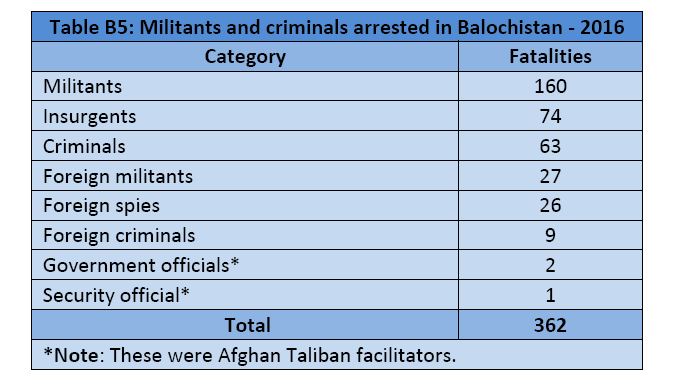
The number of high profile militants and criminals arrested in Balochistan was 363 and a sizeable number of them were foreign agents, militants, and criminals. A few government and security officials plus one political activist was also among them (table B5).
Of 26 foreign spies arrested in Balochistan, 14 were reported to be associated with Indian spy agency Research and Analysis Wing (RAW), 9 with Afghan spy agency the National Directorate of Security (NDS), and 3 remained unidentified. One press report also disclosed that the suspect Indian spies revealed to the investigators that as many as 500 Indian trained terrorists posing as Pakistani Muslims had entered Pakistan illegally and were engaged in promoting terrorism and religious conflicts, arousing anti-army sentiments, and undertaking other anti-state activities.[40] If true, this reveals the depth and extent of Indian involvement in Pakistan, in an effort to destabilize it, and maintain it as a geo-political hotbed.
Among foreign militants, 14 were Afghan Taliban[41], 11 Uzbeks[42] and two unidentified Afghans[43].
37 out of 74 insurgent arrested in Balochistan had affiliation with BRA (12), BLA (11), BLA-suspects (6), and BLF (8). In addition, another 3 arrested were family members of BLF chief (wife and offspring). The identities of the remaining 37 insurgents were not reported.
The majority of the local militants arrested this year had no identification except for a few who were reported to have an affiliation with militant outfits like Quetta hospital attack facilitators (29), TTP (12), TTP/LeJ (3), LeJ (6), and AQ/IS (6).
Two government officials and a security official were also arrested for their involvement in issuance of CNIC in the name of Mullah Akhtar Mansour. A few citizens with alleged links to foreign militants were also arrested.
- Government officials: Additional District Commissioner (DC) apprehended for verifying Muhammad Wali’s CNIC[44] (Afghan Taliban’s chief’s fake identity); retired government official who allegedly certified the local certificate also arrested[45]
- Security person: Aziz Ahmad Achakzai, a risaldar major in the Balochistan Levies Force (BLF), was arrested in Quetta for helping Wali Mohammad acquire a manual Pakistani ID card[46]
- Civilian: A tribal elder was arrested for verifying Wali Muhammad’s CNIC.[47]
Casualties of Violence in FATA
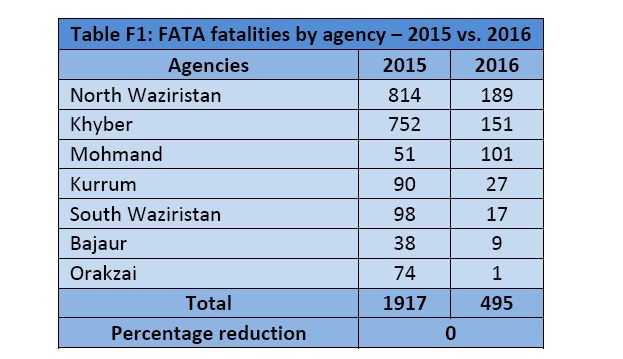
Among all the tribal agencies of FATA, North Waziristan, Khyber, and Mohmand suffered the highest number fatalities from violence during this year (table F3). In these three agencies, 83 civilians, 37 security officials and 2 government officials lost their lives due to armed attacks, landmines, IEDs, bombs, and suicide attacks. Cross-border armed attacks, mostly reported to be carried out by Afghan bandits left 11 security personnel (9 in Mohmand and 2 in South Waziristan) and one militant dead in Kurram Agency. A devastating suicide attack in Mohmand killed 36 civilians.[48] Confronted with repeated militant attacks on security officials and civilians in the region, the armed forces carried out 10 air raids in Tirah valley of Khyber Agency, 4 in the North Waziristan, and 1 in Mohmand Agency leaving 198 militants dead (100 in N. Waziristan, 93 in Khyber Agency, and 5 in Mohmand Agency).
A series of US drone attacks were also carried out in Mangrooti village of Shawal Valley, North Waziristan, close to the border with Afghanistan killed 29 militants. One of them was TTP commander, Maulana Noor Saeed, and two others were identified as Uzbek militants.[49] Another US drone attack was carried out in Lower Kurram Agency near the Afghan border killing five Afghan Taliban.[50]
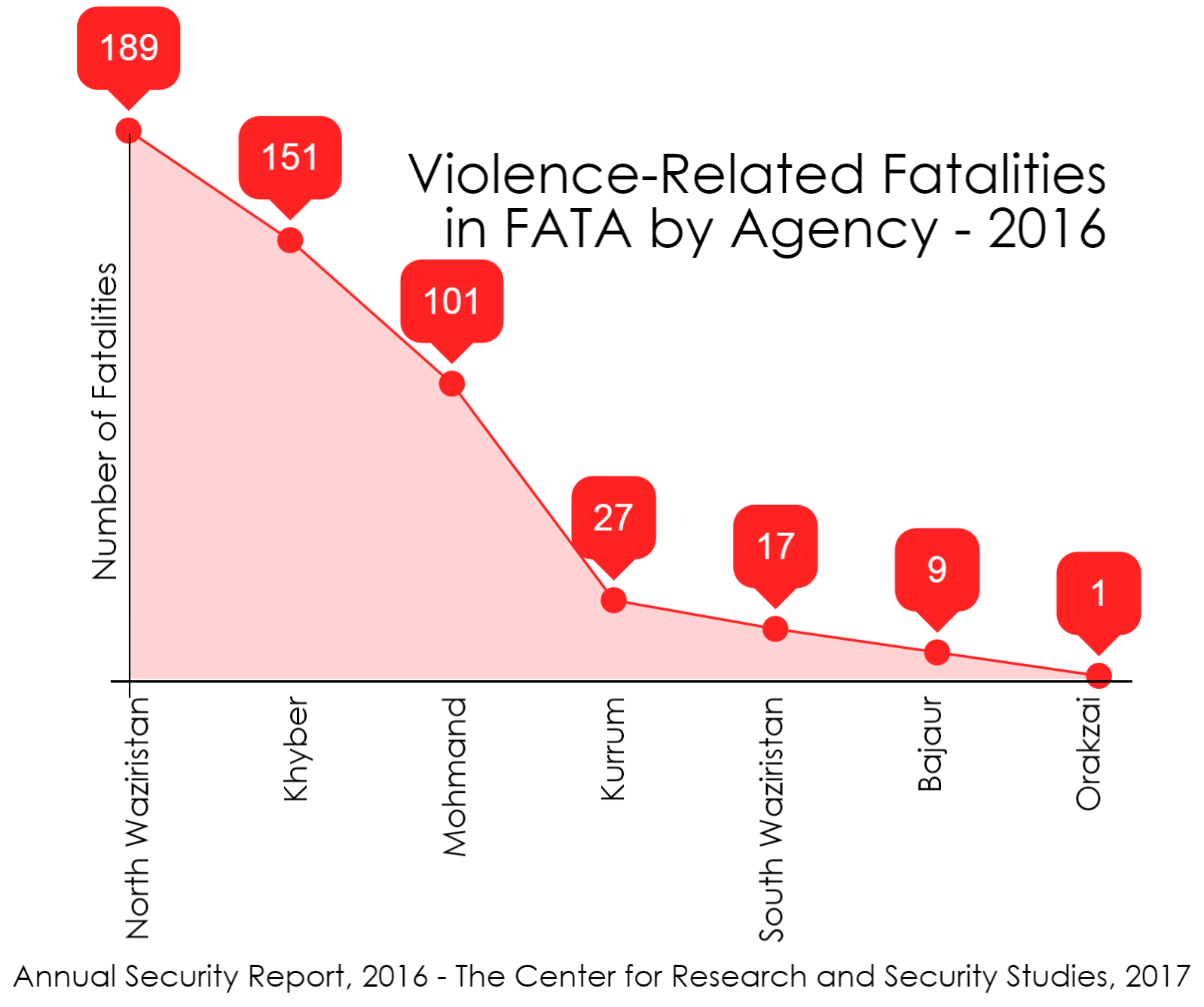
Target killing incidents were reported from FATA this year. As many as 34 persons lost their lives, the majority of whom were civilians belonging to peace committees and polio vaccinations teams. The bodies of twelve victims of cross border target killing were also found.
The upsurge in militancy is due to many factors including new tactics and methods used by the militants. Table F2 below shows the nature of violence that resulted in fatalities in 2015 and 2016.
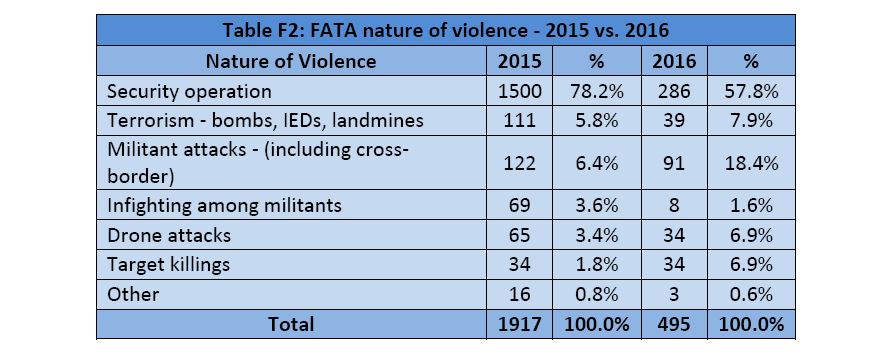
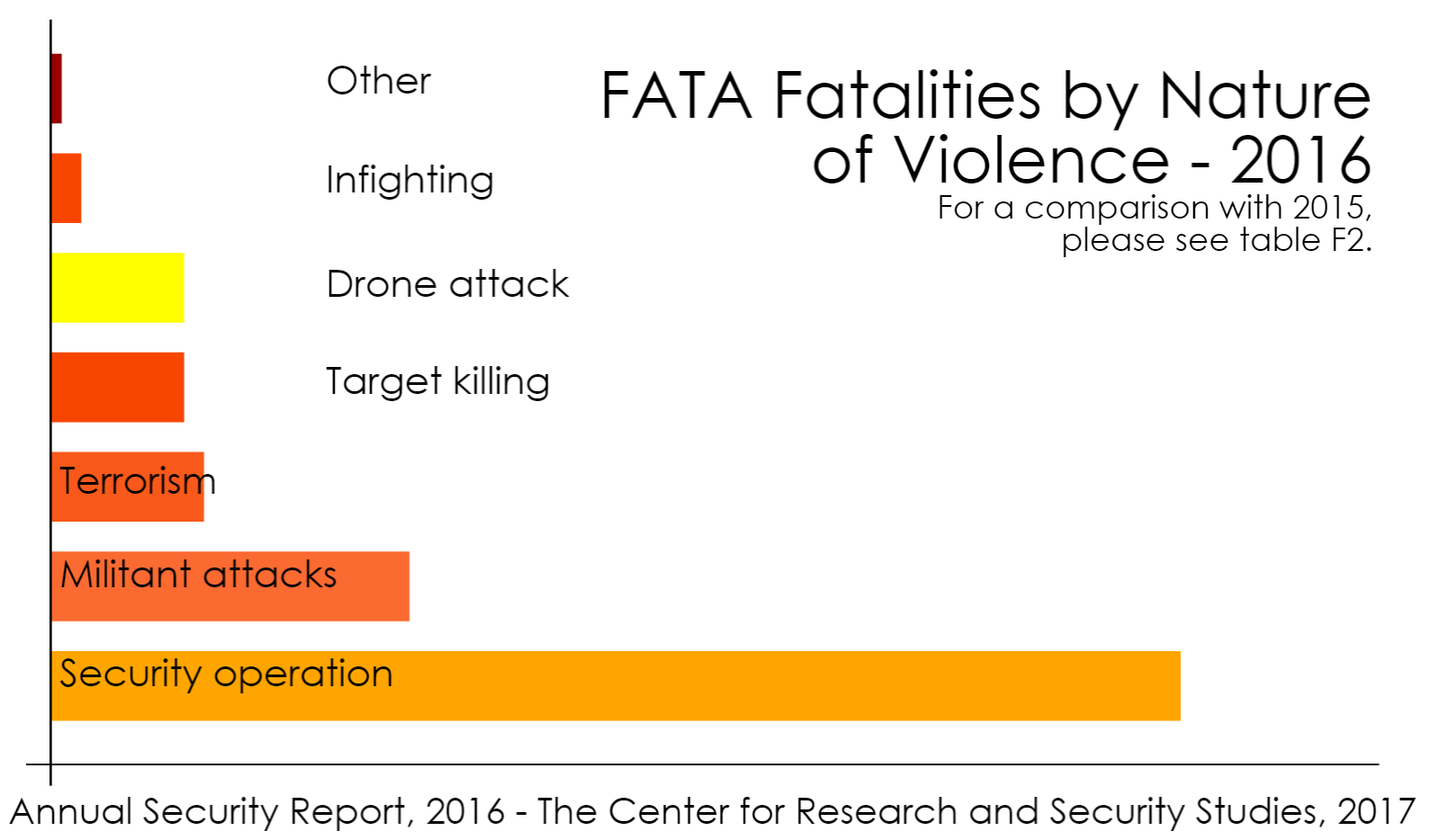
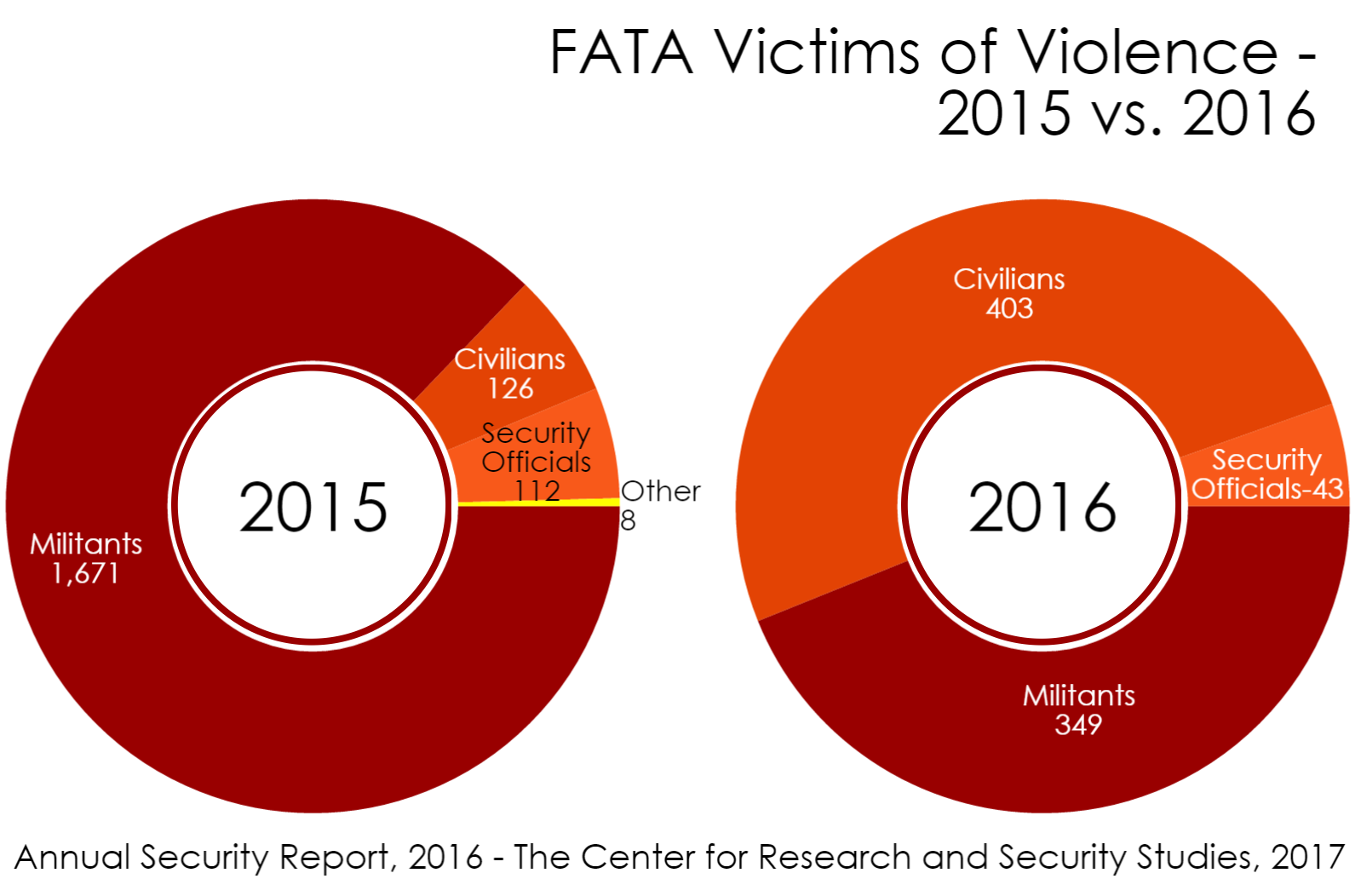
A 74.2% decline in the number of fatalities from violence was recorded in FATA this year. The number of fatalities of militants accounted for just over 70%, while the fatalities of civilians and security personnel were nearly 30% (table F3).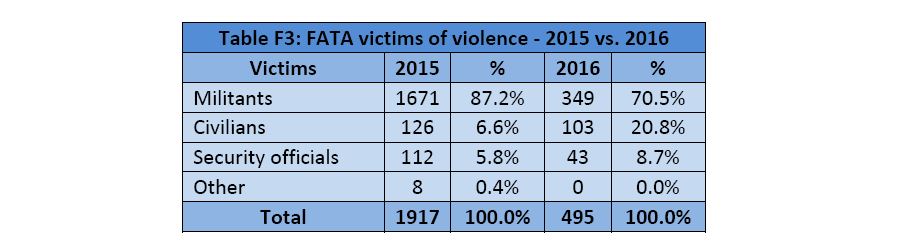
Additionally, the claimants of violence in FATA were only TTP-JA, and TTP. The Afghan militants and bandits are also shown as claimants here. However, this is based on the reports of these groups carrying out violence at the border areas, targeting the security personnel.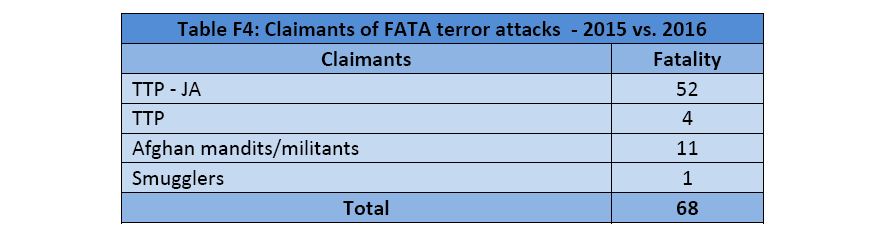 Casualties of Violence in KP
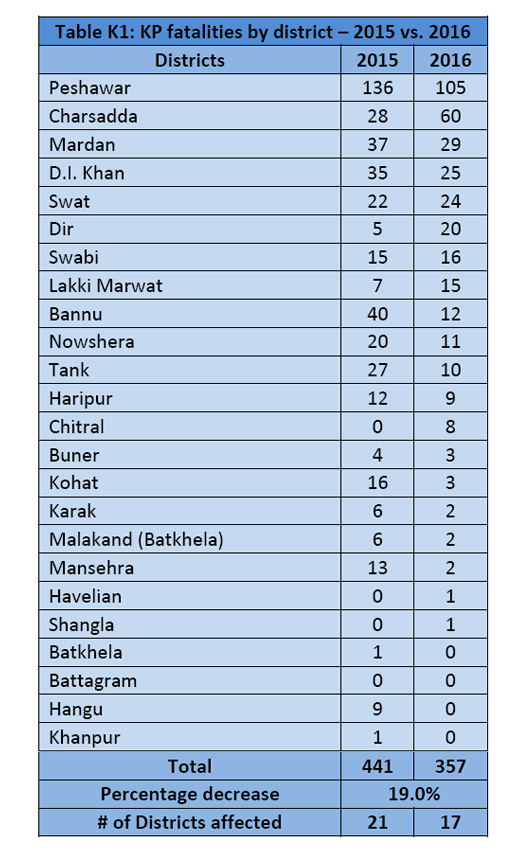
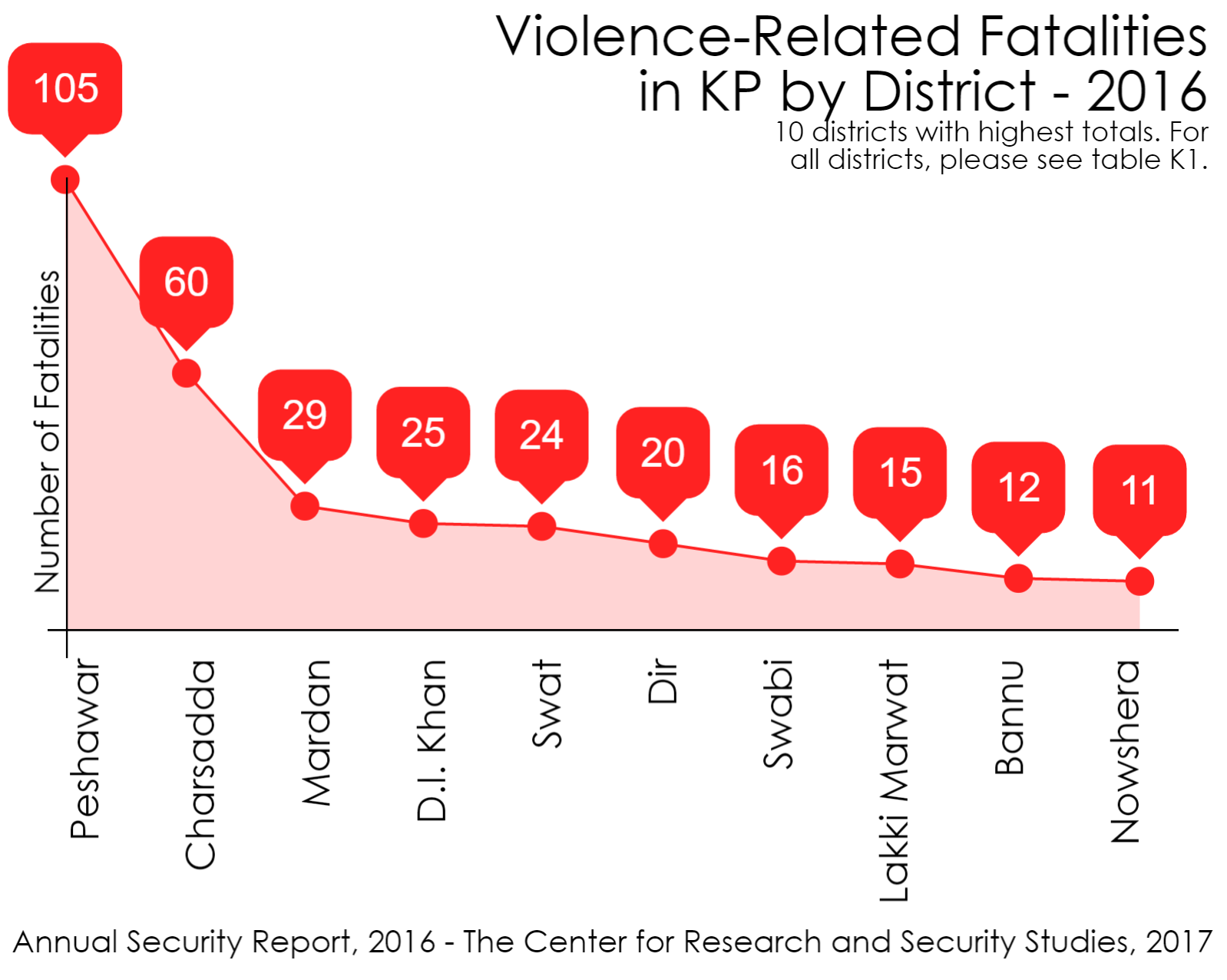
A significant decline in fatalities from violence was observed in KP this year – from 441 fatalities in 2015 to 357 in 2016, reflecting an overall 20% drop (table K1). The number of targeted districts also dropped from 21 last year to 17 this year. Peshawar, the capital of the province, lost the highest number of people to violence this year in comparison to other districts, but lesser than it did last year.
While other districts experienced a downward trend in violence, violence in Charsadda, Dir, and Lakki Marwat increased. There were 95 fatalities in these districts, and if we include Peshawar, the figure stands at 200. Most were victims of violence while 16 fatalities resulted from security operations. Some victims of security operations were not the outlaws but civilians and security personnel, killed at check-posts for not stopping, or in encounters or while trying to defuse bombs. The details are as follows:
In KP, five suicide attacks took place in 2016 that left 43 persons dead, including 32 civilians and 11 others (security personnel, media persons, and political activists).
10 armed attacks reported from KP left 36 persons dead and 49 injured. The deadliest of these armed attacks at BKU, Charsadda left 21 dead including the 4 militants and 17 students and teachers.14
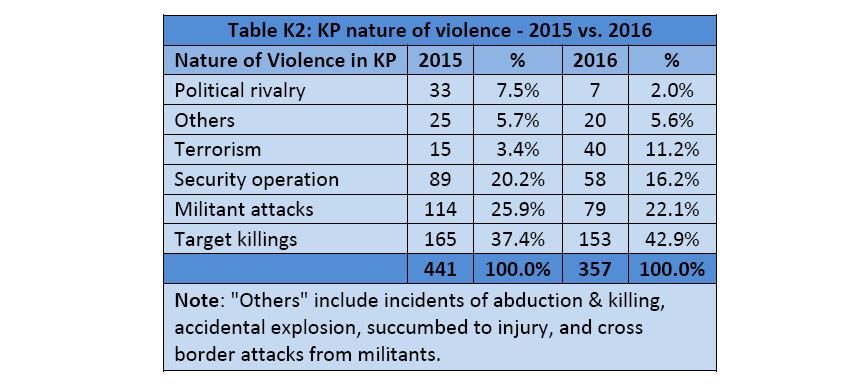
Target killings, among all other forms of violence in KP, inflicted the highest number of fatalities and its percentage also went up this year (table K2). Compared to last year, there was a decline in fatalities from militant attacks in terms of number and percentage both. However, incidents of bomb blasts, landmine detonations, and IED explosions went up significantly.
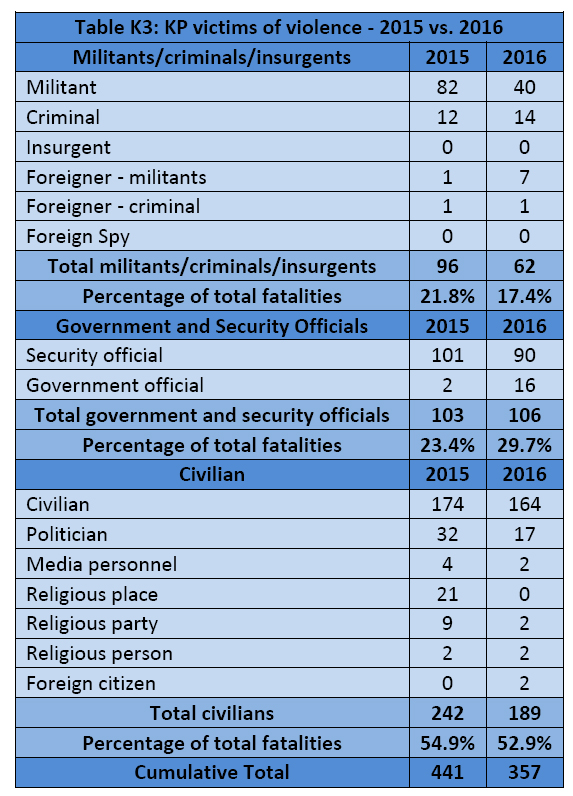
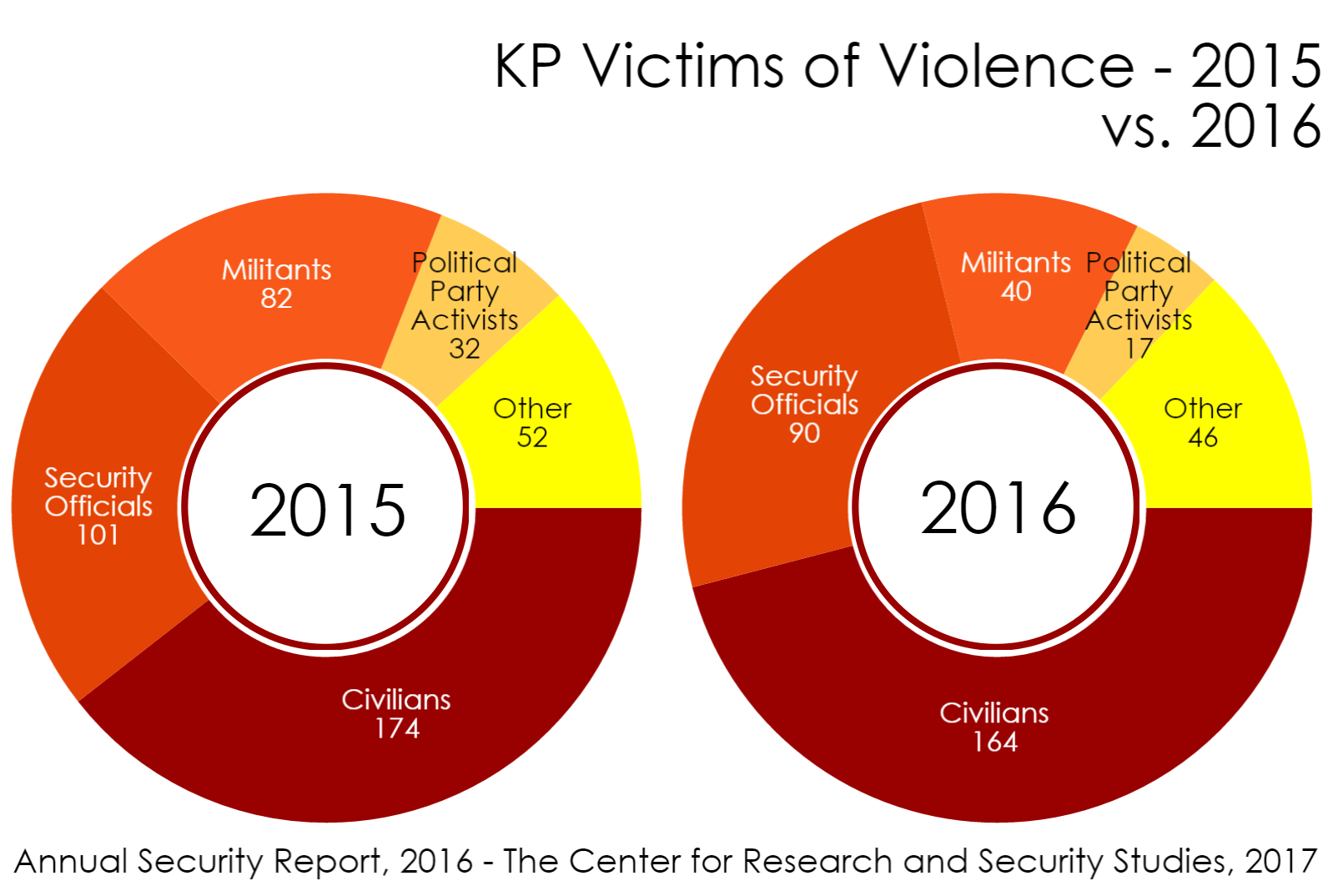
In terms of percentage, the fatalities of militants and criminals made up just over 17% of the total while civilians, security personnel, political activists and others accounted for the remainder. Last year, militants and criminals made up 22% of the total fatalities (table K3). Two foreign outlaws were eliminated last year, compared to eight this year – all of them from Afghanistan.
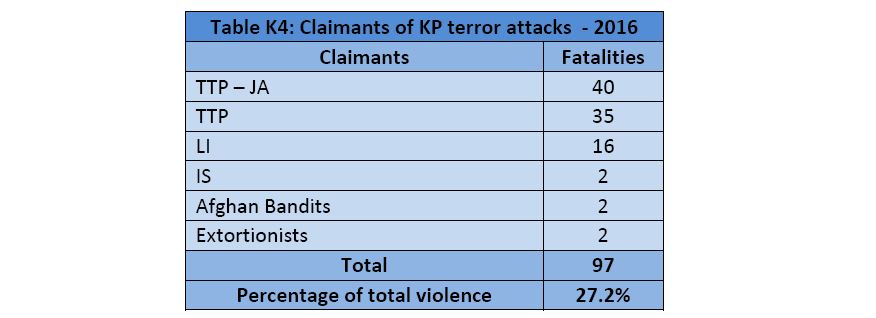
Three militant outfits, TTP-JA, TTP, and LI were the claimants of 91 fatalities that occurred in the province during this year (table K4). IS also made claims for a few terror attacks while Afghan bandits and extortionists claimed 4 suicide attacks, 6 target killings, 2 armed attacks, 2 IED explosions, 1 bomb blast, and one case of indiscriminate firing. Almost 60% victims of these attacks were civilians, 32% government and security personnel, and the remaining 8% were political activists and media persons.
While the militant outfits claimed to have killed 91 persons in KP, the security agencies in the province managed to eliminate only 8 militants belonging to TTP-JA; four of these were killed by the armed forces at Bacha Khan University and the other 4 were killed trying to enter Christian Colony in Peshawar.[51]
Five Afghan militants trying to infiltrate in Chitral were eliminated.[52] Earlier these militants had managed to steal a large number of cattle of Kailash community besides killing two local people in the area.[53] A disaster was averted in Peshawar when three militants, two of Central Asian descent and one local of Khyber Agency (Muhammad Farooq), carrying explosives to execute an attack perished in an accidental explosion.[54]
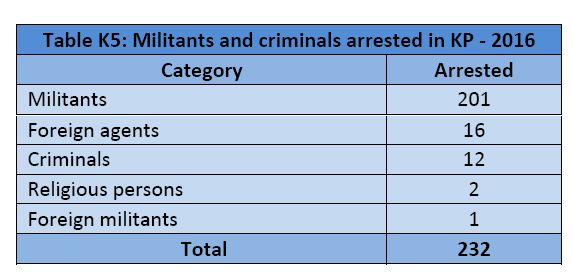
The prominent outlaws arrested in KP belonged to TTP, IS, and others. Of 16 foreign agents arrested in KP, most were Afghan nationals. Some were identified as Afghan NDS spies, while others were suspected of working for RAW. In addition to the selected list below, hundreds of other arrests were made. This list, however, shows specific actions on high-profile targets from known outfits.
- On January 16, 2016, 60 supporters of IS arrested from various locations in KP[55]
- On September 21, 2016, Muhamamd Farid arrested from Peshawar[56]
- On April 27, 2016, Musa arrested from Regi Lalma, Peshawar[57]
- On January 22, 2016, 35 arrested from KP villages in connection with BKU attack
- On January 27, 2016, Akbar Ali and Ibrahim, arrested from Mardan-Charsadda Road in connection with BKU attack[58]
- On January 31, 2016, three suspects, including two Afghans, arrested from Mandani, Charsadda in connection with BKY attack[59]
- On February 3, 2016: Waheed Ali arrested from Nowshera, main facilitator of BKU attack[60]
- On February 5, 2016, Waheed Ali’s wife arrested while trying to flee to Punjab[61]
- On June 24, 2016, banned outfit member arrested from Nowshera in connection with sending suicide bombers to provincial capital[62]
Casualties of Violence in Punjab
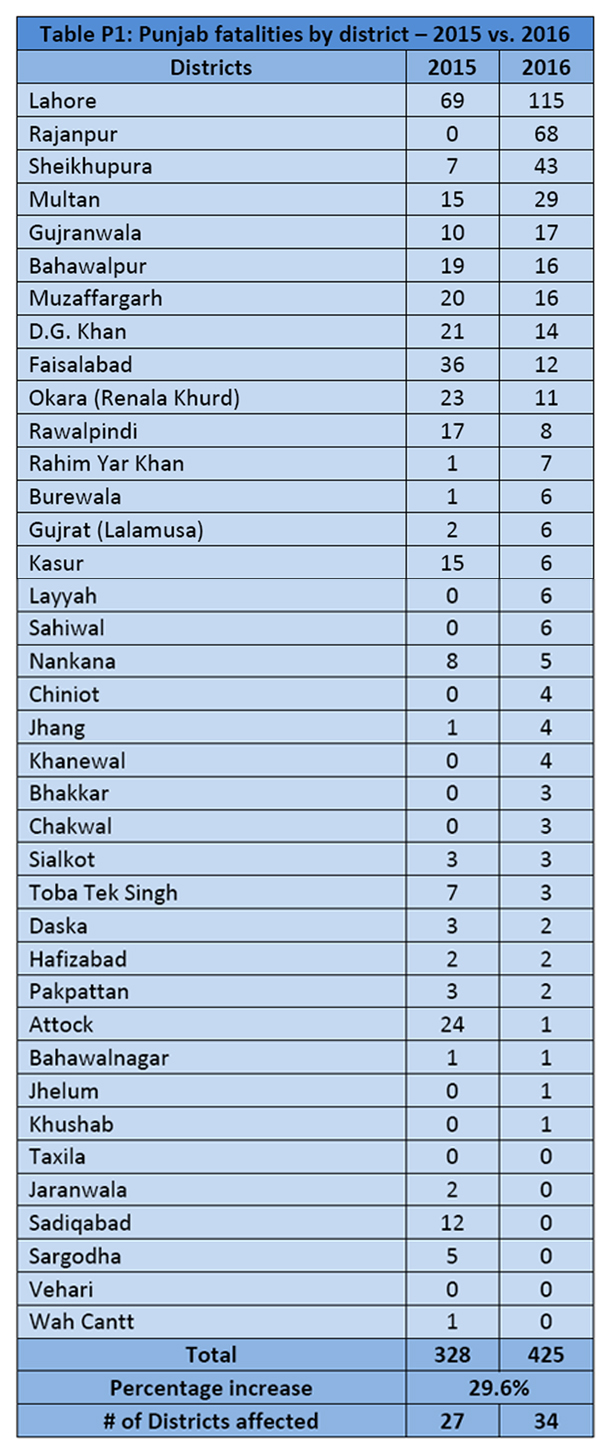
In Punjab, like Balochistan, the number of violence related fatalities and violence-affected districts went up. From 328 fatalities last year the number climbed to 425 in 2016, signifying a 30% increase. The number of districts that witnessed violence this year went up to 34 from 27 last year (table P1).
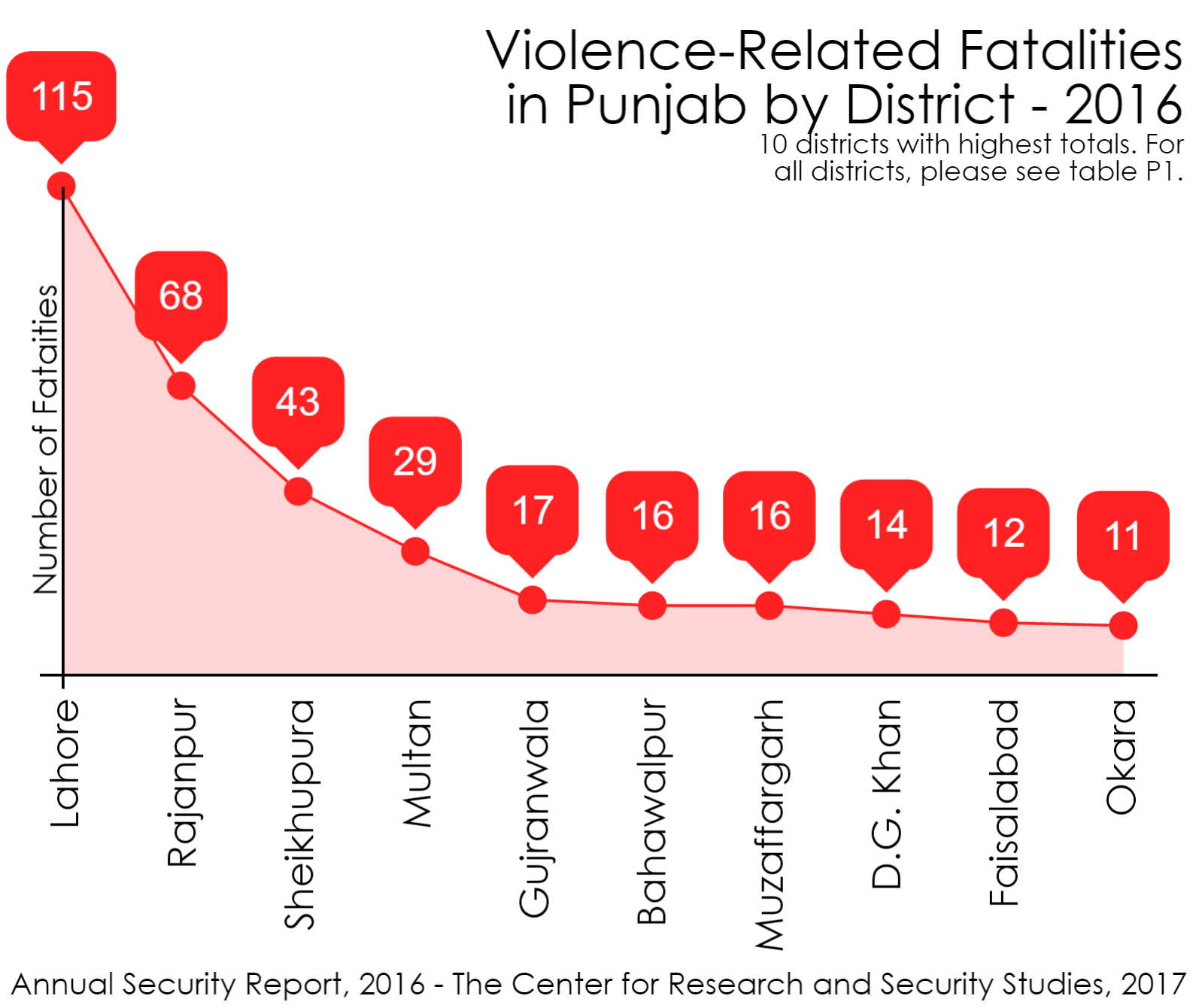
Shaikhupura, Multan, Gujranwala, and Lahore districts saw a sharp increase in violence. Almost half of the fatalities (204) from violence were reported from these four districts where the majority were civilians (87), followed by militants (84), criminals (29), security personnel (3) and one political activist. One suicide attack in Iqbal Park, Lahore left 72 persons dead on the spot and 6 more were succumbed to their injuries at later dates.
Rajanpur, Layyah, Sahiwal, Chinniot, Khanewal, Bhakkar, Chakwal, and Jehlum districts reported violence this year but had no such reports last year. Altogether, 96 persons lost their lives in these nine districts and 82 of them were outlaws (58 militants and 14 criminals). Among these eight districts, Rajanpur had the highest number of fatalities this year. Of 68 fatalities in Rajanpur, 56 were militants and criminals.
Rajanpur had been the center of multiple security operations during the year. The first operation was carried out against CMG in April with 1,600 policemen, 350 elite commandos, a platoon of Pakistan Rangers, and officials from the Counter Terrorism Department (CTD). During the operation 10 policemen lost their lives while 25 security personnel were held in custody by the gang.[63] After the failure of police and Rangers operation, the army was called in. The army commandos and paramilitary forces supported by gunship helicopters carried out a successful operation in the area forcing the gangsters to surrender.[64]
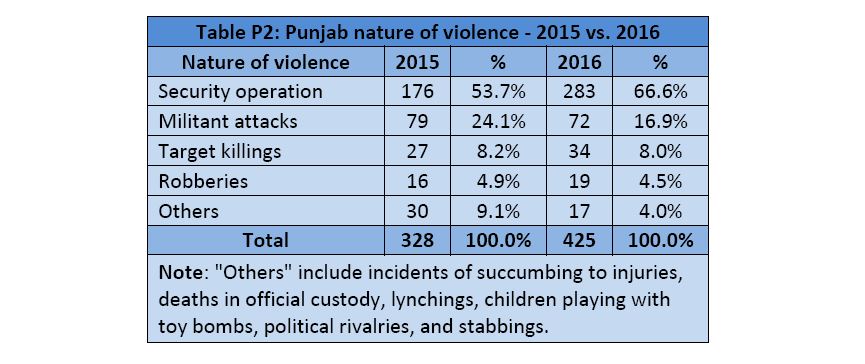
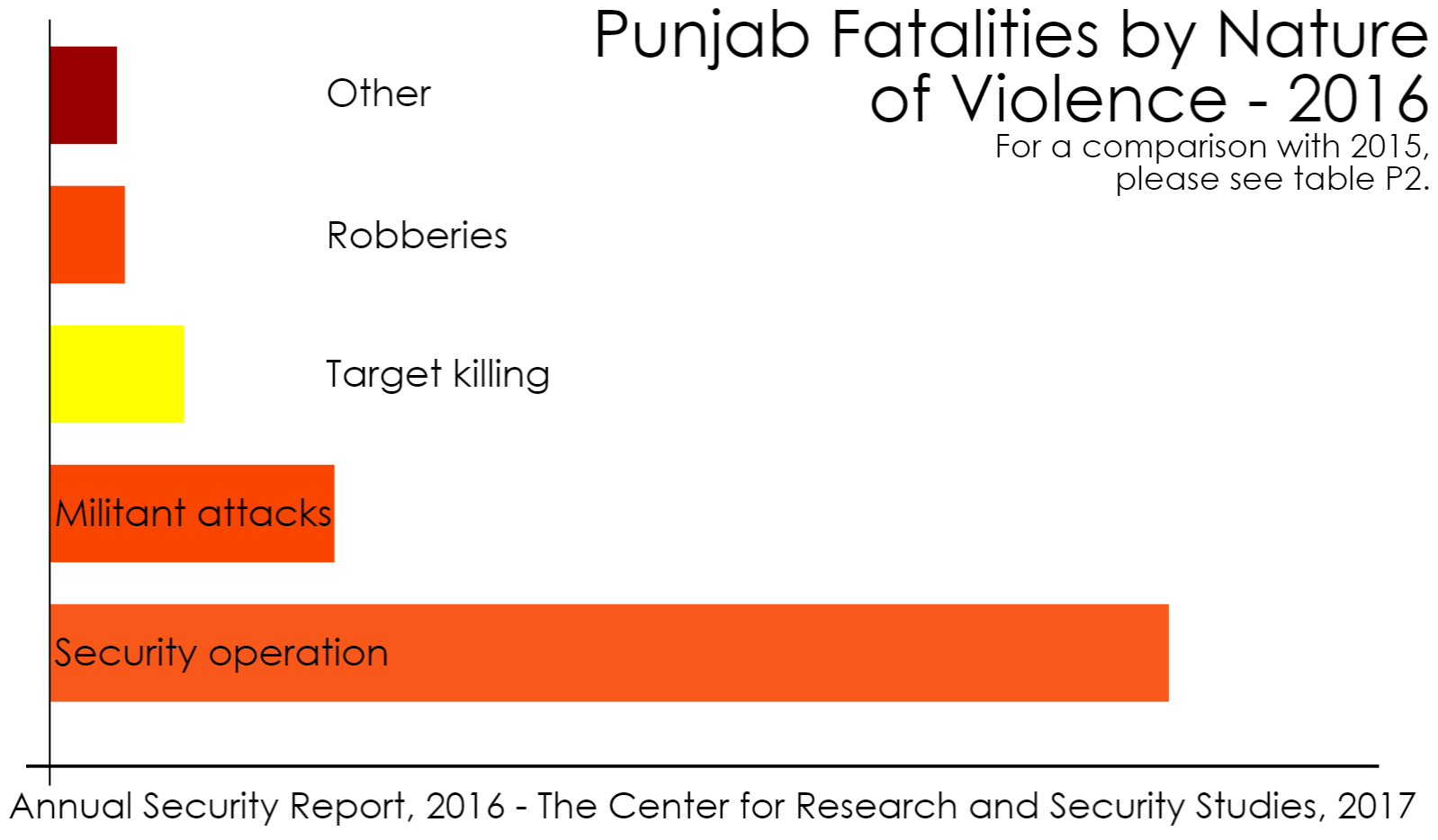
Other factors that can help understand the causes for upsurge in violence in the province is the number and percentage of the fatalities from violence and counter-violence security operations (table P2). Unlike Balochistan and KP, in Punjab the number of fatalities from security operation was around 70% of the total fatalities. All other forms of violence like militant attacks, target killings, and robberies remained approximately at par with last year’s figures.
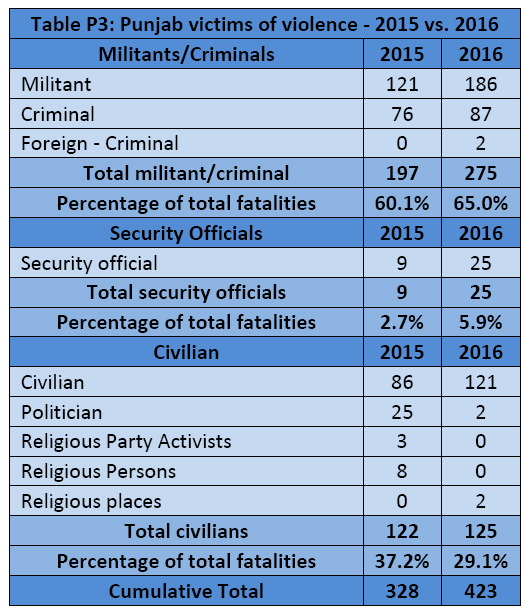
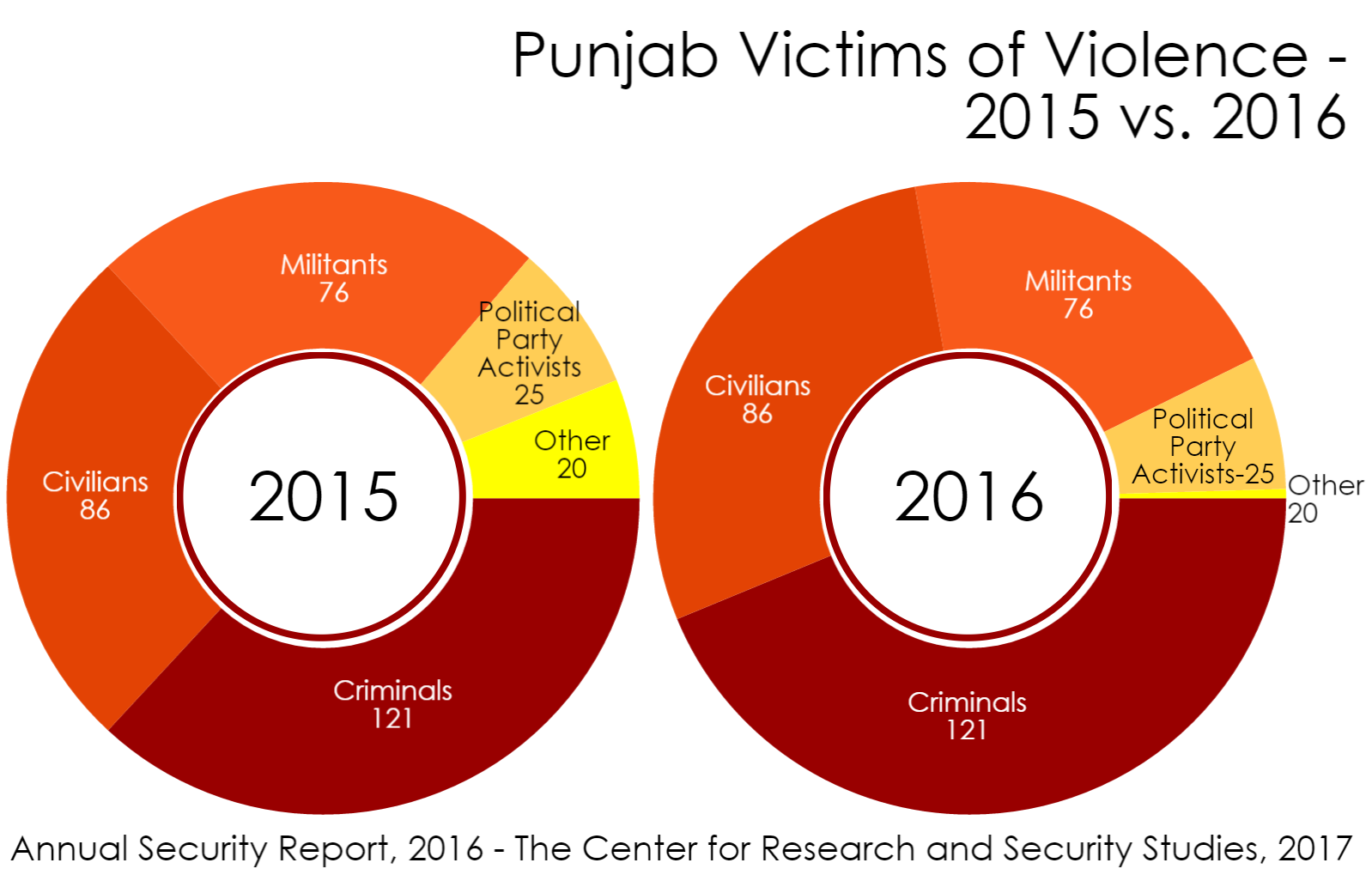
Among the victims of violence in Punjab, militants and criminals were highest in number while the security personnel were least in number. Civilians suffered the second highest number of fatalities (table P3). The least affected of violence among the civilians were political activists. No religious party member, religious or media person became victim of violence this year in Punjab. The province was also found to have no foreign outlaws operating in its borders.
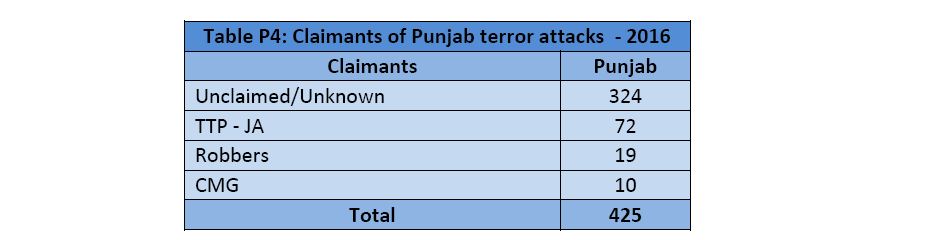
Those who claimed to have committed violence or the ones that were reported by the security agencies as the perpetrators of crimes were TTP-JA, robbers, and CMG (table P4). With the exception of TTP-JA, no other militant outfit made any claim of violence in Punjab although South Punjab is considered to be the major provider of foot soldiers for different militant organizations functioning in and outside the country.[65]
Among the outlaws arrested in the province, majority belonged to militants and criminals (table P5). They were affiliated with militant outfits including IS, AQ, TTP, Jaish-e-Muhammad (JeM), Hizbut Tehrir (HuT), BLA, BLF, LeJ, and CMG. Some militants arrested had multiple affiliations like TTP/IS/AQ, TTP/LeJ, TTP/AQ, and IS/LeJ. This cross-pollination clearly shows that despite differing groups, the overall aims and strategy is shared between these groups.
Two militants belonging to TTP-JA were arrested on August 14, 2016[66] for alleged involvement in the suicide attack at Iqbal Park, Lahore. Earlier, 17 persons were arrested as suspects of the Iqbal Park attack but they were not identified as affiliated with TTP-JA. Two of these seventeen, Abid and Bashir were arrested from Jaranwala[67] and 15 more were arrested on April 26, 2016 in a massive crackdown in Punjab against criminal elements after Iqbal Park suicide attack.
A large number of militants affiliated with IS were also arrested in Punjab, 37 from Lahore, 1 each from Gujrat, Sialkot, and Gujranwala while the militants belonging to TTP/IS/AQ, TTP, TTP/LeJ, AQ, TTP-JA, and LeJ-CMG were arrested from Attock, Bahawalpur, Lahore, Gujranwala, Multan, Bahawalnagar, Sargodha, Taxila, and D.G. Khan.[68]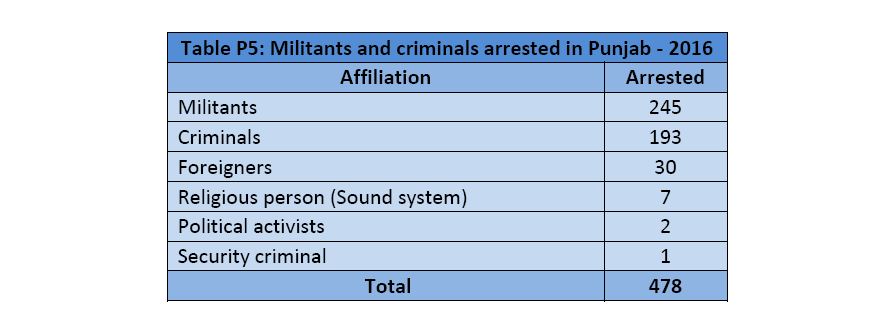
Casualties of Violence in Sindh
Besides FATA, the number and percentage of fatalities from violence witnessed a significant decline in Sindh – from 1,221 in 2015 to 520 in 2016 – a drop of more than 57% (table S1). Although the number of violence-affected districts remained the same for both years, five new districts (Dadu, Mirpur Mathelo, Sujawal, Tando Allah Yar, and Thatta) were affected despite no reports last year (table S1).
The upsurge of violence in Hyderabad and five new districts in Sindh has multiple causes. Crimes related to sectarianism, insurgency, political rivalry, and street crimes in these regions left 23 persons dead, including criminals (15), political activists (5), civilians (2), and a militant.
The 15 criminals (robbers, gangsters, and unidentified criminals) who lost their lives were eliminated in encounters with the police. One university student, Hadiur Rehman Narejo, 20-years-old, was killed in an encounter by Naseem Nagar police, Hyderabad. The police initially claimed that Hadi was a hardened criminal while the family of the student lodged an FIR against two policemen involved in the incident and got them arrested.[69] In another controversial encounter in Hyderabad, 3 suspected criminals from Karachi were put to death.[70]
Five political activists from PPP/Sindh Tehrik-pasand Party (STP) lost their lives to political rivalry in Sujawal. One activist of Jeay Sindh Mahaz (JSM) was killed in Thatta while the dead body of an activist of a nationalist party, Sindh Muttahida Mahaz (SMM), was found in Sukkur after 3 years of his disappearance from Degree College Ghotki.[71]
One incident of religious violence was reported from Mirpur Mathelo where a Hindu teenager was killed and another was seriously wounded when armed men opened fire on them. Locals described it as a backlash against an alleged act of blasphemy committed by a Hindu man in nearby Daharki earlier. Police, however, claimed that the motive behind the attack was personal enmity.
Karachi and Sukkur had the highest number of fatalities during this year but showed an overall decline. Only Hyderabad district showed an upsurge in fatalities from violence this year.
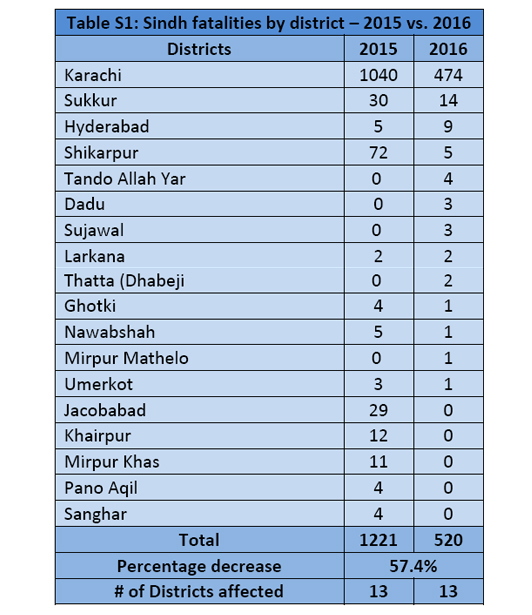
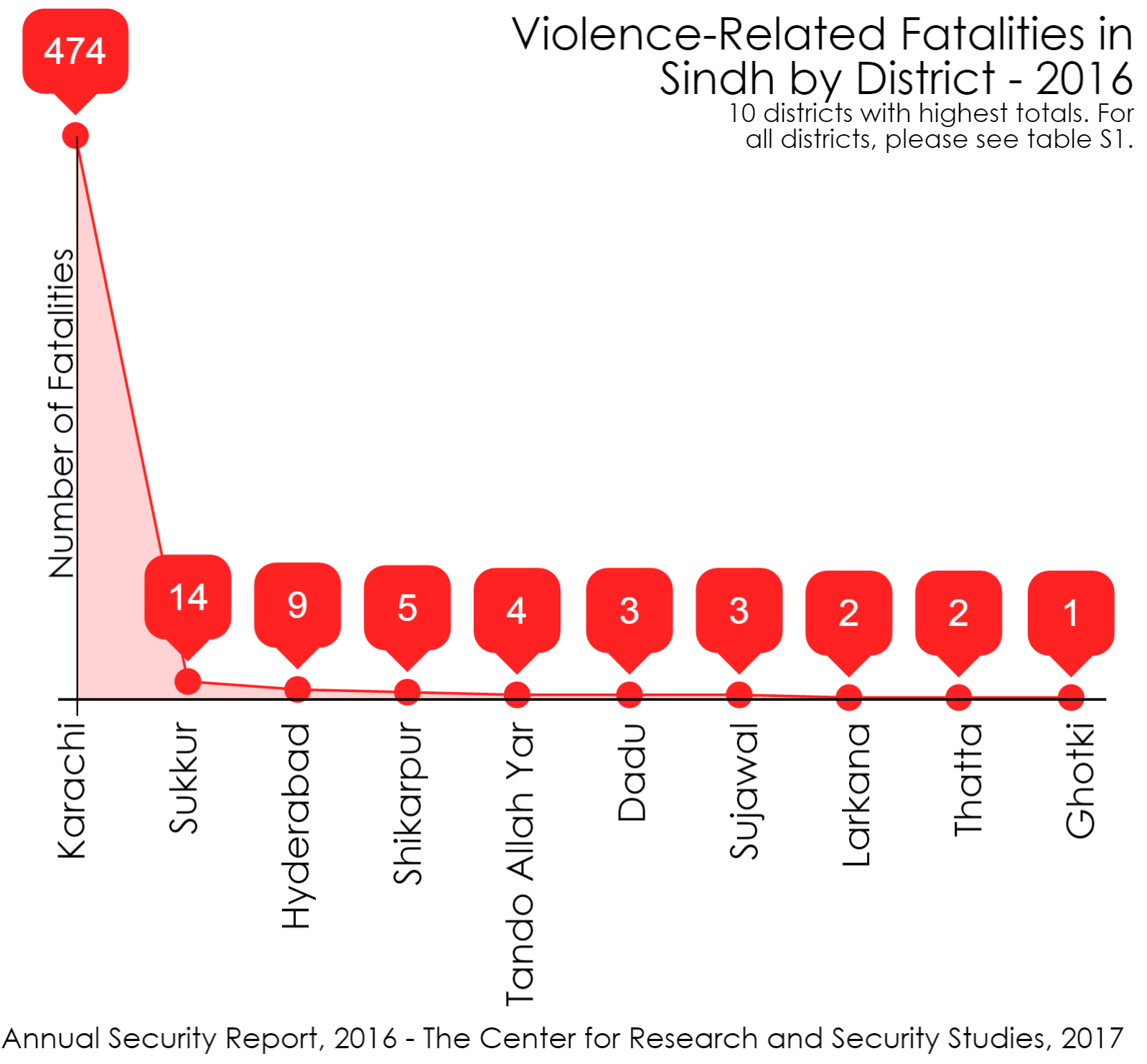
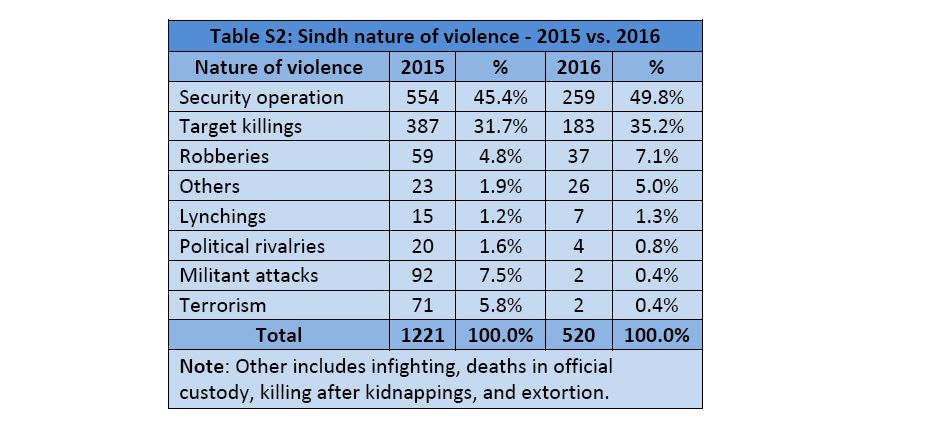
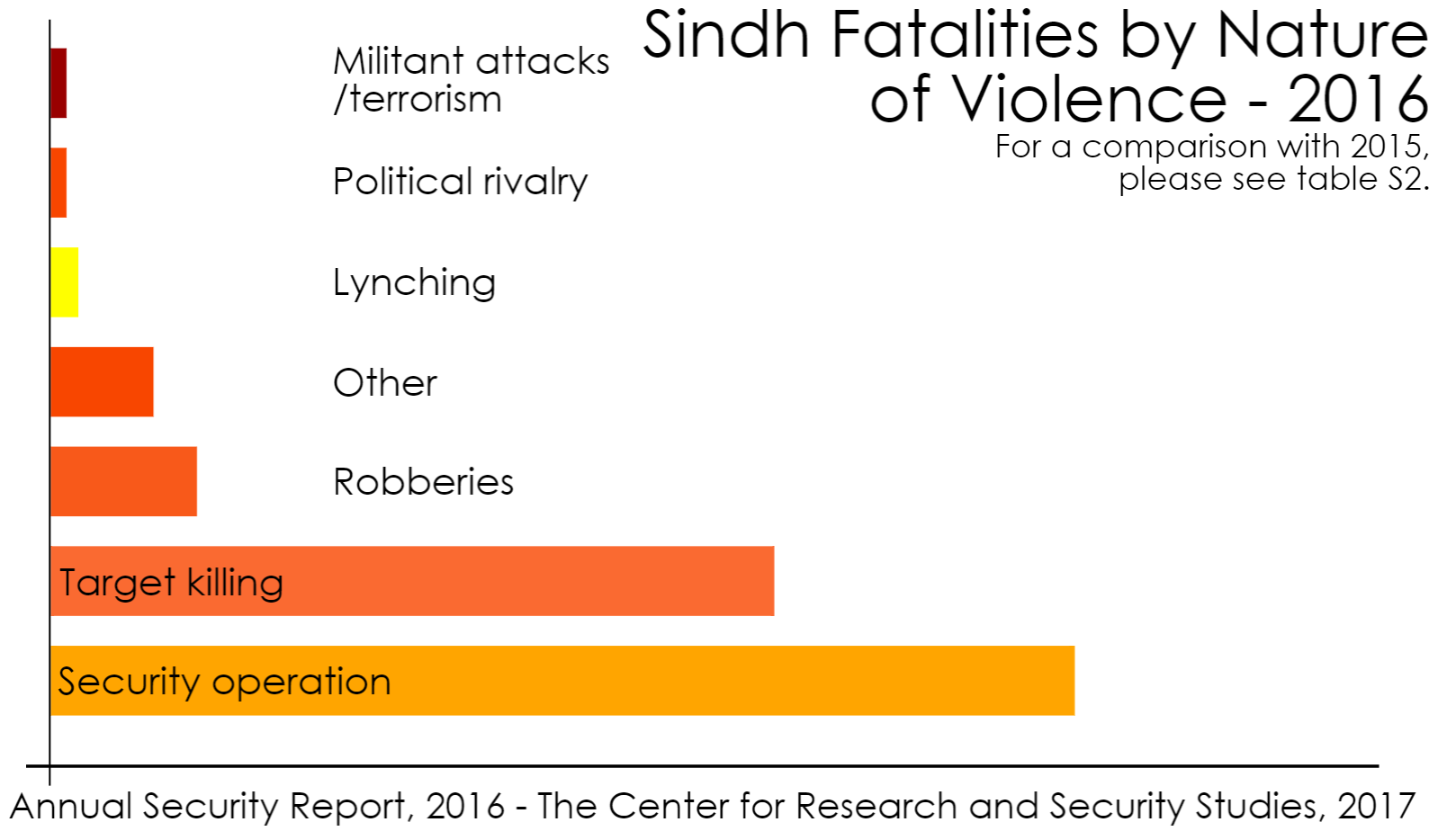
Table S2 below shows that the number of fatalities for each type of violence for this year is less than the year prior. A slightly different picture emerges when these figures are reviewed in terms of percentages. Target killings and robbery-related fatalities went up this year and so did the fatalities from counter-violence security operations in the province. A significant drop in acts of violence like militant attacks and terrorism was observed in Sindh during this year that left 6 persons dead – 5 in Karachi and 1 in Larkana. However, the number of persons injured because of terror attacks is 99 and the majority of these victims belonged to Karachi (64), followed by Hyderabad (14), Shikarpur (13), Larkana (5), and 1 each in Badin, Tando Jam, and Sukkur.
Two suicide attacks were reported from Shikarpur leaving 1 police officer dead and 13 civilians (Namazis at Eid Gah and Imambargah on Eid Day) injured. Policeman Rafiq Qureshi, who was injured in attack passed away in Karachi three days after the incident.[72]
Another suicide attempt was thwarted in Hyderabad when a suicide bomber tried to sneak into an Imambargah in Amani Shah Colony during Friday prayers. This suicide attack was to be carried out by two suicide bombers but one of them disappeared after hurling a hand grenade at the Rangers’ van parked near the Imambargah while the other was shot dead by the security personnel.[73]
In Sindh, eight bomb explosions took place this year in Karachi, Badin, Larkana, Hyderabad, and Tando Jam districts.
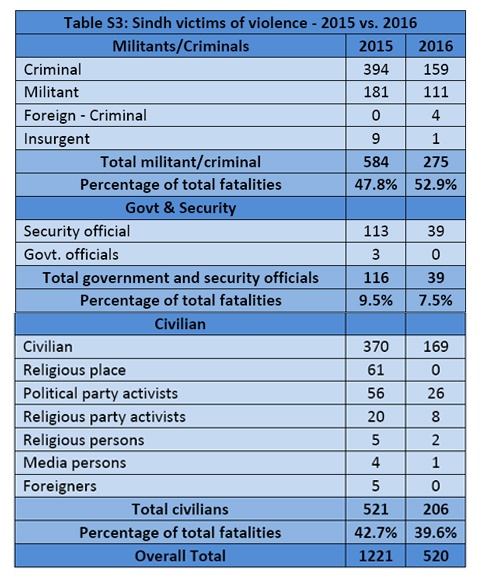
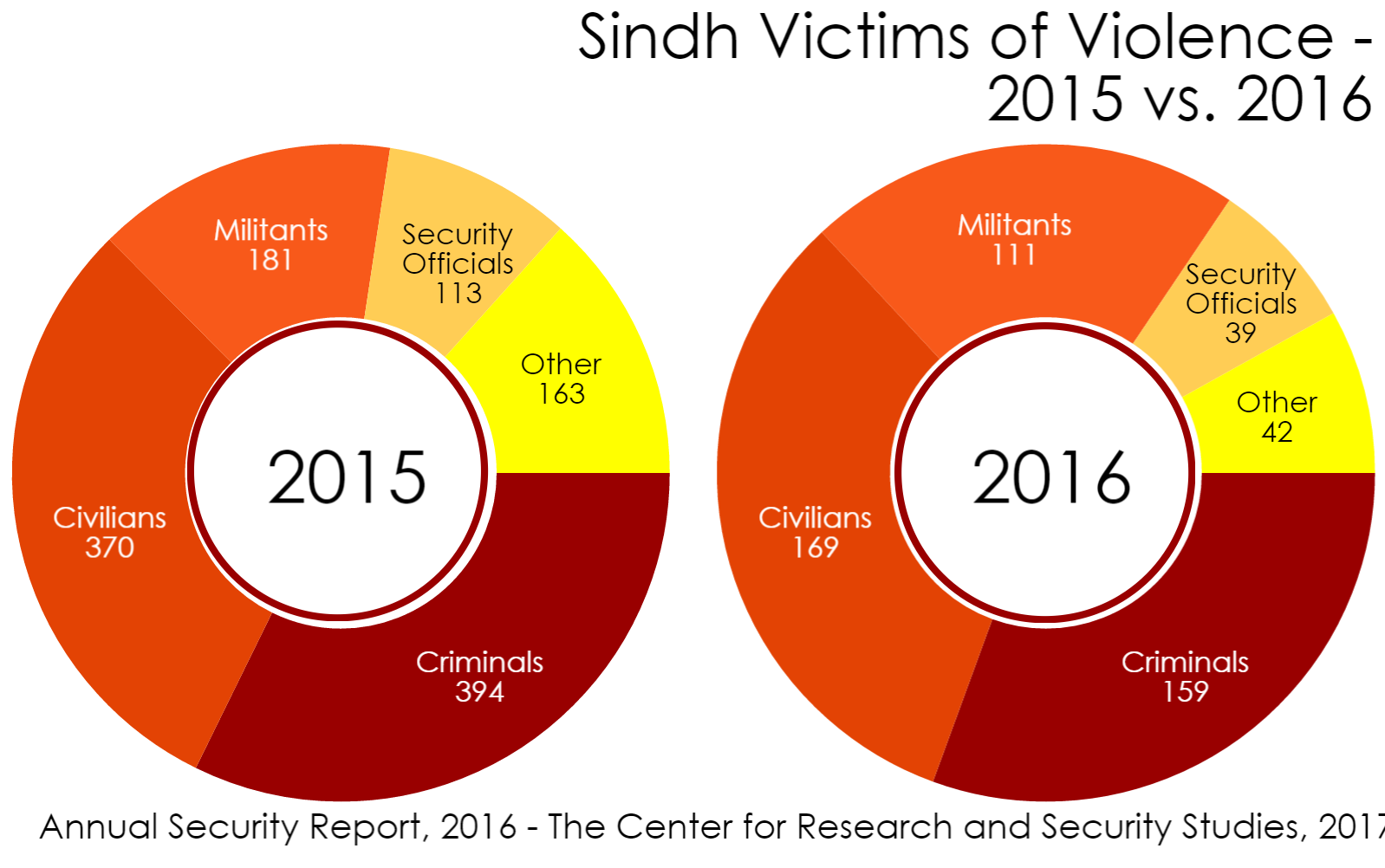
The highest number of fatalities reported in Sindh this year were of the militants and criminals (275), followed by civilians (205) and security officials (40), as depicted in table S3. Of the 39 fatalities of security personnel, 34 were policemen and 5 soldiers. The affiliations of militants, criminals, political party activists, and religious party activists were as follows.
Militants: TTP (40), LeJ/AQIS (16), LeJ (7), AQIS (7), LeJ-NB (4), TTP/AQ (6) TTP-AM (3), IS/Ex-TTP (2), BLA (1), Sipah Sahaba Pakistam (SSP)/ASWJ (1), TTP-J (1), and unknown (1). Criminals: robbers (57), Lyari gangsters (11), Baba Ladla group (10), Uzair Baloch gang (10), Afghan robbers (4) and many others. Religious party activists: ASWJ (6), JI (1), and ST (1). Political party activists: MQM (14), PPP/STP (3), and one each of Muttahids Qaumi Movement – Pakistan (MQM-P), Pak Sarzameen Party (PSP), Sindh Muttahida Mahaz (SMM), PPP, and Jeay Sindh Tehreek (JST).
While the violence against political party activists dropped to half of what was recorded last year, the violence against religious party activists reduced to one third of what was recorded last year. Religious persons and media persons also witnessed a significant drop in fatalities this year.
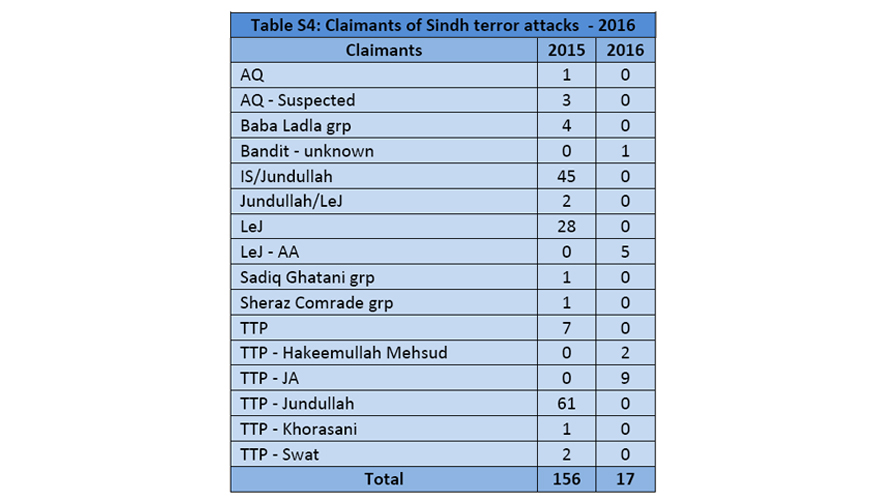
The drop in terror attacks also resulted in drop of claims made by militant outfits in Sindh (table S4). Outmaneuvered by the counter-violence operation of the security forces in Sindh, the militant outfits either failed to retaliate or went into hiding. As opposed to other provinces, the militants in Sindh resorted to target killings instead of using improvised explosives, a kind of tactical change in the face of security alertness. Like other provinces, TTP-JA was the key militant outfit that made most of the claims of violence in Sindh. All of them were incidents of target killing with the exception of two failed suicide attempts in Shikarpur.[74] Another failed attempt of suicide attacks in Hyderabad was not claimed by any militant outfit.[75]
A large number of militants, criminals, and other outlaws were arrested in Sindh during this year (table S5).
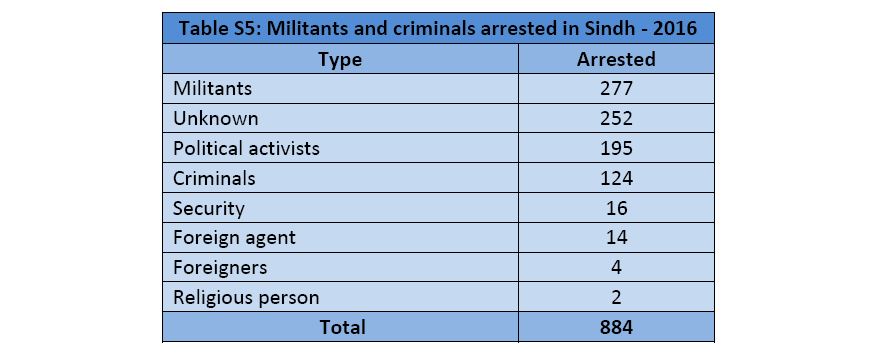
A brief detail about the affiliations of the outlaws that were arrested in 2016 is provided to understand what nature of crimes were committed in Sindh and by whom:
Criminals: As many as 27 suspected outlaws from the vicinity of Shahbaz Airbase in Sukkur were arrested in combing operation in the area. In addition: robbers (18), Lyari gangsters (22), Suspects of Amjad Sabri assassination (8), Wasiullah Lakho gang (8), Aziz Jan Baloch/Baba Ladla gang (4) and others
Militants: LeJ (53), TTP (18), LeJ/AQIS (9), LeJ/AQIS – Ex HuM (9), LeJ/AQIS/SSP (8), TTP-Abid Muchchar grp (8), AQIS (5), Dockyard attackers (5), LeJ-AA (4), AQIS-Hafiz Shahid grp (4), AQIS-Safoora Goth attacker (4), ASWJ (3), AQIS/JeM (3), AQIS-Afghan trained (3), TTP-Sajna grp (3), JSMM/JSQM-B/RAW Agent (2) and many unknown militants.
Foreign Agents/Facilitators: RAW agents (7), foreign trained sectarian killer (5), RAW facilitators (2). Brief details of these agents are:
- Indian agent Safdar Don from the area of Liaquatabad, Karachi[76]
- Saddam Hussain and Bachal Solangi from Thatta[77]
- Anees-ul-Hassan, Bobby, Sohail Bengali and Saleem Baloch, from Karachi[78]
- Three suspected Indian agents including a father and son from Karachi[79]
- Two unidentified terrorists funded by India arrested from Karachi[80]
- Mehmood Siddique and Khalil Behrami from Karachi[81]
Foreign trained sectarian killers: Syed Amir Hussain Rizvi alias Babar alias Irfan, Zainul Abideen alias Sunny, Faizyaab Ali alias Isphan alias Sheraz, Syed Mohsin Hussain alias Talha alias Pagal and Syed Mohammad Abbas alias Ashir alias Hamza[82]
Political activists as outlaws: MQM (88), MQM, UK – Hate crime (4), MQM,UK-Target killer (5), Unidentified political activists (9) and others.
Security personnel: Police as kidnappers (8), police as target killers (4), police cops as encounter suspect (2)[83], police as militants’ informer (1)[84]
Target Killing in Karachi
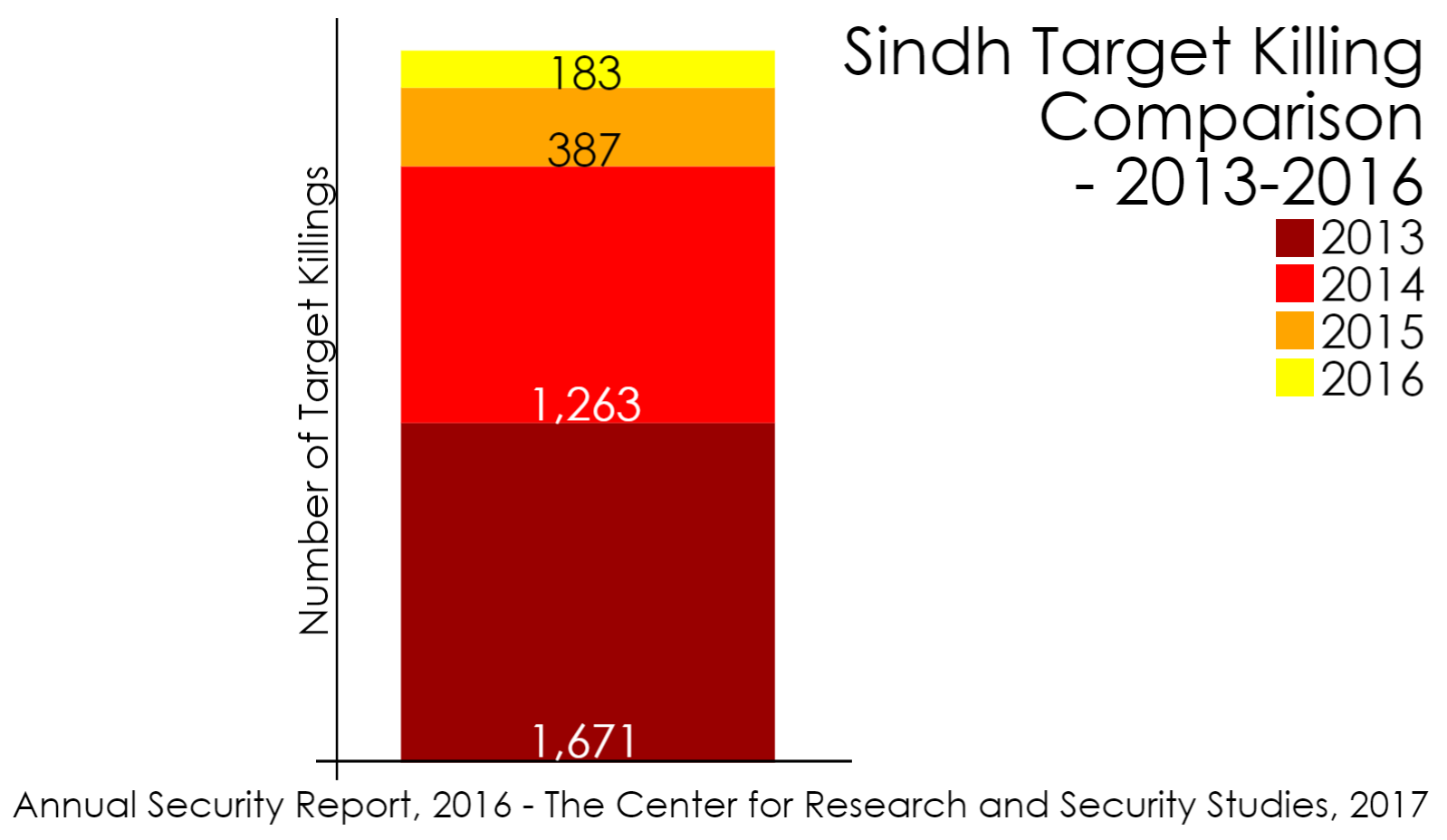
Target killing incidents in Karachi, in the last several years running, made it the most violent district in Pakistan. However, with the security operations pacifying urban crime, that number has dwindled significantly in the last three years, as illustrated in the graph below.
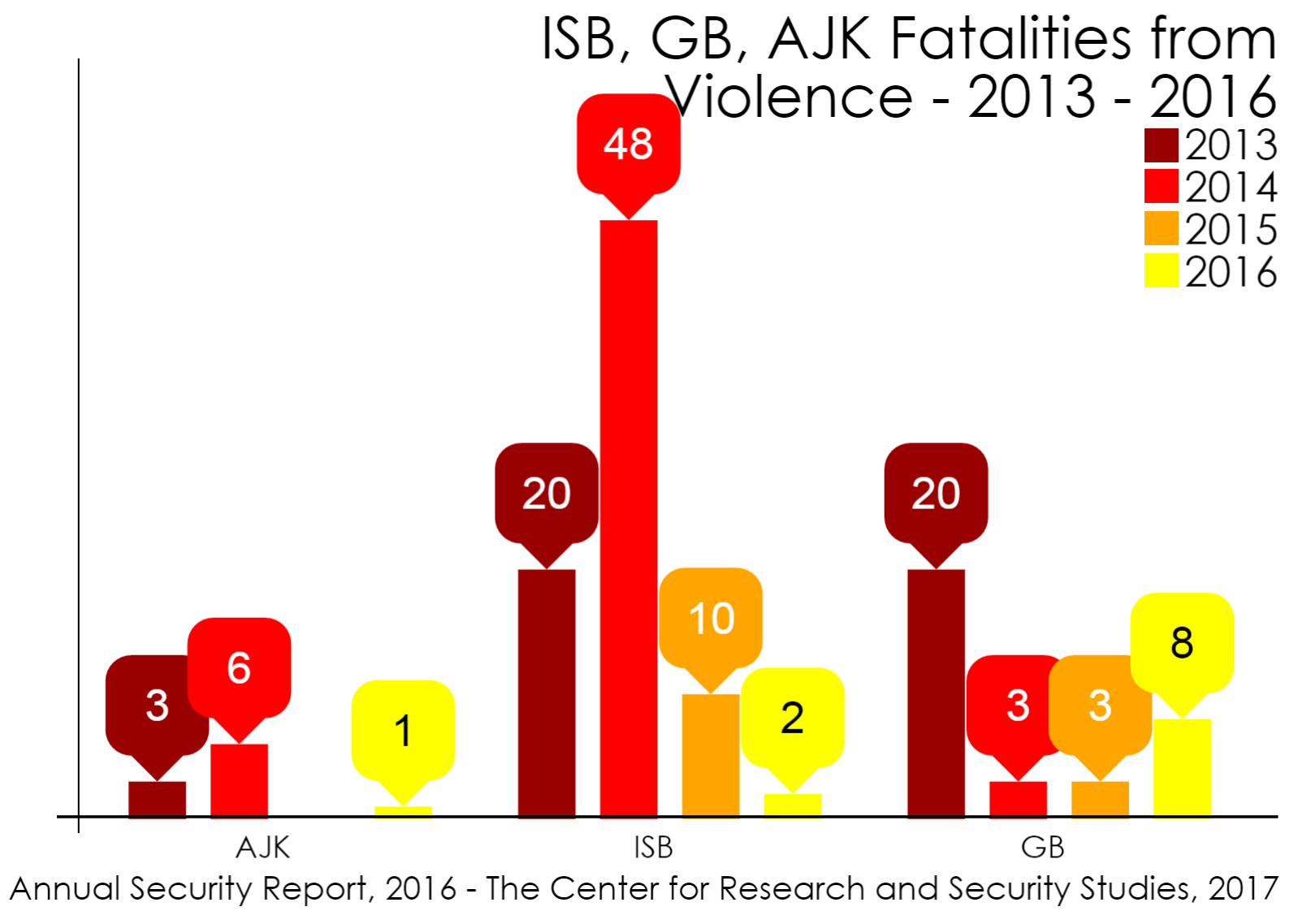
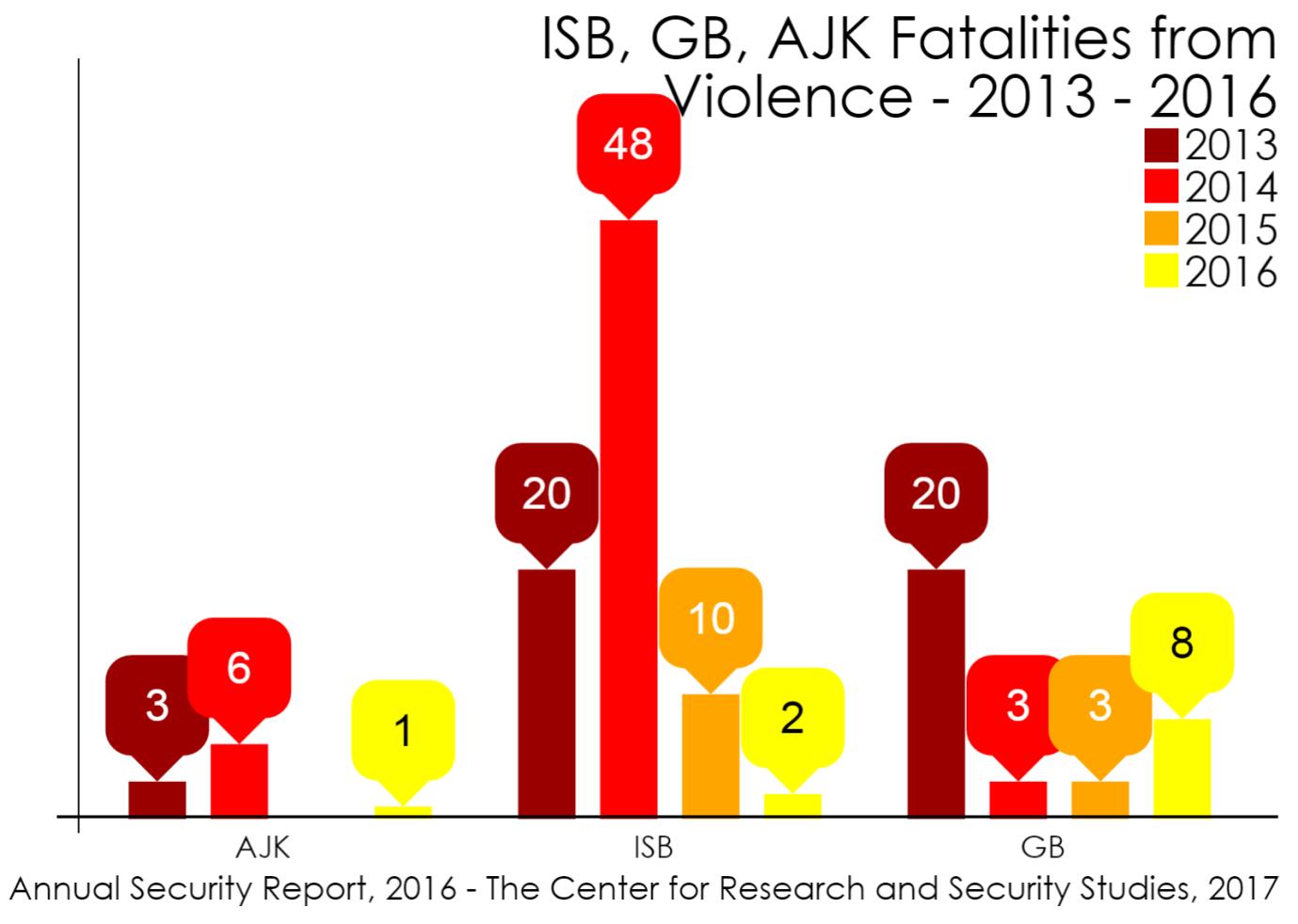
Casualties of Violence in Islamabad, AJK, and GB
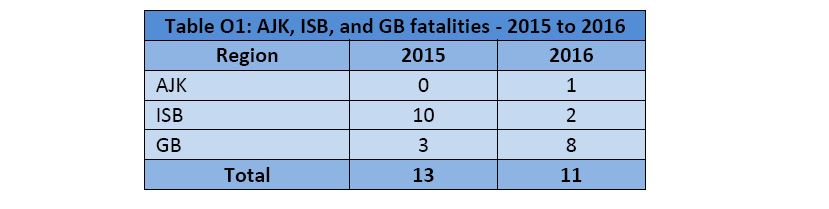
While Islamabad had a significant decline in fatalities from violence in 2016, AJK and GB showed an upward trend in violence (tyable O1). The only fatality from violence in Islamabad (in adjacent area of Murree) resulted when two militants were encountered. One of them, Ehsan Satti, affiliated with IS was killed in a raid carried out by the CTD while the other, Imran Satti, the alleged head of IS operations in the area, managed to escape.[85]
In AJK, political rivalry between PPP and PMLN resulted in leaving one activist dead and 10 injured during an election campaign.[86]
In GB, three militants and two soldiers were killed in a clash between security forces and militants.[87] During this clash, the militant, Hazrat Noor, detonated himself killing himself, his wife, and daughters.
Sectarian Violence in Pakistan
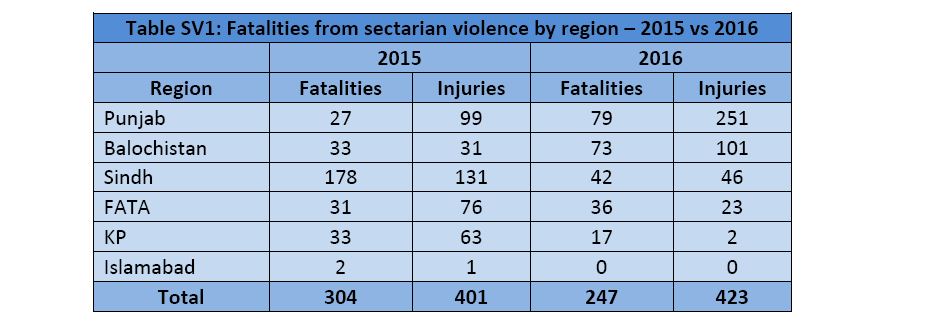
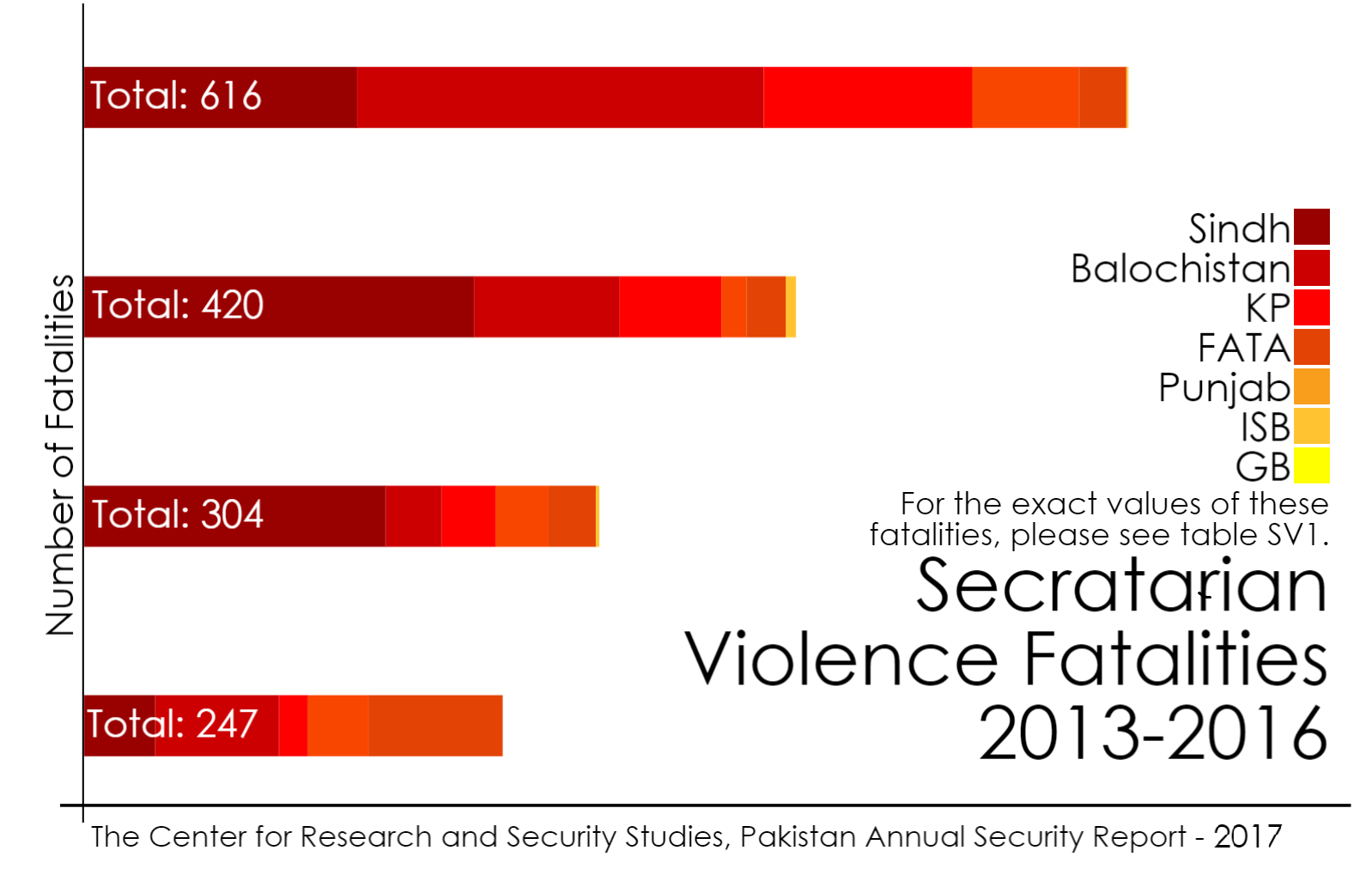
In a year that witnessed 44% drop in all forms of violence throughout the year, sectarian violence recorded a 19% decline – with 247 dead and 423 injured. The number of people injured from sectarian violence went higher than those recorded in 2015 because of the forms of violence used in carrying out such attacks (table SV1). In Punjab, Balochistan, and FATA sectarian violence went up significantly while KP and Sindh recorded a sizeable drop in it.
Five suicide attacks left 170 persons dead and 386 injured while one suicide attempt remained unsuccessful. Targeted killings left 57 persons dead and 17 injured.
Some of the districts that suffered sectarian violence in 2016 had zero occurrence of this crime last year. With the exception of Lahore, all other districts with previous history of sectarian violence recorded a drop in this year (table SV2). The perpetrators, facing resistance from the security forces, changed their strategy and selected places like Shah Noorani shrine in Khuzdar, a mosque in Mohmand Agency, and Iqbal Park in Lahore. Besides the strategy change, the perpetrators also have a vast network of followers ready to take laws into their hands and commit violence.
One of the two suicide bombers arrested in Shikarpur, informed the investigators that he was a resident of Swat’s Qabal tehsil and had studied in Karachi’s Abu Huraira seminary.[88]
On July 28, 2016, a Hindu teenager was killed and another was seriously wounded when armed men opened fire on them in Mirpur Mathelo. According to local people, the fatal attack was part of a backlash against an alleged act of blasphemy committed by a Hindu man in nearby Daharki earlier. Police, however, claimed the motive behind the attack was personal enmity.[89]
On September 2, 2016, a brazen militant attack targeting Peshawar’s Christian Colony was averted by police, FC and Pakistan Army commandos. Four militants and a civilian (Christian) died in this attack[90].
On December 13, 2016, a charged mob of over a thousand civilians besieged an Ahmadi place of worship in Chakwal. Armed with batons and weapons they resorted to throwing stones and firing on the premises. The mob was attempting to seize Ahmadi property. Two persons were found dead at the end of this mob attack.[91]
It must be said, however, that year over year, sectarian violence has reduced consistently in the country.
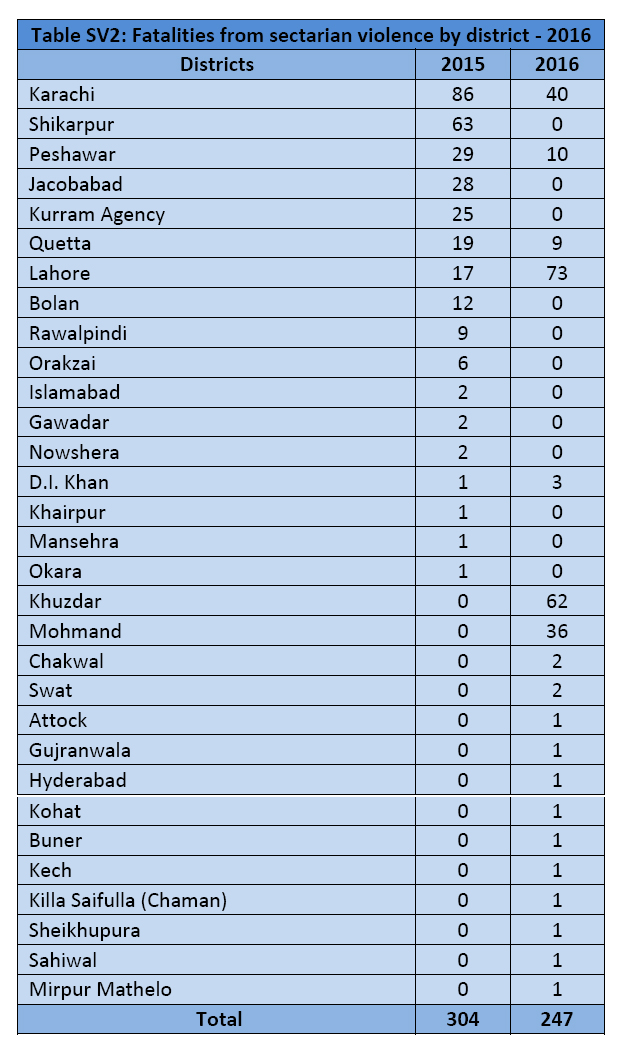
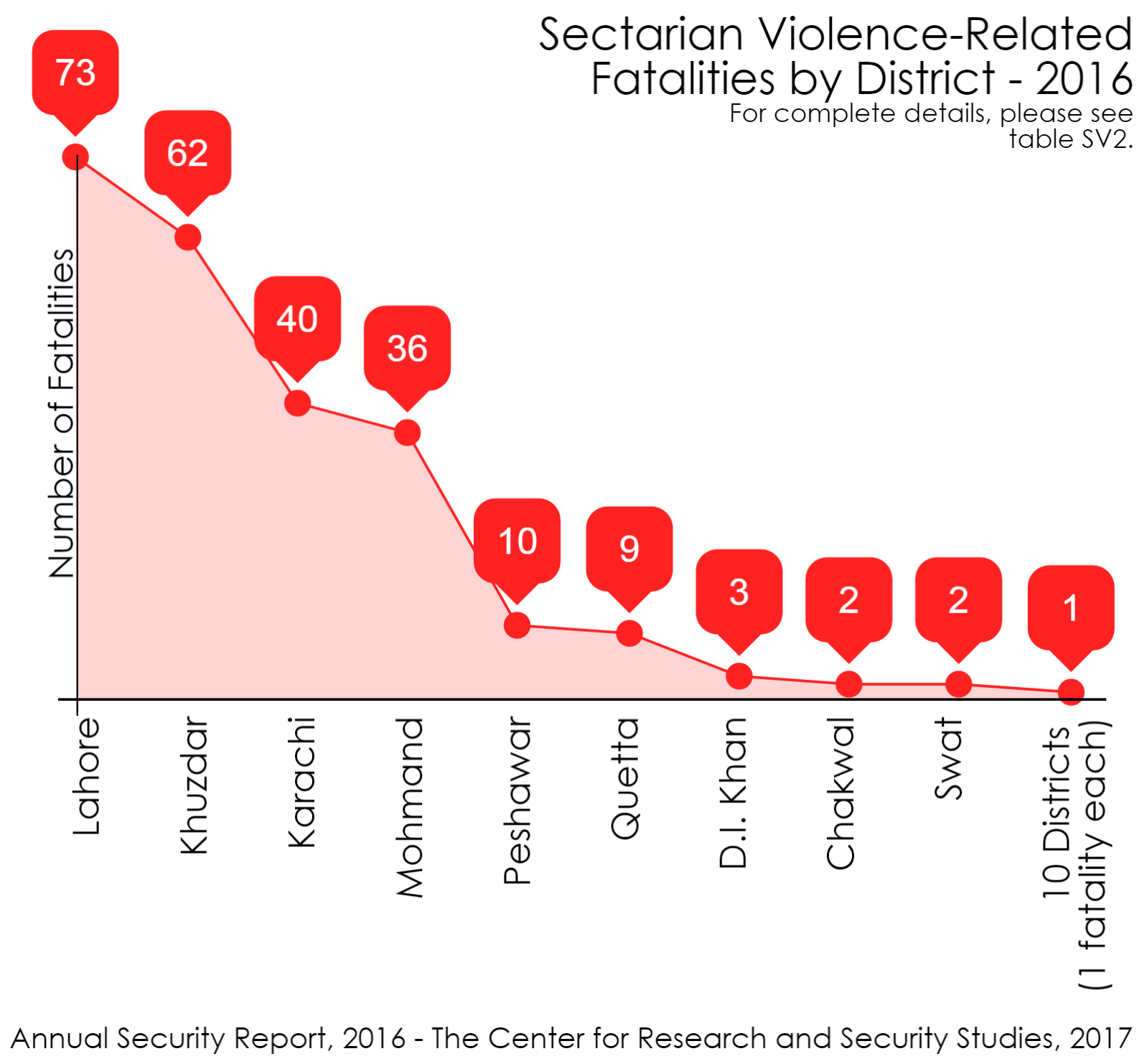
As many as 41 worshipers at different mosques were killed in attacks. Besides damaging a mosque, and two sufi shrines – Syed Rasool Shah shrine in AJK[92] and Shah Noorani shrine in Khuzdar, Balochistan. At least 37 children (29 at Iqbal Park, Lahore and 8 at the mosque in Mohmand Agency) and 4 women from Hazara Shia community lost their lives to sectarian violence.
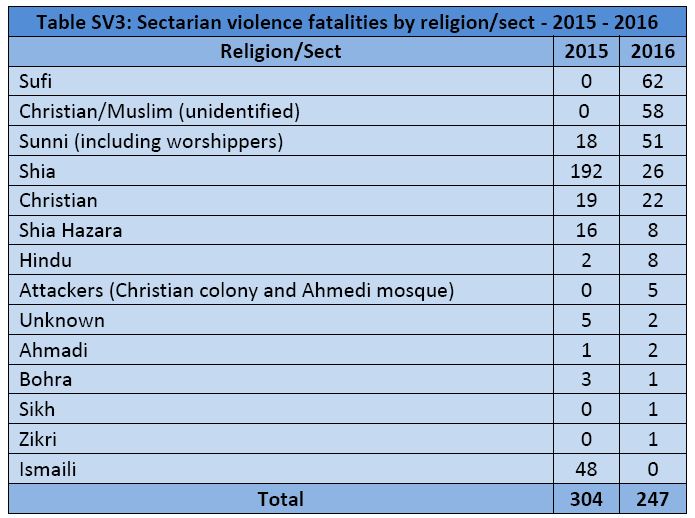
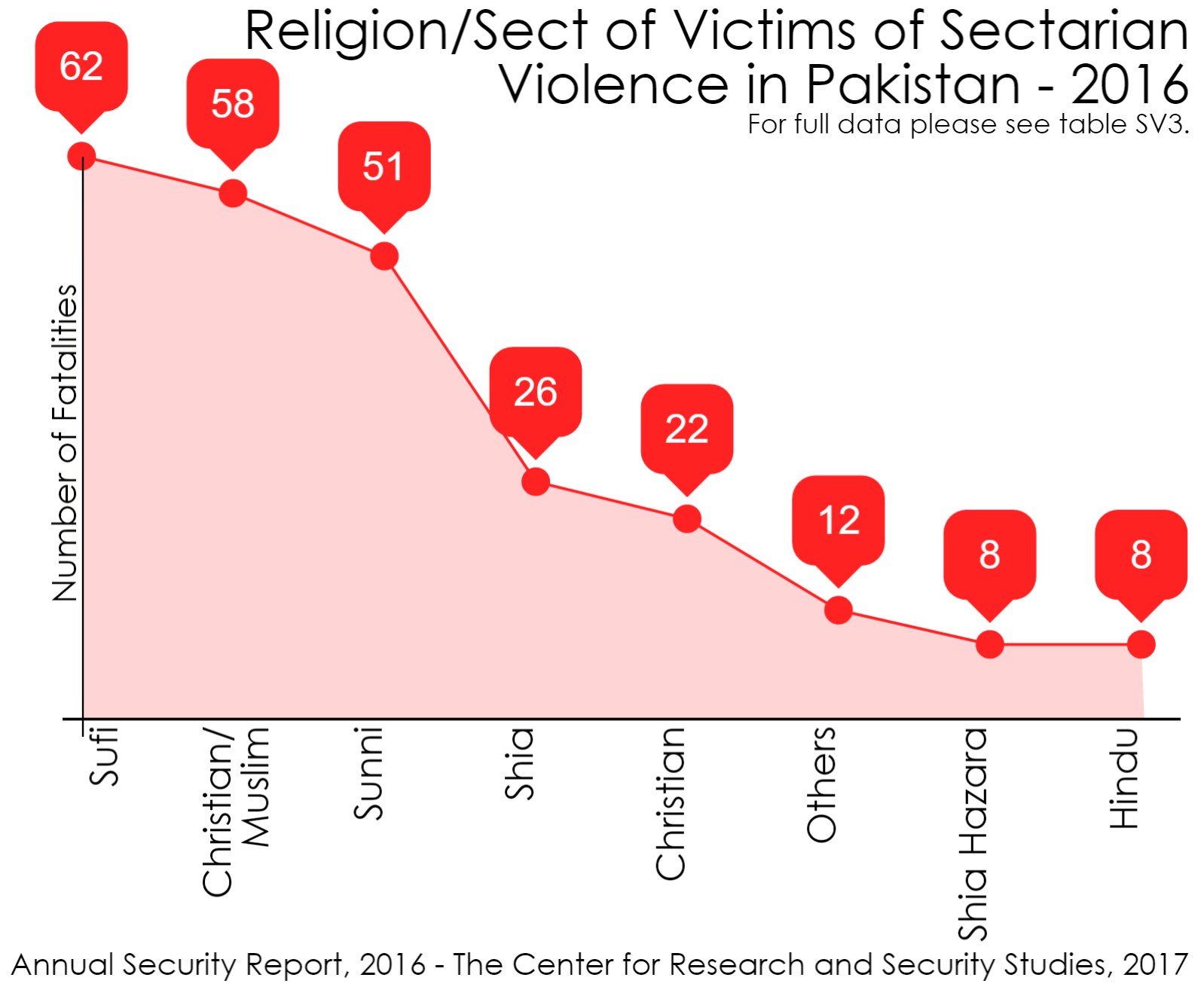
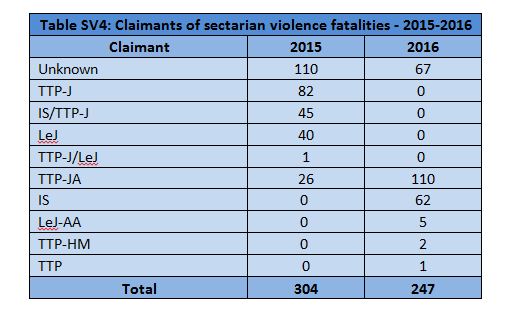
Newly formed militant outfits with no past history of involvement in such attacks such as TTP-JA, IS and LeJ-AA claimed most of the sectarian attacks this year (table SV4).
Conclusion
The year 2016 witnessed a significant decline in violence. The fatalities from violence in 2016 were not only half of the fatalities of last year but significantly lower than the annual average of the fatalities (5,980 per year) recorded during 2013-2015. Overall, this is a 66% decline from 2014. This achievement says a lot about the kinetic implementation of NAP.
Threats, however, still exist and operate. For instance, sectarian violence has seen a major spike, even though the deaths resulting from it have reduced significantly. The menace is far deeper than it is perceived. Although many terror attacks are not categorized as sectarian violence, the motivations arise from mindsets influenced by religious hatred. The surge in attacks on polio team and the attack of a mob in Chakwal at Ahmadi mosque are two examples of this trend.
The persistence of militancy in Balochistan and KP reflected both a rapidly evolving militant strategy and difficult for the law enforcement agencies to adapt to the changes. In Sindh, two suicide attempts were foiled by security guards while in Balochistan and KP, no such attacks could be thwarted by the security forces. In an incident of extreme negligence, 11 ‘hardcore terrorists’ escaped from police custody in Mardan district of Khyber-Pakhtunkhwa.[93]
The strategy change in carrying out suicide attacks was also a big reason for their successes. Instead of sending one suicide bomber at a location, two were sent. The multiple claims of violence by various militant outfits are reflective of similarities in their approach. Considering IS or any other militant outfit as more brutal and barbarous doesn’t carry any weight in view of the crimes they commit.
Balochistan and FATA are the two important regions of the country that continue to manifest extremism and insurgency in the form of armed conflict. Throughout the country nearly 2,068 outlaws were arrested in 2016, some with known identities and groups. Only 14 of them were apprehended in FATA. This raises a serious question about the law enforcement mechanism prevailing in the region. However, 349 militants were killed in that region.
The only change observed so far in government narrative is the downgrading of militants from “disgruntled brothers” to “foreign agents funded by foreign intelligence agencies” especially of India.[94] This narrative may be useful in hunting down the hardcore militants but may not be effective enough to change the mindset that gets common people riled up, and leads to, in some cases, mob attacks. Long-term, softer strategies are needed to combat the root cause of terrorism, extremism itself.
__________________________________________________________________________
[1] Staff Reporter. (2016, January 03). Traced: Missing women left for Syria on their own, says DIG. Retrieved March 06, 2017, from https://tribune.com.pk/story/1021015/traced-missing-women-left-for-syria-on-their-own-says-dig/
[2] Gabol, I. (2016, Jan 04). 42 IS supporters arrested in Punjab: Rana Sanaullah. Retrieved March 06, 2017, from https://www.dawn.com/news/1230719/42-is-supporters-arrested-in-punjab-rana-sanaullah
[3] Staff Reporter. (2016, January 04). Around 100 Pakistanis left for Syria, Iraq to join Da’ish: Punjab law minister. Retrieved March 06, 2017, from http://tribune.com.pk/story/1021663/around-100-pakistanis-left-for-syria-iraq-to-join-IS-punjab-law-minister/
[4] Asghar, M. (2016, January 05). Agencies hunt brothers ‘recruiting for IS’ in Islamabad. Retrieved January 11, 2017, from http://www.dawn.com/news/1230858/agencies-hunt-brothers-recruiting-for-is-in-islamabad
[5] Staff Reporter. (2016, January 04). Around 100 Pakistanis left for Syria, Iraq to join Da’ish: Punjab law minister. Retrieved March 06, 2017, from http://tribune.com.pk/story/1021663/around-100-pakistanis-left-for-syria-iraq-to-join-IS-punjab-law-minister/
[6] Gishkori, Z. (2016, November 21). Over a dozen Pakistanis join Daesh in Syria. Retrieved, January 06, 2017, from https://www.thenews.com.pk/print/166563-Over-a-dozen-Pakistanis-join-Daesh-in-Syria
[7] Schimit, E, et al. (2015, September 26). Thousands Enter Syria to Join ISIS Despite Global Efforts. Retrieved January 06, 2017, from https://www.nytimes.com/2015/09/27/world/middleeast/thousands-enter-syria-to-join-isis-despite-global-efforts.html
[8] https://crss.pk///wp-content/uploads/2010/07/CRSS-Annual-Security-Report-2015.pdf
[9] Staff Reporter. (2016, January 14). 15 killed in suicide attack outside polio centre in Quetta. Retrieved January 11, 2017, from http://www.thenews.com.pk/print/90262-15-killed-in-suicide-attack-outside-polio-centre-in-Quetta#sthash.zT9mXnlx.dpuf
[10] Islam, Shamsul. (2016, January 15). Anti-polio drive: Lawyer beats up polio workers. Retrieved Jnauary 11, 2017, from http://tribune.com.pk/story/1027530/anti-polio-drive-lawyer-beats-up-polio-workers/
[11] Staff Reporter. (2016, August 9). 70 martyred as lawyers targeted in Quetta hospital. Retrieved January 12, 2017, from, https://www.thenews.com.pk/print/141213-70-martyred-as-lawyers-targeted-in-Quetta-hospital
[12] Staff Reporter. (2016, August 11). 13 injured in Quetta blast ‘targeting Shariat Court judge’. Retrieved January 12, 2017, from http://nation.com.pk/national/11-Aug-2016/loud-explosion-heard-in-quetta
[13] Firdous, I, et al. (2016, September 2). At least 14 killed, 52 wounded in suicide blast at Mardan district courts. Retrieved January 13, 2017, from https://tribune.com.pk/story/1174675/twin-blasts-rock-mardan-district-court/
[14] Saifi, Sophia. (2016, January 21). At least 22 killed in attack on Bacha Khan University in Pakistan. Retrieved January 13, 2017, from http://edition.cnn.com/2016/01/20/asia/pakistan-university-militant-attack/
[15] Mohmand Mureeb et al. (2016, January 20). Breakthrough achieved in identifying Charsadda attackers: DG ISPR. Retrieved January 12, 2017, from, http://tribune.com.pk/story/1030820/gunfire-heard-at-bacha-khan-university-in-charsadda/
[16] Staff Reporter. (2016, April 25). PTI MPA killed over political rivalry, TTP claim false: KP police. Retrieved January 13, 2017, from https://www.dawn.com/news/1254324
[17] Staff Reporter. (2016, January 26). No casualties: Hand grenade attack at Balochistan minister’s house. Retrieved January 17, 2017, from https://tribune.com.pk/story/1034705/no-casualties-hand-grenade-attack-at-balochistan-ministers-house/
[18] Zafar, M. (2016, October 24). 61 killed, at least 165 injured as militants storm police training centre in Quetta. Retrieved January 13, 2017, from, http://tribune.com.pk/story/1208735/militants-attack-police-training-centre-quetta/
[19] Shah, S. A. (2016, October 25). 61 killed in twin suicide attacks as terrorists storm police training college in Quetta. Retrieved January 15, 2017, from http://www.dawn.com/news/1291999/59-killed-in-twin-suicide-attacks-as-terrorists-storm-police-training-college-in-quetta
[20] Khan, M. H. (2016, September 14). At least 13 injured as police foil suicide blasts targeting Eid prayers in Shikarpur. Retrieved January 28, 2017, from http://www.dawn.com/news/1283861/at-least-13-injured-as-police-foil-suicide-blasts-targeting-eid-prayers-in-shikarpur
[21] Khan, J. A, et al. 13 killed, 52 injured in Mardan court suicide hit. Retrieved January 15, 2017, from https://www.thenews.com.pk/print/147460-13-killed-52-injured-in-Mardan-court-suicide-hit
[22] Khan, J. A. (2016, October). BDU expert escapes unhurt as IED goes off. Retrieved January 16, 2017, from https://www.thenews.com.pk/print/160007-BDU-expert-escapes-unhurt-as-IED-goes-off
[23] Ali, A. (2016, May 18). http://www.dawn.com/news/1259112/one-killed-17-injured-in-peshawar-blasts. Retrieved January 16, 2017, from http://www.dawn.com/news/1259112/one-killed-17-injured-in-peshawar-blasts
[24] Staff Reporter. (2014, November 11). No presence of IS militants in Pakistan, says interior minister. Retrieved January 17, 2017, from http://tribune.com.pk/story/789166/no-presence-of-is-militants-in-pakistan-nisar/
[25] Staff Reporter. (2014, November 11). No presence of IS militants in Pakistan, says interior minister. Retrieved January 17, 2017, from http://www.thenews.com.pk/print/100193-Robber-killed-in-encounter
[26] Staff Reporter. (2016, April 14). Briefs. Retrieved January 17, 2017, from http://www.thenews.com.pk/print/112582-Briefs
[27] Baluch , Z. (2016, April 16). Afghan intelligence agent arrested in Balochistan. Retrieved January 17, 2017, from http://tribune.com.pk/story/1079579/afghan-intelligence-agent-arrested-in-balochistan/
[28] Target killings include hit and run attacks using firearms by unidentified assailants, as well as bodies discovered after being killed and dumped.
[29] Militant attacks include suicide attacks, armed attacks, hand grenade attacks, and indiscriminate firing.
[30] Terrorism includes attacks via bombs, IEDs, and landmines
[31] Syed, S, B. (2016, May 23). US strike crosses ‘red line’ on Balochistan. Retrieved January 18, 2017, from, https://www.dawn.com/news/1260044
[32] Shah, S, A. (2016, May 26). Two charred bodies found near Pak-Afghan border in Balochistan . Retrieved January 18, 2017, from http://www.dawn.com/news/1259976/two-charred-bodies-found-near-pak-afghan-border-in-balochistan
[33] Khan, T. (2016, January 08). Afghan Taliban claim senior commander assassinated in Balochistan. Retrieved January 18, 2017, from http://tribune.com.pk/story/1024025/afghan-taliban-claim-senior-commander-assassinated-in-balochistan/
[34] Mohammad, Z. (2016, January 26). Four militants killed in Balochistan search operation. Retrieved January 19, 2017, from http://tribune.com.pk/story/1034387/four-militants-killed-in-balochistan-search-operation/
[35] Staff Repoter. (2016, October 11). Taliban leader Akhundzada taught, preached in Pakistan. Retrieved January 19, 2017, from https://www.thenews.com.pk/print/156554-Taliban-leader-Akhundzada-taught-preached-in-Pakistan
[36] Staff Reporter. (2016, August 9). 70 martyred as lawyers targeted in Quetta hospital. Retrieved January 12, 2017, from, https://www.thenews.com.pk/print/141213-70-martyred-as-lawyers-targeted-in-Quetta-hospital
[37] Bhatti, W, M. (2016, November 13). 62 killed, 100 injured in Khuzdar suicide blast. Retrieved January 19, 2017, from https://www.thenews.com.pk/print/164577-62-killed-100-injured-in-Khuzdar-suicide-blast
[38] Mohammad, Z. (2016, October 24). 61 killed, at least 165 injured as militants storm police training centre in Quetta
. Retrieved January 19, 2017, from http://tribune.com.pk/story/1208735/militants-attack-police-training-centre-quetta/
[39] Sha, S, A. (2016, August 11). BDS official dies while defusing landmine in Naseerabad district. Retrieved January 20, 2017, from http://www.dawn.com/news/1278163/bds-official-dies-while-defusing-landmine-in-naseerabad-district
[40] Staff Reporter. (2016, March 28). 13 more cohorts of RAW agent arrested. Retrieved January 14, 2017, from http://www.thenews.com.pk/print/108536-13-more-cohorts-of-RAW-agent-arrested
[41] Shah, S, A. (2016, March 10). 14 ‘Afghan Taliban’ militants arrested from Quetta. Retrieved January 19, 2017, from http://www.dawn.com/news/1244774/14-afghan-taliban-militants-arrested-from-quetta
[42] http://omnifeed.com/article/tribune.com.pk/story/1074666/crackdown-11-uzbeks-suspected-militant-held-in-quetta/
[43] Shahid, Saleem. (2016, July 14). Afghan spy, five militants arrested. Retrieved January 15, 2017, from http://www.dawn.com/news/1270708
[44] Zafar, M. (2016, May 25). Additional DC apprehended for verifying Muhammad Wali’s CNIC. Retrieved January 15, 2017, from http://tribune.com.pk/story/1110290/additional-dc-apprehended-verifying-muhammad-walis-cnic/
[45] Zafar, M. (2016, June 03). Slain Taliban chief’s facilitator held. Retrieved January 15, 2017, from http://tribune.com.pk/story/1115372/slain-taliban-chiefs-facilitator-held/
[46] Khan, I. A. (2016, May 29). Two more booked for helping Mansour get identity papers. Retrieved January 16, 2017, from
http://www.dawn.com/news/1261319/two-more-booked-for-helping-mansour-get-identity-papers
[47] Shah, A. S. (2016, August 30). FIA arrests tribal elder in connection with Mullah Mansour’s NIC. Retrieved January 16, 2017, from http://www.dawn.com/news/1280962/fia-arrests-tribal-elder-in-connection-with-mullah-mansours-nic
[48] Ali, A. (2016, September 16). At least 24 killed in suicide blast at Mohmand Agency mosque during Friday prayers. Retrieved January 23, 2017, from https://www.dawn.com/news/1284121
[49] Staff Reporter. (2016, January 10). Unmanned war: 29 killed as US steps up drone strikes. Retrieved Janury 17, 2017, from http://tribune.com.pk/story/1024969/unmanned-war-29-killed-as-us-steps-up-drone-strikes/
[50] Akbar, A. (2016, February 22). Drone strike in Lower Kurram Agency wounds one suspected militant. Retrieved Januru 17, 2017, from http://www.dawn.com/news/1241154/drone-strike-in-lower-kurram-agency-wounds-one-suspected-militant
[51] Staff Reporter. (2016, September 02). Terrorist attack foiled in Christian Colony Peshawar, 4 suicide bombers killed. Retrieved January 18, 2017, from https://www.thenews.com.pk/latest/147215-1-person-dead-2-security-officials-injured-in-Khyber-Agency-attack
[52] Staff Reporter. (2016, August 03). Five militants killed in clash with security officers in Chitral. Retrieved January 23, 2107, from http://dunyanews.tv/en/Pakistan/347565-Five-militants-killed-in-clash-with-security-offic
[53] Staff Reporter. (2016, July 30). Afghanistan-based militants slaughter two Kalash shepherds in Chitral . Retrieved January 24, 2017, from https://www.thenews.com.pk/print/138837-Afghanistan-based-militants-slaughter-two-Kalash-shepherds-in-Chitral
[54] Khan, J. A. (2016, May 21). Two suicide bombers, among three killed in Peshawar. Retrieved January 17, 2017, from http://www.thenews.com.pk/print/121598-Two-suicide-bombers-among-three-killed-in-Peshawar
[55] Akbar, A. (2016, January 15). 60 suspected IS supporters arrested in KP. Retrieved Janury 18, 2017, from http://www.dawn.com/news/1233159/60-suspected-is-supporters-arrested-in-kp
[56] Staff Reporter. (2016, September 22). Target killer of 32 people arrested in Peshawar . Retrieved January 24, 2017, from https://www.thenews.com.pk/print/151718-Target-killer-of-32-people-arrested-in-Peshawar
[57] Akbar, A. (2016, April 26). Facilitator of Afghan Daesh commander arrested from Peshawar: police . Retrieved January 25, 2017, from http://www.dawn.com/news/1254537/facilitator-of-afghan-daesh-commander-arrested-from-peshawar-police
[58] Staff Reporter. (2016, January 27). Two arrested facilitators of BKU attack hail from Mardan. Retrieved January 18, 2017, from http://www.thenews.com.pk/print/94153-Two-arrested-facilitators-of-BKU-attack-hail-from-Mardan#sthash.R9tlMglP.dpuf
[59] Staff Reporter. (2016, January 31). Two Afghans held in Charsadda. Retrieved Jnaury 18, 2017, from http://www.thenews.com.pk/print/94989-Two-Afghans-held-in-Charsadda#sthash.WDUmA8F1.dpuf
[60] Staff Reporter. (2016, February 03). Main facilitator of BKU attack arrested. Retrieved January 18,, 2017, from http://www.dawn.com/news/1237113/main-facilitator-of-bku-attack-arrested
[61] Staff Reporter. (2016, February 05). BKU attack facilitator’s wife arrested. Retrieved Janury 18, 2017, from http://www.thenews.com.pk/print/96222-BKU-attack-facilitators-wife-arrested#sthash.SjKtvQns.dpuf
[62] Staff Reporter. (2016, June 24). Briefs. Retrieved Janury 18, 2017, from http://www.thenews.com.pk/print/130330-Briefs
[63] Chaudhry, A. (2016, April 24). 25 cops go missing after clashes with Rajanpur gangsters. Retrieved January 18, 2017, from http://www.dawn.com/news/1252016/25-cops-go-missing-after-clashes-with-rajanpur-gangsters
[64] Staff Reporter. (2016, April 16). 40 Chotu gang members surrender as Pak Army takes control. Retrieved Jnaury 18, 2017, from http://dunyanews.tv/en/Pakistan/332426-40-Chotu-gang-members-surrender-as-Pak-Army-takes-
[65] [Excerpt] …… South Punjab with a history of having provided foot soldiers to sectarian outfits since 1990 had been offering a promising opportunity for al-Qaeda, TTP and now for Islamic State to strengthen its network in the region, many analysts believe. Gishkori, Z. (2016, June 20). LeJ’s entire leadership eliminated in Punjab. Retrieved January 18, 2017, from http://www.thenews.com.pk/print/129252-LeJs-entire-leadership-eliminated-in-Punjab
[66] Staff Reporter. (2016, August 14). Two hardcore terrorists among 11 suspects arrested. Retrieved January 19, 2017, from https://www.thenews.com.pk/latest/142260-Two-hardcore-terrorists-among-11-suspects-arrested
[67] Staff Reporter. (2016, April 12). Two alleged members of Lahore park blast attacker’s network arrested in Jaranwala. Retrieved January 19, 2017, from http://dunyanews.tv/en/Pakistan/331898-Two-alleged-members-of-Lahore-park-blast-attacker
[68] Staff Reporter. (2016, April 26). Lahore: 15 suspects arrested in search operation in Iqbal Town. Retrieved January 19, 2017, from http://dunyanews.tv/en/Pakistan/333931-Lahore-15-suspects-arrested-in-search-operation-i
[69] Staff Reporter. (2016, October 10). Cops booked for killing Rangers cadet in fake encounter. Retrieved January 26. 2017, from https://www.thenews.com.pk/print/156110-Cops-booked-for-killing-Rangers-cadet-in-fake-encounter
[70] Staff Reporter. (2016, November 03). Police ‘justice’: Three suspects killed in encounter. Retrieved January 21, 2017, from http://tribune.com.pk/story/1218922/police-justice-three-suspects-killed-encounter/
[71] Staff Reporter. (2016, December 11). Nationalist Zakir Bozdar found dead. Retrieved January 22, 2017, from http://tribune.com.pk/story/1259618/nationalist-zakir-bozdar-found-dead/
[72] Staff Reporter. (2016, September 17). Cop injured in Shikarpur suicide attack dies. Retrieved January 22, 2017, from https://www.thenews.com.pk/print/150579-Cop-injured-in-Shikarpur-suicide-attack-dies
[73] Staff Reporter. (2016, December 17). Terror bid thwarted: Would-be suicide bomber slain in Hyderabad. Retrieved January 23, 2017, from http://tribune.com.pk/story/1265855/terror-bid-thwarted-suicide-bomber-slain-hyderabad/
[74] Memon, S. (2016, September 13). Eid day attack injures 10 in Shikarpur Imambargah. Retrieved January 26, 2017, from http://tribune.com.pk/story/1181600/several-feared-injured-blast-eidul-azha-prayers-shikarpur-imambargah/
[75] Staff Reporter. (2016, December 17). Terror bid thwarted: Would-be suicide bomber slain in Hyderabad. Retrieved January 23, 2017, from http://tribune.com.pk/story/1265855/terror-bid-thwarted-suicide-bomber-slain-hyderabad/
[76] Staff Reporter, (2016, March 29). CTD arrests RAW agent, recovers weaponry. Retrieved January 23, 2017, from http://dunyanews.tv/en/Pakistan/329832-CTD-arrests-RAW-agent-recovers-weaponry
[77] Staff Reporter. (2016, April 19). Apprehended RAW agents reveal communication codes. Retrieved January 24, 2017, from http://dunyanews.tv/en/Pakistan/332902-Apprehended-RAW-agents-reveal-communication-codes
[78] taff Reporter. (2016, July, 06). RAW yet again found involved in spreading terrorism in Karachi. Retrieved January 24, 2017, from http://dunyanews.tv/en/Pakistan/344072-RAW-yet-again-found-involved-in-spreading-terroris
[79] Staff Reporter. (2016, August 31). And yet another RAW network detected in Karachi. Retrieved January 24, 2017, from http://dunyanews.tv/en/Pakistan/351565-And-yet-another-RAW-network-detected-in-Karachi
[80] Staff Reporter. (2016, October 14). Two India-sponsored terrorists nabbed in Karachi, more arrests likely. Retrieved January 25, 2017, from http://dunyanews.tv/en/Pakistan/356829-Two-Indiasponsored-terrorists-nabbed-in-Karachi-
[81] Staff Reporter. (2016, April 30). Two RAW facilitators exposed in Pakistan. Retrieved January 26, 2017, from http://dunyanews.tv/en/Pakistan/334603-Two-RAW-facilitators-exposed-in-Pakistan
[82] Pervez, S. (2016, September 06). Five hitmen involved in sectarian killings arrested. Retrieved Janury 25, 2017, from https://www.thenews.com.pk/print/148036-Five-hitmen-involved-in-sectarian-killings-arrested
[83] Staff Reporter. (2016, October 10). Cops booked for killing Rangers cadet in fake encounter. Retrieved January 26. 2017, from https://www.thenews.com.pk/print/156110-Cops-booked-for-killing-Rangers-cadet-in-fake-encounter
[84] Ali, I. (2016, December 09). Special Branch officer held for ‘facilitating’ militants, says Sindh Police. Retrieved January 27, 2017, from http://www.dawn.com/news/1301442/special-branch-officer-held-for-facilitating-militants-says-sindh-police
[85] Staff Reporter. (2016, November). Daesh terrorists killed in CTD raid. Retrieved January 27, 2017, from https://www.thenews.com.pk/print/166101-Daesh-terrorists-killed-in-CTD-raid
[86] Staff Reporter. (2016, February 14). PPP, PML-N activists clash in Azad Kashmir. Retrieved January 27, from http://www.thenews.com.pk/print/98244-PPP-PML-N-activists-clash-in-Azad-Kashmir
[87] Staff Reporter. (2016, March 17). Security forces kill eight terrorists in Gilgit-Baltistan, Khyber Agency. Retrieved January 27, 2017, from http://dunyanews.tv/en/Pakistan/328050-Security-forces-kill-eight-terrorists-in-GilgitBa
[88] Khan, M. H. (2016, September 14). At least 13 injured as police foil suicide blasts targeting Eid prayers in Shikarpur. Retrieved January 28, 2017, from http://www.dawn.com/news/1283861/at-least-13-injured-as-police-foil-suicide-blasts-targeting-eid-prayers-in-shikarpur
[89] Ali, A. (2016, September 02). Attack on Peshawar’s Christian Colony: Civilian killed, all terrorists’ dead. Retrieved January 28, 2017, from http://www.dawn.com/news/1281557
http://tribune.com.pk/story/1150849/blasphemy-backlash-hindu-teenager-killed-mirpur-mathelo/
[90] Ali, A. (2016, September 02). Attack on Peshawar’s Christian Colony: Civilian killed, all terrorists’ dead. Retrieved January 28, 2017, from http://www.dawn.com/news/1281557
http://tribune.com.pk/story/1150849/blasphemy-backlash-hindu-teenager-killed-mirpur-mathelo/
[91] Gabol, I. (2016, December 13). Mob ‘besieging’ Ahmadi place of worship in Chakwal dispersed by police. Retrieved January 29, 2017, from http://www.dawn.com/news/1302057
[92] Staff Reporter. (2016, March 15). Briefs. Retrieved January 29, 2017, from http://www.thenews.com.pk/print/105418-Briefs
[93] Muhammadzai, U. (2016, August 18). Top al Qaeda facilitators in custody since Zarb-e-Azb launch. Retrieved January 29, 2017, from http://tribune.com.pk/story/1164987/revealed-top-al-qaeda-facilitators-custody/
[94] Staff Reporter. (2016, November 04). Indian diplomats have contacts with Taliban: FO. Retrieved January 29, 2017, from https://www.thenews.com.pk/print/162313-Indian-diplomats-have-contacts-with-Taliban-FO