



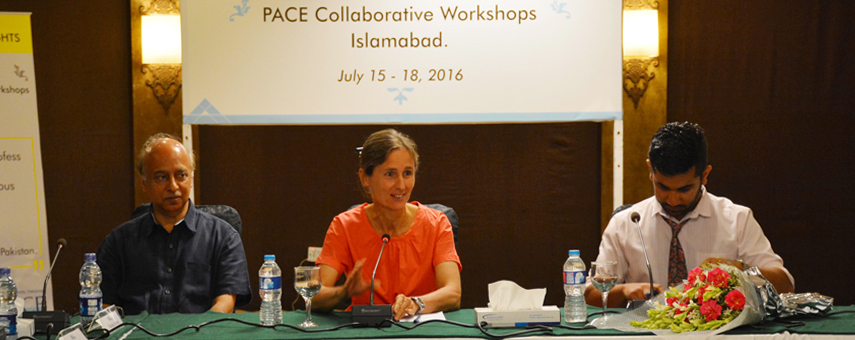
As children, we were always encouraged in our school to ask why, to speak out about things that agonized us. We were also provided with responses and grievance redress. This is crucial for critical thinking, which leads to nation and peace building.
These remarks were made by Her Excellency Ambassador Ms. Jeannette Seppen of The Netherlands, during the closing ceremony of Pakistan Center of Excellence’s (PACE) fifth round of collaborative workshops; a four day residential training program between July 15 and 18, 2016. She added that Europe suffered greatly because there was not enough critical thinking in its history. Despite being one of the most highly educated parts of the world, people followed a doctrine of divisiveness without thought during WWII. She said that the Dutch government is proud to be able to host events like PACE, as they encourage critical thinking and discourse. “It is better to allow all these diverse colors to blend, to blossom, than having one singular, bland color,” she concluded.

PACE is a major CVE initiative launched by the Center for Research and Security Studies (CRSS) – with the support from the government of Netherlands – to promote democratic values, respect for diversity, fundamental human rights and virtues of tolerance as a measure of ensuring social peace and harmony for peaceful co-existence. It aims to facilitate a socio-political discourse – the Alternate Narrative on democratic rights and responsibilities anchored in the globally accepted and practiced concepts. These concepts include adherence to the rule of law, equal citizenry, secular governance as a primary condition for social cohesion, and tolerance within the society at all levels.
The resource persons and public intellectuals who interacted with the participating university lecturers and professors from different universities across Pakistan included Muhammad Jibran Nasir, Professor Saeed Minhas, Dr. Khalid Zaheer, Dr. Shoaib Suddle, Ms. Gulmina Bilal, Mr. Safiullah Gul, and Mr. Charles Petrie. The discussion themes we primarily rule of law, tolerance, respect for diversity, fundamental human rights, equal citizenry, democracy and governance, and perhaps most importantly, the importance of questioning the narratives that are presented before us.
Participants lauded the collaborative workshops. Pervaiz Khan from Kohat University of Science & Technology said that these workshops are extremely beneficial and they give him a renewed sense of purpose. “We are leaving with this positive energy, to try harder, to do better, and to build a better future for our children.”
Imtiaz Gul, Executive Director, CRSS, spoke about the importance of nation building and national cohesion, referring particularly to The Netherlands as an example Pakistan can learn from. He also stressed the importance women can play in the social fabric of society and how they can aid in bringing about social harmony.