



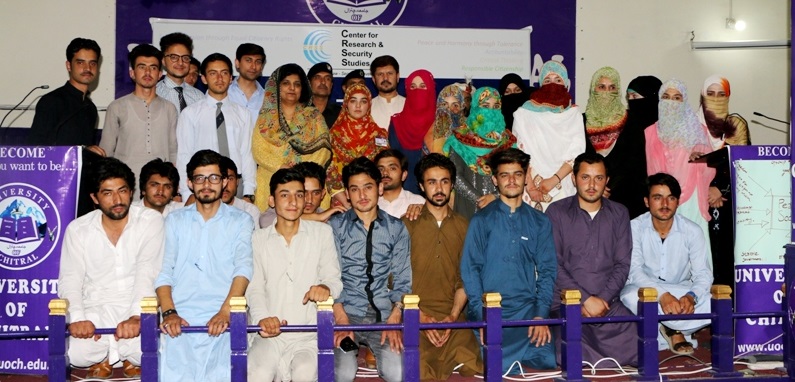
The eighth round of Ulasi Taroon Youth Capacity Building Workshops was held at University of Chitral, to exchange knowledge and information on social cohesion and cultivate the future leaders in the constitutional values critical to social peace and harmony. The event was organized by the Center for Research and Security Studies (CRSS) from July 19-20, 2018.
Mr. Noor Jamal, Superintendent of Police (SP) Operations, Chitral said that the workshops like Ulasi Taroon help youth to unleash their full potential and channelize their talents and energies into peaceful conflict resolution. Rule of law means equality – i.e. every individual in the society is important – and indiscriminate application of law; equally applicable and accessible on and to everyone regardless of their background. Rule of law is conducive to peace, socio-political and economic progress, democratic development, employment opportunities, foreign investment, equality and across the board accountability. The efforts to strengthen rule of law in Khyber Pakhtunkhwa (KP) are manifested in the massive reformation that the KP police had gone through over the last few years with several public service initiatives – aimed to ameliorate the public-police trust deficit – at the core. The linkages between the public and police are extremely crucial to counter-extremism and foster rule of law. The youth must be educated on their rights and responsibilities enshrined in the constitution to uphold rule of law, besides, the media should also create awareness among the masses on the criticality of adherence to rule of law.
Dr. Zia-ul-Haq, Director (Academic), University of Chitral, said that the idea to prepare youth for the future challenges is deeply rooted within the policy of University of Chitral. This is achieved by involving the students in different academic and co-curricular activities to develop their critical thinking and problem solving skills. He urged the participating students to master the skill of thought management as it is critical for clear vision and success in life.
While speaking on Human Rights, Mrs. Shagufta Khalique, an educationist, said that the principles of human rights are the standards that allow individuals to live with dignity in peace and equitably. They are guaranteed as indivisible and inalienable to everyone, without discrimination of caste, gender and faith. The Universal Declaration of Human Rights (UDHR) actually sets down the basic guidelines for the states to ensure and incorporate fundamental human rights in their respective constitutions. Violation of one human right leads to violation of other rights, triggering a chain of violations. That is why peace and social cohesion are directly proportional to the level of access to law /services and legal protection of individuals.
She said that diversity is a mosaic, wherein each fragment as an individual entity adds to its beauty. Diversity in Pakistan and its acceptance matters if we are dreaming of a cohesive society, wherein gender, faith, caste and cultural norms enjoy universal respect. Cross-cultural interaction in this regard is critical and leads to greater gelling of individuals belonging to different faiths, cast or ethnicity. It also evokes greater understanding as each culture and faith is unique in its own right. Greater understanding also can result in greater social cohesion, bound of by socio-cultural commonalities and accepting the differences with tolerance. She further added that the core value of equality – enshrined in the Article 25 of the constitution – leads you to believe in the equality of human beings, which is an essential ingredient for a cohesive society.
“Though we know democracy as a form of government, yet we have to understand that it is a behavior. And the essentials of a democratic behavior are of course the understanding and acceptance of human rights, diversity and tolerance. That is why the youth must recognize that democracy is about the conduct of individuals, and that it is the prerequisite for an inclusive governance. Also for Pakistan, this remains the only choice i.e. accountable and transparent system of governance,” she spoke on Democracy, Governance and Accountability.
Discussing Conflict Resolution and Peace Building approaches, she said that the key to a sustainable peace in any society is the approach of its individuals towards conflicts and conflict resolution. Sensitizing the society on how to look at conflicts, and empowering them with the skills of conflict resolution is an important element for social cohesion. This requires empathy towards fellow citizens, respectable communication, respect for the diversity and critical thinking, which makes the people understand and acknowledge in the first place the existence of conflict in the society.
Mr. Shams Momand, CRSS project manager and a senior journalist, highlighted the role of democratic institutions and noted that the primary function of parliament is to legislate and ensure oversight on the relevant institutions. Public awareness is critical for not only for their active participation in the political processes but also for strengthening democracy. Only by democratic education, can our citizens hold the public representatives accountable.
Mr. Malik Mustafa, Manager Programs underscored that only by abiding by and compliance with the constitutional values embedded in the Articles 8-28 of the constitution of Pakistan, can we strengthen social cohesion. The values are critical to social integration and peaceful co-existence and include respect for fundamental human rights, acceptance of different opinions, tolerance and respect of diversity, equal citizenry and adherence to rule of law to uphold sanctity of constitution. The fault lines in the society such as deviation from constitution and giving up on rule of law make us every more vulnerable to push and factors of extremism. As future leaders, it’s extremely important for youth to be not only familiar with these ideals but also promote them within their social and professional spheres.
Ulasi Taroon is a counter radicalization initiative of CRSS that aims to address the radicalization challenges, extremist ideologies and foster social cohesion through a discourse anchored in the core constitutional values which are fundamentally essential prerequisites for social peace and harmony. The endeavor aims to cultivate and sensitize the youth – in the universities across KP – in the core values in the Pakistani constitution and our social contract. It’s an attempt to highlight the criticality of abiding by these ideals – such as adherence to rule of law, primacy and sanctity of constitution, equal citizenry, responsible citizenship, respect for fundamental human rights, tolerance for diversity and different opinions, inclusive democracy and good governance – as a measure of fostering social cohesion and peaceful co-existence.