



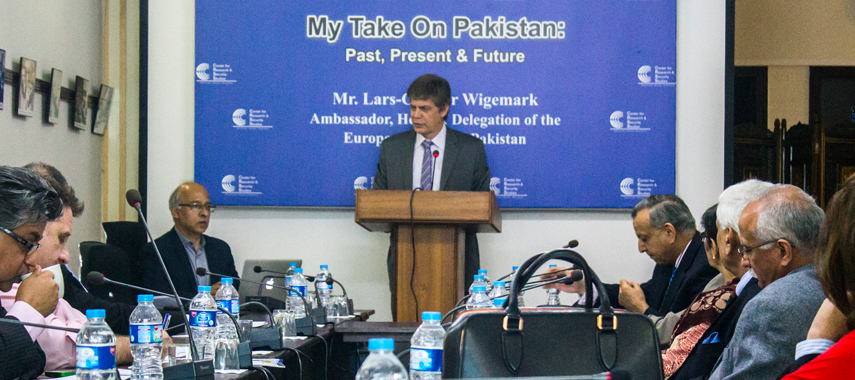
Mr. Lars-Gunner Wigemark, ambassador, head of delegation of the European Union to Pakistan gave his observations on the Pakistan’s political landscape in a roundtable discussion at Center for Research and Security Studies (CRSS). The ambassador bemoaned the fact that Pakistanis in general lacked confidence in their own institutions. Parliament is the center of democracy but it is often bypassed via executive orders and All Parties Conferences (APCs). Often this results in critical issues not being debated in the parliament. It reinforces the people’s distrust of their representative prime institution. What happened a year before in Islamabad was democracy of the streets, in shape sit-ins. It happened because of the distrust in institutions.
He said that since the Lawyer’s Long March, in the last eight years or so, the judiciary has strengthened. In a veiled reference to former chief justice Iftikhar Chaudhry, he said although overshadowed by some figures, who became the embodiment of the new-look judiciary, the institution has evolved for the better. The quality and capacity of legal argumentation is impressive but needs water-tight systems, immune from political interference, to improve rule of law and governance. Local government is absolutely essential, so that MPs can focus on policy and government performance. The solutions for Pakistan’s multiple problems must spring from within, and be devolved all the way down to the grassroots levels.
The Ambassador said that by 2011, when he arrived in Pakistan, there was a deep downturn in US-Pakistan relations. Pakistan was looking for partners like China, and the EU was here to offer help as Pakistan was seeking support in the energy, economics and military sectors. It took a long time to make strides toward economic progress. After 2011, Pakistan and the European Union have been trying to broaden the relationship, manifest in the range of issues being discussed and dissected.
Back in 2011, the EU concern with Pakistan was the growing Talibanization. Their relationship with Pakistan has always been different than that of US, as the EU not a single nation state. EU is the largest trading block in the world. As far as the trade between Pakistan and EU is concerned it is pertinent to know that in 2014, the volume of trade between Pakistan and EU was 1 billion euros, owing to autonomous trade measures.
The EU’s policy in Pakistan is support for democracy and respect for fundamental human rights. They are not happy with the military regimes. However, democracy is not enough; there are issues at the governance level. The EU does not expect miracles here but a mechanism must be evolved to govern effectively. There are issues like women’s rights, minority and human right abuses. The legislation needs to focus on all these areas.
The EU also observed the 2013 elections, and worked diligently to improve the processes involved. The matter of local government is still not resolved. The electoral system needs to be reformed. The ambiguities don’t end here. For instance, back in 2013 on the occasion of Pakistan’s general elections there was a lack of confidence and insecurity about whether elections will be held? The relief came when 10 days before the elections, marred by unprecedented violence, when then Chief of Army Staff General (retd.) Ashfaq Pervez Kiyani spoke, “elections are going to be held on its proper time”. There is something to be said about the COAS making that statement, but that is a topic for another time.
For the betterment of Pakistani electoral system after the elections of 2008 the EU gave 86 recommendations for the improvement and in 2013, it gave 50 recommendations. If issues in Pakistan’s electoral system are not resolved, next elections would also be in doubt, whether PTI wins or any other party. These problems are fundamental and needs to be fixed. And the important most of the reforms would be a strong election commission. Similarly, political parties also need to agree on a blue print for the proposed system. Nobody, whether it’s EU or US can help Pakistan unless it helps itself.
The situation of rule of law is not exemplary either. In Pakistan for the settlement of feuds there are alternative systems because of number of unsolved cases in the courts. This is a good thing, but it highlights both the backlog in courts, and the inherent trust deficit.
The argument that Pakistan is in a state of war and certain exceptions must be made is flawed because in these times is when the rule of law must prevail above all else. The so-called “soft” values of the Europeans are often criticized, but just 20 years ago, a civil war claimed the lives of 200,000 people in three years. The EU has issues regarding human rights violations. Even in harsh conditions like in Pakistan torture cannot be a solution for getting confessions. Moreover, the EU is also concerned with the lifting of the moratorium on the death penalty, torture by police and disappearances. The EU is ready to engage with Pakistan in all three areas.
Furthermore, the media, civil society, academia and intelligentsia all have a role in discovering and unearthing of these issues. Local governments must be functioning in Pakistani for the democracy to be practiced at the grassroots level, as the primary objective of the members of the parliament is formulating policies and legislating and not merely construction projects in their local constituencies. These development works are to be carried out by the local government representatives.
Improvement of security, governance and the judicial system are very important and solutions for Pakistan’s multiple problems must spring from within.
The talk concluded with the Ambassador expressing his gratitude for the attendees, and in the larger context for getting to see the wonderful sides of Pakistan first hand. His wish in his last days in Pakistan, he said, was to have spent more time in the country. A short Q&A session from the members of the audience concluded the session.