



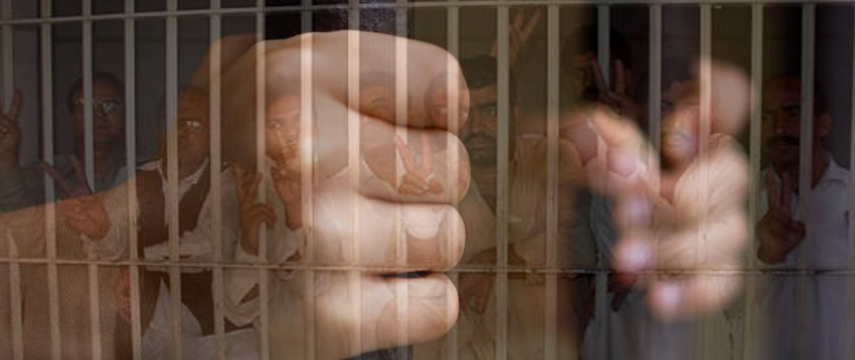
The 1898 British era Criminal Procedure Code (CrPC) constitutes the foundation of Pakistan’s criminal justice system. Socio-political developments, however, seem to have outweighed this dated legal code. The ineffectiveness of the system thus entails serious implications such as questionable investigation, exploitation of the system and long-drawn litigation.
Heavy pendency in courts in Pakistan also reflects the obstructive nature of the CrPC, which lawyers and criminals exploit to the hilt. The seriousness of the matter is such that as many as 20480 cases are pending even before the Supreme Court of Pakistan.
As of December 2014, the pendency before the Lahore, Sindh, Balochistan and Peshawar High Courts was 173037, 66475, 4923 and 26716 respectively. As many as 13387 cases were pending even before the relatively new Islamabad High Court. The situation at district courts was even worse; a staggering 1107634 cases pending in the Punjab district courts, followed by 132762 in Khyber Pakhtunkhwa, 8444 cases in Balochistan and 124190 cases in the Sindh courts. The pendency before district courts in Islamabad is 30300 cases.[1]
Further debilitating factors impacting justice delivery are the absence of professional autonomy, poor training, lack of access to basic data and inadequate tools to investigate are the main causes of undermining the investigative processes resulting in meagre 5 to 10 percent conviction rate in the country hence higher crime rates.[2]
A number of Rule of Law initiatives in the last decade, including the Access-to-Justice led by the Asian Development Bank (ADB) have focused on the reform of the system but none has been pursued in a holistic way. Most of the initiatives focused on the symptoms and not the root-causes to adapt the legal justice system to the current day mounting challenges. Repeated demands by the civil society and well-meaning jurists for a comprehensive reform of the CrPC have fallen on deaf ears. The PM Nawaz Sharif’s 20-point National Action Plan – a response to the execution of some 149 people, mostly schoolchildren at an army-run school in Peshawar on December 16 – also acknowledged and underscored the need to reform the Justice System of Pakistan including the CrPC.[3]
Criminal Procedure Code is to be followed in any and every criminal case at each step from registering the First Information Report (FIR) till the final verdict. The filing of the FIR, is prescribed in the Section 154 of CrPC. According to this, the investigation officer is bound to ascertain the facts and circumstances of the case with fairness and impartiality. Unfortunately in Pakistan, due to the absence of a pre-arrest investigation, false accusations lay the foundation for the next steps of investigation. Section 154 of the CrPC makes it obligatory on a police officer to file an FIR which sadly is not a common practice. This happens also because the common citizen is unaware of the trail of procedures involved in the filing of an FIR.
The majority doesn’t know, for instance, that in case of an uncooperative police officer, two remedies are available in the CrPC and the Constitution of Pakistan. The former contains two alternative methods namely Section 22-A, which empowers the Justices of Peace with the same powers of filing an FIR as of a police officer, and Section 200, which lays down the procedure of filing a private complaint to a Magistrate. Moreover, the Constitution of Pakistan contains the remedy through a writ petition as a last resort.
Jurists suggest that one better way of doing this would be to allow filing of an incident report electronically or physically on places designated for the purpose and each report is allocated a specific number. This means waiving the condition for personal appearance of the complainant for filing of an incident report.
This has a peculiar social context though; citizens don’t trust the police and often view it with fear and suspicion. Consequently, the requirement of the personal appearance for case-filing serves more as a deterrent rather than a facilitating factor.
Jurists also suggest that the template for reporting the crime/terror incident report may be simplified to encourage voluntary crime reporting. Furthermore, they say, the distinction between cognisable / non-cognisable offences should also be removed as they hold an opinion that all offenses are cognisable and for that, should be investigated.
The province of Khyber Pakhtunkhwa has successfully launched online FIR system which other provinces could also follow.
Legal experts have also suggested installation of CCTV cameras in Police Stations for improving performance and as a means of accountability to make sure that the police, while filing an FIR, upholds principles of fairness.
Furthermore, many laws in the 1898 code have become completely obsolete for the complex and diverse society that we live in today. For instance, under Section 46 of the Criminal Procedure Code and its subsections, an act of arrest requires the police officer to physically confine the body of the person to be arrested. In this regard, the code fails to provide the precautions or steps the police officer must take prior to conducting an arrest. This in practice has led to a wrongful arrest of a suspect and leaves a large room for police brutality in Pakistan which has attracted a lot of international criticism as it leads to grave violations of human rights.
Furthermore, the code allows the police officer to use ‘all means necessary’ to carry out an arrest where the suspect forcibly resists arrest. However, the Criminal Procedure Code and the Police Rules 1934 do not specify what falls within the definition of ‘all means necessary’ which might enable the police officials to use lethal force. The clashes in June 2014 between the Punjab police and the Pakistan Awami Tehreek (PAT) workers in Lahore, for instance, also exposed the brutal face of the police , which apparently went out of way to quell the protests. Therefore, it is crucial that the power of arrest be regulated through rules prescribing the authorities with whose permission any person may be arrested and the Provincial Government be empowered to frame rules in this regard.
Also, under Section 173 of the Code, the investigator shall submit the investigation report / Challan to the prosecutor within 14 days. The delay – a very common practice in Pakistan – allows an accused party greater scope for engineering or manipulating ‘evidence’ and thereby weaken the case against someone accused of corruption or any other crime. The prosecutor should then take prosecutorial decision to prosecute any person or not in the light of the facts and circumstances of the case as well as the availability of sufficient evidence.
Since Pakistan has failed to update its criminal justice system, its law enforcement agencies are heavily reliant on extracting information and confessions through torture. Growing incidence of custodial violence i.e various forms of torture to extract information from persons in Pakistan also calls for some serious attention. In the absence of any procedure of investigation under Section 155 of the Criminal Procedure Code the detention of a person based merely suspicion is against the Constitution.
In this context the police in particular, ends up violating the Article 5 of the UN Declaration on Human Rights (UNDHR), which forbids the use of torture by all UN member countries. (Pakistan is a signatory to UNDHR). That is why human rights activists and jurists also opposed the 2014 Protection of Pakistan Act(PPA) which they claim legalizes enforced disappearances and sanctions use of torture by the military and police.
To one’s further disappointment, there are around 1300 police stations in the country and roughly at least one person is tortured at each police station every day, making it over 1000 persons tortured daily in Pakistan. Sexual violence is also reported and up to 70 per cent of women in police custody are subject to torture.[4]
Although CrPC allows judges to demand a reason from the investigating agency for demanding the custody of an accused rather than transferring the accused into judicial custody, the judicial oversight of torture in custody is commonplace. This is how lack of implementation weakens the justice system.
Moreover, to make the justice system effective and efficient the Police and Prosecution need to work in close collaboration. Another flaw that undermines the justice system is the role of the prosecutor during the remand stage. The prosecutor’s role needs to be defined more clearly with greater authority that he/she currently enjoys.
Experts strongly recommend that the police produce the record of case / reasons / grounds of arrest of accused within twelve hours to the concerned prosecutor. The prosecutor shall review the reason of arrest and may forward to the nearest magistrate who can give the accused in police custody if there is reasonable cause for remand or direct the investigation officer to release the accused on bond with or without sureties. In case there is no ground for believing that the accusation or information is well founded, the prosecutor shall immediately forward the copy of his direction to the officer in-charge of the prosecution in the district provided that the police officer may conduct further investigation in the case even after the release of the accused on bond and may arrest the accused with permission of the concerned prosecutor.
In June last year, 2014, the Law and Justice Commission of Pakistan introduced amendment to the Criminal Procedure Code, CrPC, disallowing law enforcers from actions causing injury or death of a person being arrested unless those arresting him faced a threat to life. Next amendment in line was to the Section 54 (A); every person arrested shall be informed about the grounds of his arrest.
Another flaw in the CRPC is the lack of proper mechanism for witness protection, which too is responsible for low conviction rate in Pakistan. The witnesses and their families are often threatened by the accused party. And in most cases the witnesses step back. This is one of the reasons that most of the terrorists have been released by the courts due to “lack of evidence and witnesses” under Section 169 (release of accused when evidence deficient). This necessitates that witness protection must be added to the existing CrPC.
Moreover, there is no mechanism for the protection of the prosecutor either. It is about time to make video and audio evidence be made acceptable part of the whole process. Interrogation of the accused by taking audio / video, the statement of the witnesses via audio / video should also be made permissible.
Besides the issue of witness protection, the statements of witnesses in Pakistan are not signed under Section 162 of the Code which makes it easier to manipulate the evidence in terms of those statements and the accused gets benefit of this provision.
Most of the reasons that the government used to justify the military courts also stemmed from the CrPC. Earlier, the Protection of Pakistan Act (PPA) was also promulgated in June 2014 to facilitate speedy disposal of terrorism-related matters materialize.[5] Under this law, the help of Armed Forces can also be sought to provide security to the witnesses, judges and prosecutors. Both moves i.e. the military courts and the PPA remain controversial. They however are grouned in some of the pressing problems that are stemming from the legal justice system i.e. delays, poor enforcement, manipulation of the dated laws by the bar and the criminals/offenders.
Unfortunately, successive governments in Pakistan have merely ignored implementation of existing laws, introduced new laws and thought little of reforming and updated the CrPC.
Pakistan need to overcome all contradictions and loopholes in its legal justice system, including the police and prosecution reforms. Recent commitments of government officials to toughening the Criminal Justice System may be good news but they need to invest serious hours in a serious revamp of the criminal justice system, massive imporvement in investigations, permitting and increasing reliance on forensic evidence to cope with the mounting crime and terrorims.The process needs to redefine the functions of institution involved to ensure “justice for all” in Pakistan. This war on injustice, crime and terrorism cannot be won halfheartedly and without clarity in absolute terms.
(Shumaila Ishfaq, Research Fellow at CRSS. Can be reached at shumaila@crss.pk)
[1] “Large number of cases pending in courts,” The News Tribe, Jan 14’ 2015. http://www.thenewstribe.com/2015/01/14/large-number-of-cases-pending-in-courts/
[2] “Poor probe techniques behind meagre conviction rate,” The News, Dec 8’ 2014, Accessed Jan 21’ 2015. http://www.thenews.com.pk/Todays-News-6-288823-Poor-probe-techniques-behind-meagre-conviction-rate
[3] “Verdict of the nation: Days of terrorists are numbered, says Nawaz,” Tribune, Dec 25’ 2014, Accessed Jan 20’ 2015. http://tribune.com.pk/story/811900/live-pm-nawaz-addresses-the-nation-on-anti-terror-action-plan/
[4] “Call for law to criminalise custodial torture,” The News, Jun 27’ 2014, Accessed Jan 19’2015. http://www.thenews.com.pk/Todays-News-5-258377-Call-for-law-to-criminalise-custodial-torture
[5] “Protection of Pakistan Act 2014 approved in NA,” Dawn, Jun 2’ 2014. http://www.dawn.com/news/1116529