



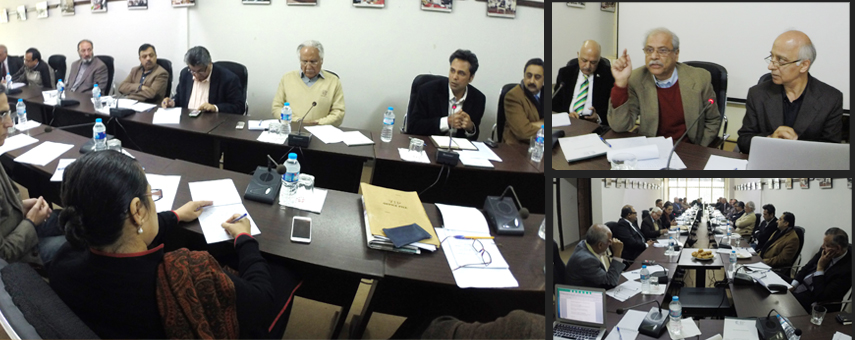
On December 31, 2014, leading members of the media, civil society, political parties and former military and law enforcement officials gathered at the Center for Research and Security Studies, Islamabad, for a roundtable discussion on the counter-terror National Plan of Action, announced by Prime Minister Nawaz Sharif, in the wake of the devastating terrorist attack on the Army Public School in Peshawar. The following is a summary of the discussion, and a list of recommendations for the Pakistan government.
A list of participants is below, followed by a list of formal recommendations, and then a short summary of the major themes discussed that do not necessarily fall into any set of recommendations.
Participants
| # | Name | Organization/Affiliation |
| 1 | Ahmer Bilal Soofi | Lawyer, former Law Minister |
| 2 | AVM (r) Shahzad Chandhry | Security Analyst |
| 3 | Ayaz Wazir | Former Ambassador |
| 4 | Dr. Shoaib Suddle | Former Federal Tax Ombudsman of Pakistan, Former Head Intelligence Bureau, Former IG Police Sindh/Balochistan |
| 5 | Farhatullah Baber | Senator PPP, former Press Sec. for President Zardari |
| 6 | Gen. (r) Asif Yaseen Malik | Former DG ISI, Secretary Defense |
| 7 | Gen. (r) Mehmood Aslam | Retired Officer |
| 8 | Maj Gen.(r) Athar Abbas | Former DG ISPR |
| 9 | Hashim Babar | Qaumi Watan Party |
| 10 | Jan Achakzai | Spokesperson, JUI-F |
| 11 | Mariam Khan | CAMP (NGO) |
| 12 | Mirwais Khan | JUI-F Youth Wing |
| 13 | Murtaza Solangi | Journalist, Former DG Radio Pakistan |
| 14 | Najib Ahmad | Radio News Network, FM99 |
| 15 | Nasim Zahra | Journalist, Host Dunya News |
| 16 | Naveed Shinwari | CEO CAMP |
| 17 | Shahzad Akbar | Director/FFFR, Legal Fellow Reprieve |
| 18 | Syed Talat Hussain | Journalist, Host Saach TV, Geo TV |
| 19 | Tahira Abdullah | Human Rights Activist, HRCP |
| 20 | Mian Sanaullah | Former Ambassador |
Formal Recommendations
Overarching and Governance Recommendations
- There is a distinct lack of political will. The National Action Plan’s agenda items are not new ideas.
- There is also a complete lack of ownership, even now. APCs are confidence-building measures, not partners in executive decisions. The counterterrorism narrative needs to be owned by the state.
- Terrorism must be fought by the civilian government. The military has no business to be taken into confidence or being a part of the decision-making process, unless the nation treats the present situation in the context of law of war.
- Do not be selective about the nature of extremism now, including sectarian outfits, and those provided state patronage on the Eastern front. The federal and provincial governments, GB, AJK and FATA must deal with Taliban of all hues with the same zeal as in Operation Zarb-e-Azb.
- Facilitation of terrorism in Punjab, and Punjabi terrorists needs to be curbed through proper governance.
- The new system must be transparent, accountable, and demonstrate efficacy beyond ATA, POPA and other rule of law measures and clauses.
- Local governments are not in place. They will not only ensure the development of the areas, but can also manage local securities, by engaging local foot intelligence.
- The last census was held in 1998, 17 years ago, and we need to conduct a new one immediately in a transparent manner.
Planning and Execution Recommendations
- In addition to physical elimination of terrorists and their hideouts, steps must be taken to prevent radicalization in the society at large.
- We must address the larger problem of extremism, hate speech and jihadi radicalization.
- We are missing timelines and criteria for these new measures. We need to know when they will be evaluated and how they will be evaluated. An initial timeline of two years has been given for military courts, does this mean that the first assessment of the new system’s efficacy will be conducted two years down the line?
- Tactically, what is the immediate timeframe? What are the corrective, punitive and kinetic measures that will be taken, to help balance the situation immediately? These would be actions where military coordination and intervention is direct and immediate, such as reclaiming territory, intelligence gathering, and prosecution of state criminals.
- Operationally, what is the long-term timeframe? For example, once the power is handed back to the civilian authority, how will they be trained to tackle the situation strategically and operationally, for the long haul? Swat operation ended five years ago, the military is still present in the region. This long-term planning needs to happen now. What, precisely, is the operational plan?
Legal Precedent, Ramifications and Requirements Recommendations
- In addition to military courts, we must strengthen civilian courts; provide them with the tools and security needed to perform their necessary functions.
- We must look at this situation not from a law of peace paradigm, but a law of war paradigm. There must be a new law enacted that may constitutionally allow military courts, detention frameworks, terrorist prosecutions etc. This new law has to be regulated, have strong oversight, and political ownership as well. Again, this will only work in a law of war paradigm. This simply will not stand in a law of peace environment, and will be viewed as parallel judicial system.
- The political government needs to very clearly define the legal conveyer belt, and the laws that drive that belt need to be clarified. We must create the legal framework, and give the Interior Minister the authority to determine which set of rules apply to which region, whether it is regular law enforcement, or anti-terrorism action, or non-international armed conflict.
Counterterrorism and Law Enforcement Recommendations
- The government must depoliticize local law enforcement agencies, and allow the security apparatus to operate through local governments. The Police Order 2002 must be revisited and strengthened.
- The current counter-terrorism measures of the armed forces must be accompanied with civil law enforcement agencies, increased recruitment in police, paramilitary and other law enforcement agencies, specialized training, equipment.
- The state must ensure the effective protection of the accused, as well as of the judges, prosecution, police, LEAs and justice must prevail, even in the face of violent threats and intimidation.
- Intelligence agencies must curb their traditional rivalry and hostility, and move towards coordination and joint efforts. We urgently need a Joint Intelligence Directorate (JID) in order to make sense of implementation of anti-terrorism laws, especially ATA and POPA, link it to NACTA operationalization, and revisit NISP.
- All federal and provincial governments must immediately arrest and apprehend leaders of all banned organizations, NGOs and madrassas, even if they legally change their name, for example Jamaat-ud-Dawa and ASWJ, etc.
- The security apparatus must involve the international community, including neighbors and superpowers. In the regional security arrangements. India, in addition to Afghanistan, Iran, China, the US, the UK and the EU must be included.
Tolerance and the Elimination of Hatred Recommendations
- All hate literature distributions from mosques, shrines, seminaries and other religious institutions must be banned and taken note of. The ban must be implemented by the local law-enforcement agencies, specifically the police, not the rangers or the FC, . If necessary, change the law against hate speech and literature immediately.
- All seminaries, NGOs, trusts, foundations, philanthropic and charitable organizations run by these proscribed groups must also be banned and prevented from working in conflict or humanitarian situations, especially with reference to the current IDPs in frontier regions and district of KP.
- All seminaries and their funding sources must be registered. There should only be one Wafaq-ul-Madaris. Wafaq-ul-Madaris-AlArabia should be banned, including all Sunni and Shia sects and sub-sects. All seminaries must follow government curriculums in addition to a unified curriculum of religion.
- All public sector government schools curricula, textbooks, and teachers training curricular must be completely revamped on an emergency war footing, in order to remove all the documented instances of hatred and bias, especially those pertaining to religious instruction, history, social studies, Pakistan studies and ethics. Enact a new law called Respect for all Faiths, Religions and Sects Act 2015 in January.
Media and Journalism Ethics Recommendations
- The private and public media must be brought to rein itself in from the current state of unfettered license and use of phrases encouraging violence, for example, jihad, shaheed, maulana, fatwa, wajib-ul-qatal etc.
- Ban talk show appearances and solo interviews of heads of banned and controversial organizations, and banned individuals for example, Lakhvi, Hafiz Saeed, Ludhainvi, Abdul Aziz, TTP, etc.
- Ban all coverage of TTP and sectarian jihadist extremists, including their names, faces, voices, press releases, public statements. This should be a blanket ban.
- Immediately cease to create panic, despair, misplaced ridicule through the abuse and misuse of film songs, poetry, blaring music, red screens and blatant abuse of the red news syndrome.
Miscellaneous Recommendations
- FCR 1901 should be immediately repealed through a constitutional amendment.
- FATA should be made a separate province with its own complete setup. Failing that, FATA reforms need to happen immediately, and the people of FATA need to be treated as equal citizens, including access to educational, economic, and employment opportunities.
- Punjab should be divided into two provinces.
Summary
Military Courts
Attendees felt that the government had given a range of reasons to establish the need for military courts, and that the center will recommend to the provincial governments to call the army under article 245 of the constitution[1]. Most felt that that the next step would be to wind up the civilian government. and that there was no need for a democratically-elected government in such a setup. These reasons given include:
1. civil courts have failed by not providing speedy trials, and
2. not providing effective deterrent punishment
3. laws are not stringent enough
The argument that current laws are not stringent enough is inherently flawed. On the contrary, there is an excess of laws which would suitably address terrorism and help establish the rule of law. Unfortunately, these laws are compromised. The argument that civil courts have failed to deter terrorism is a slippery slope, because following that logic, the parliament and senate, as well as the military, have also failed the people of Pakistan and as such, the civil bureaucracy and armed forces should also be abolished. They cautioned that an independent judiciary is a fundamental tenant of the constitution. The establishment of military courts would alter the basic structure of the constitution which only a constituent parliament can enact.
The Media Angle
The establishment of military courts invokes a sense of fear among political parties in view of the past experience. The media is beset with many aspects of the issue as it considers it an important debate. However, the debate defuses the primary issue. Do we require exceptional administrative and judicial measures to crack terrorism or not?
Second, the context of the military courts has also been sabotaged. The context was the Peshawar tragedy. The civil society, politicians and the military leadership joined hands for a united, extraordinary response to extraordinary circumstances. In a national state of grief and pain, all political parties agreed on the establishment of military courts. Once this initial grief wore off, and the motivation leveled out, in a reflective mode, problems arose with the commitment they made. The context needs to be examined minutely: was this part of some long-standing conspiracy against the civilian government, or were the circumstances truly extraordinary?
Third, the Patriot Act is a classic example of a society with a functional, near exemplary system that the rest of the world emulates, that be felt the need to exercise extraordinary measures to deal with an unprecedented threat, and create a legal exception. It was, however, pointed out that even the Patriot Act only suspended rights for aliens, not citizens.
As long as the new system is thoroughly transparent and promotes accountability, people in Pakistan may accept the measure. Nevertheless, the government and the military will have to prove the efficacy of these steps, above and beyond what the Anti-Terrorism Act, the Protection of Pakistan Act, and other similar laws already provide for. A week after the NAP was announced with all parties on board, it seems that the narrative is already under considerable strain from the very quarters that approved it with initial zeal. This will inevitably affect civil-military ties, and it remains to be seen if the two sides will still be on the same page with full commitment for its implementation.
Failure to effectively deal with terrorism has been at multiple levels, executive, judiciary and above all political. While history teaches us to be fearful of these steps, we need to recognize that this is not the 80’s or 90’s, the game has changed altogether in these contemporary times. Unfortunately, the points about transparency, accountability, legality, imposition of rule of law, which are critical issues, have been subdued with this very broadly contextual issue of civil-military relations.
The Prime Minister’s statement that we are doing this for the children of Peshawar is tantamount to belittling the larger issue, which is the security situation in the country, and our system’s complete inadequacy to address it. The media will continue to expect more responsibility, more maturity, more sincerity and more competence from politicians, and will continue to raise questions about NAP, especially if it lacks transparency. We need to focus on our existential crisis, rather than fanning conspiracy theories of martial law and military takeovers.
Civil-Military Debacle
The urgent need of the moment is to unify the nation, recognize that something has gone very wrong in the affairs of the state and we are faced with an existential threat, and decide on steps to address it. This is not a failure of institutions alone; it is the collective failure of the nation. Since 1948, it has been the state policy to use non-state actors in places like Kashmir in the name of national security. Military courts are neither the answer nor can the military decide who should be prosecuted and convicted.
On December 17, 2014, the nation was united and willing to do anything to curb terrorism and bring some semblance of normalcy back to the country. On December 31, 2014, we are once again a divided nation, questioning civil-military relations and military intervention in the affairs of the civilian government. The executive decisions are the responsibility of the civilian setup, and no one else needs to be a part of it.
Good, Bad Taliban and State Patronage to Banned Outfits
All participants were grateful to both the civil and military leadership for reassuring that the good/bad Taliban narrative held no relevance anymore and welcomed their vow to hunt terrorists without any distinction. However, some participants expressed the apprehension that while physical commitment behind these words would apply to the groups operating in Pakistan and Afghanistan, those active in India and Kashmir would not be reined in. The state, they insisted, continues to provide patronage to renamed banned outfits, despite a 2013 law that explicitly prohibits such action, e.g., Lashkar-e-Taiba operating under the new name of Jamaat-ud-Dawa.
Also, it was said that known extremists are currently on bail; courts claim that prosecution case was weak; prosecution blames that the law enforcement agencies for not collecting ample evidence. This cycle also needs to be addressed, and the loopholes closed.
State institutions must not be selective about the nature of extremism, including sectarian outfits, and those who were trained to operate against Indian interests. All of them should be treated alike. Banned outfits needs to be judiciously dealt with. Even when an organization does not subscribe to extremist ideology, this may not be true at the foot soldier level.
It is now the Prime Minister’s executive responsibility to fight this war and save this nation. He has to avail all national resources, including the military, judiciary, media, law enforcement and civil society to fight this battle. In addition to military courts, civilian courts must be strengthened, security and protection must be ensured for judges and prosecution.
FATA and Afghanistan
It is easy to dictate terms to the people of the tribal areas, and to not consider them proper citizens of Pakistan. FATA has been historically ignored and marginalized. The government, military establishment and intelligence agencies have failed to provide the people with fundamental rights and economic opportunities. There is clear and urgent need for legislative, structural and political reforms in FATA. FATA needs to be brought into the Pakistani fold. This issue cannot be ignored any longer, or FATA will continue to be the black hole it is today.
You cannot delink peace in the KP/FATA region from peace in Afghanistan. Historically, Pakistan was not peaceful when Afghanistan was not at peace. In the broader context, this counter-terrorism policy needs to involve regional players, including all of our neighbors, as well as superpowers, to create a holistic, comprehensive, credible policy.
Is Pakistan in a State of War?
There is considerable confusion about whether Pakistan is in a state of war or not, and the answer to this question will define the actions that need to be taken, providing right framework for the current debate. Additionally, this divisive debate is perfectly fine and healthy, as it reflects the divisive nature of this conflict and the public difference of opinion. We have been on the wrong path for 67 years, but at least we are admitting today that we have been wrong, and that our policies regarding Afghanistan have extended to KP/FATA.
We need to own the War on Terror, and in the service of this objective we need to equip, train, and strengthen our law enforcement agencies. We need to empower them, reinforce them, and allow them to do their jobs without political interference. Provincial governments are incapable of proper governance, because local governments are not in place and this is because provincial governments are not willing to let go of their powers. Once local governments are in place, and they have powers over not only the development of the areas, but local security, by arranging local, foot intelligence. Without foot intelligence, it is impossible to win this war.
NGOs
NGOs are not being provided ample security against the Taliban threat. NGOs need a long series of NOCs to be able to operate in the field to help people in their respective focus areas. Even after obtaining the proper NOCs, and letters from institutions such as NDMA and FDMA, NGO workers are not allowed to work in certain regions. NGO workers are constantly harassed. Seminaries spread misinformation about NGO funding. The funding of all properly registered NGOs is according to the Ministry of Finance’s Economic Affairs Division’s regulations. Their funding information is audited, accounted for and available on a yearly basis on their respective websites. However, 40,000 seminaries are unregistered and not much is known about their funding.
The government is not appreciative of civil-society, especially NGOs. Members of the government in talk shows have blamed NGOs for conducting anti-state activities
The Legal Angle
We are confused about the legal paradigm. We have to look at our current situation not from a law of peace paradigm, but from a law of war paradigm. We are not under attack by regular terrorism, our state are under systematic, systemic attack by a well-entrenched, well-coordinated, well-funded enemy. The notification of Article 245(1) is a de facto law of war notification, and it is only applicable on the national scale, not in a confined territory, such as Islamabad. Invoking this article sends a few crucial messages. First, the civil setup has crashed and is ineffectual. Second, we cannot enforce our constitution without the aid of our military. Third, we are giving the army the license to use force because it has to restore public order.
Further, their framework has to be regulated. This is why Article 245 specifically says “…subject to law…”, implying that this is not carte blanche, there has to be a limit to this use of force, and it has to obey the existing legal structures. The threshold of the existing law is very low, and it calls for the military in aid of civilian government under rule of law, it does not allow for a military-run judicial setup. So there has to be a new law enacted that may constitutionally allow military courts, detention frameworks, terrorist prosecutions etc. This new law has to be regulated, have strong oversight, and political ownership as well. Again, this will only work in a law of war paradigm. This simply will not stand in a law of peace environment, and will be viewed as parallel judicial system.
Courts have become revolving door, based on bails. Article 8 of the constitution states that laws necessary for the performance of state functions may be created. Therefore, laws can be enacted that can allow for exemptions, for examples those that bypass the revolving door of the civil courts, under the law of war paradigm. The logic is simple, if you call in the military to restore public order, while adhering to the same rules and regulations that have so catastrophically failed the people, these new steps simply will not work. Non-international armed conflict legitimizes the use of force to restore balance, and this use of force is implicit, and it needs an objective framework.
This objective framework needs to be clear, as well as the duration of the conflict. There are several legal provisions and acts that allow Pakistan to operate in a law of war paradigm and draw clear lines for who the enemy is. A gangster in Karachi may be upsetting public order, but his allegiance to the constitution is intact, he cannot and should not be prosecuted under this setup. However, if your allegiance is with banned/terror outfits, and if you publically denounce the state of Pakistan, encourage taking up arms against it, or engage in damaging the state apparatus, you are by definition an enemy of the state.
The political government needs to very clearly define the legal conveyer belt, and the laws that drive that belt need to be clarified. This is the important part. You need to create legal framework, and give someone in the civilian government to determine which set of rules apply to which region, whether it is regular law enforcement, or anti-terrorism action, or non-international armed conflict (which most international experts agree is automatically in effect whenever warplanes are used). . We sit in a state of confusion, because the nature of the conflict has never been made clear. There has been no jurisprudential guidance from the Supreme Court, only a logging of events and actions. All of this confusion can be eliminated by the domestication of the law of war paradigm.
If these courts are made, and there is a reversal of the political pledges made, this will have a very damaging effect on the overall legitimacy and efficacy of these courts. POPA and ATA both need severe judicial surgery and revaluation, POPA especially really hurts the system, than help it, and has created a lot of confusion at the Station House Officer (SHO) level in police stations. Additionally, the military courts can only take selective, extreme cases. For example, if they tackle the 2,500+ ATC cases, they will collapse and sink into the same ineffectual quagmire our civilian courts suffer from.
[1] Article 245 (1) “The Armed Forces shall, under the directions of the Federal Government, defend Pakistan against external aggression or threat of war, and, subject to law, act in aid of civil power when called upon to do so.”