



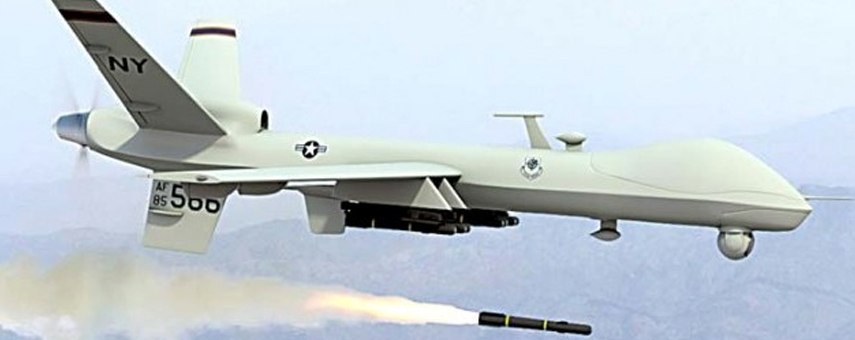
A recent report by Open Society Foundations ‘After the Dead are Counted: U.S. and Pakistani Responsibilities to Victims of Drone Strikes’ recommends that concerted efforts should be made to investigate civilian loss and compensate victims of Drones. The report focuses on compensating the victims of drone attacks because innocent lives are also affected due to this. It also asks the government to fortify political reforms in FATA because the FCR is a threat to the basic rights of citizens of FATA. The report recommends that the U.S government make public any agreement signed with the Pakistani government regarding drone attacks beside making sure its drone operations observe international laws. The United States should also expand its civilian victim support programmes to drone affected families in FATA, the report recommends. 
Below is a review of the report by Farooq Yousaf, a CRSS Research Analyst.
The report focuses on a number of issues related to complexities in estimating the number of civilian casualties as well as the US and Pakistani Governments’ respective responsibilities towards the Drone victims in FATA, Pakistan. Researchers from Open Society Foundations and its partners analyse 27 drone strikes between 2009 and 2012 and civilian casualties in those strikes. Due to limited sample size and survey limitations, the reports also admit to its shortcomings of being unable to imply an average casualty rate in drone strikes. The total sample set for this report consists of 96 residents of FATA along with government officials from USA and Pakistan, experts as well as journalists reporting on the issue.
This report is the first of its kind that focuses more on documented civilian deaths and the circumstances in which the victims were killed. Among many stories, the incident where a 12 year old boy, Arif, was killed during a strike on a guest house, hujra, stands out in terms of explaining the complexity of CIA drone operations. Although Arif was a common student, and a shepherd, yet eyewitnesses, including his relatives, think that the attack may have also killed local Taliban. But exclusive events such as the targeting of Shaheed ur Rehman, a local chromite businessman, also indicate the susceptibility of drone operations in making targeting errors.
Along with documenting the victims, the report also sheds light on governance failures in FATA as a pretext to instable situation in the region. Among many reasons, the Frontier Crimes Regulation (FCR) stands out as the major culprit for the plight of FATA. The FCR is law for animals, not people, says a member of the Parliament while giving an interview for the report. Not only has the FCR resulted in lack of basic governance in FATA but also helped the militants consolidate their hold in North and South Waziristan. Furthermore, the issuance of ‘Action in Aid of Civil Power Regulations’ (AACPR) have further compounded the miseries of residents in FATA.
While further commenting on U.S. drone strikes as a tactic and not a strategy, the report notes the effectiveness of drone strikes by containing the militants in the short run, but also causing collateral damage. Furthermore, a number of interviewees didn’t consider drones to be the biggest issue they face, rather what they needed was strong leadership, governance and political inclusion to solve their problems. Furthermore, it is also noted that political inclusion, reforms and mainstreaming of FATA into Pakistan proper should be a priority for Pakistani legislators rather than focusing more on Drone strikes.
While laying much of blame on inconsistent drone figures, Pakistani authorities have been criticised for cooking up inconsistent figures on drone deaths and casualties. Further, it is also noted that Pakistani officials have seldom asked the U.S. authorities for intelligence reports on Drone strikes. Also, the government has made little or no effort in estimating the human loss in drone strikes or formulating compensation policies for drone victims. The only exception in this regard is the FATA Secretariat, the prime institution for managing everyday affairs in FATA, which has made some effort in estimating the civilian loss in various instances of violence in FATA.
Policy formulation for victim mapping and compensation could help affected families such as that of Khalil ur Rehman’s brother who left behind a family of nine children and yet the government didn’t provide any assistance to his family. It is noted that even though a number of efforts are being made by the Federal as well as provincial governments to improve the response and assistance mechanisms for violence affected Pakistanis, there is still little progress made on the Drone front in FATA.
In its final section, the report explains the legal complications in assessing the legal implications of the CIA drone programme. With an alleged consent to the use of force against individuals who “may not” pose a threat to the U.S., Pakistan is undermining its position in terms of International Humanitarian law. Even with an apparent consent, Pakistan is still obliged to provide protection to its citizens on its territory subject to lethal force by another state.
While giving policy recommendations to the respective governments, the report asks Pakistan to establish transparent mechanisms for reporting, investigating and compensating the victims of US drone strikes. Furthermore, it also asks the government to ensure political reforms in FATA as the FCR is undermining the basic rights of citizens of FATA. As for the U.S., it is recommended that the authorities should make public any agreement signed with the Pakistani government regarding drone strikes, along with making sure its drone operations comply with International laws. Furthermore, the U.S. should also expand its civilian victim support programmes to drone affected families in FATA. Finally, the U.S. should also push Pakistan to allow access for INGOs and journalists in the FATA region.
Although the report dwells upon an already established fact – civilian deaths in drones – it still helps in emphasizing on the plight of drone victims, who, unlike victims of militant attacks in other parts of the country, are not compensated by the Pakistani government. Moreover, even with its shortcomings, the report successfully reiterates the need for transparency in drone operations and number of casualties.