



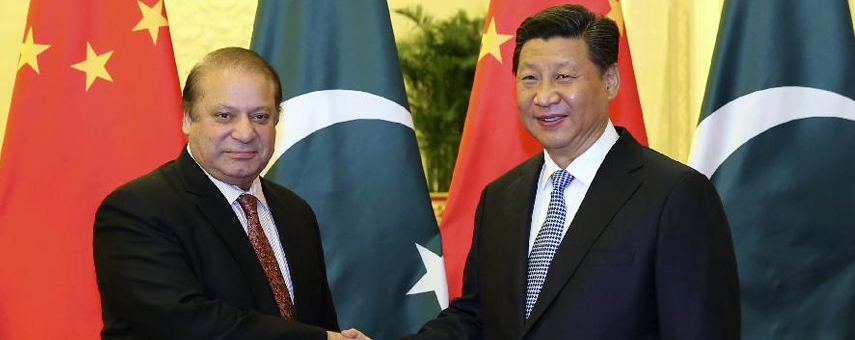
Chinese Ambassador, Sun Weidong, held a meeting with representatives of various think tanks, including the Center for Research and Security Studies, on November 13, 2014. Senior Research Fellow Zeeshan Salahuddin provides an overview based on the briefing as well as the question-answer session that followed the briefing.
Note: Chinese Ambassador, Sun Weidong, held a meeting with representatives of various think tanks, including the Center for Research and Security Studies, on November 13, 2014. The objective of the meeting was to provide an overview of the Sino-Pakistan ties to the context of Pakistani Premier Nawaz Sharif’s recent visit to Beijing, and to explain Chinese views on various international and regional issues. The following write-up by CRSS Senior Research Fellow Zeeshan Salahuddin is based on the briefing as well as the question-answer session that followed the briefing.
Iron Brothers
During Premier Nawaz Sharif’s visit to Beijing in November 2014, Pakistan-China signed some 19 agreements on economic cooperation and infrastructure investment projects. Bilateral cooperation dates to over five decades and includes collaboration both in economic and defense hardware spheres. This has now been expanded to a concerted investment in the energy sector, with 13 of the 19 agreements designed to address Pakistan’s crippling energy crisis.
The Chinese consider Pakistanis their “iron brothers”, a bond forged in the wake of the democratization of modern China, and tested over time. For decades, Pakistan has been China’s closest ally in South Asia, collaborating on a range of opportunities, including bilateral trade, the economic corridor, defense cooperation. Ambassador Weidong termed the larger goals of the cooperative framework as a “community of shared destiny”, a phrase that underlines President Xi Jinping’s the new “Chinese Dream” philosophy of cooperation with China’s extended neighborhood.
The Chinese way of development is strengthening internal security and stabilizing political turmoil. “Political stability is a pre-condition for economic growth”, said Ambassador Weidong. For decades China combated political strife, in addition to a range of other issues. The Chinese feel that the lessons learned could be easily applied to Pakistan. Easing political tensions and strengthening the democratic process is vital to allow a healthy economy to gestate.
President Jinping was scheduled to visit Pakistan as part of his Asia tour in early September but political protest in Islamabad prompted both countries to postpone it, a subtle hint the Chinese dislike for political unrest. Ambassador Weidong expressed his deep regret over the cancellation of President Xi Jinping’s visit to Islamabad, and expressed hope that trip would be rescheduled soon.
Flagship Projects
The flagship project between the two sides is the continued building and strengthening of the economic corridor. The China-Pakistan Project is of utmost importance to the Chinese, and a mandated national priority. The plan is comprehensive, and meant as an intervention from the people of China to the people of Pakistan, and that all projects should begin and end with the goal of helping the people. Part of this process are the industrial parks being set up in Lahore and Faisalabad, the latter of which will result in fifty thousand jobs alone. The Maritime Silk Road that connects Gawadar, already benefits from a $40 billion Chinese “silk fund”, and will provide 20,000 training opportunities to neighbors in the coming months.
In addition, Ambassador Weidong was clear about “early harvest” priorities. Cooperation between the two sides is a continuous process. There will always be projects to undertake that can help the people, but it is equally imperative to prioritize and tackle issues that have an immediate and lasting impact.
During Prime Minister Nawaz Sharif’s visit, a memorandum of understanding (MOU) potentially worth $42 billion dollars was signed between the two sides, across a wide variety of disciplines, most notably the energy sector. China provides free grants to Pakistan every year, bordering $100 million last year alone, and every year, this amount goes up by around 10%. China has also been quite vigilant in providing support for victims of natural disasters, such as the floods of 2010, and man-made disasters, such as the internally displaced people resulting from military campaigns against extremists. China also offers relaxed loans to Pakistanis, as well as concessional commercial loans to Chinese companies that want to invest in Pakistan directly.
In the past, energy shortage was historically a major bottleneck for Chinese progress. Within the last thirty years, China has overcome this problem, and it has proved to be a major milestone in the country’s progress. China is committed to applying this critical lesson to Pakistan, where rural electrical outages can be in the upwards of 20 hours a day. The Chinese fully recognize the need to be self-sufficient in the energy sector, and that they will continue to pursue this larger goal through coal, hydro, solar, wind and nuclear projects.
The Chinese seem to take their oath to the iron brotherhood very seriously, despite being a developing country. The Chinese might boast the second largest economy in the world because of sheer numbers, but it is worth mentioning that on a per capita basis, the China is still considered a developing country.
Security Apparatus
The Chinese are deeply invested in regional stability, in addition to combating terrorism at home. At the Istanbul Process on Afghanistan conference, China signed 64 agreements across six broad categories with Afghanistan. China feels that reconciliation with the Taliban is the way forward for a politically stable, developing, secure Afghanistan. Despite a long and at times sordid history with neighbor India, China wants expanded cooperation with the fellow BRICS member, seeking closer ties with New Dehli.
With the rise of the East Turkestan Islamic Movement (ETIM), responsible for a series of devastating attacks in the western parts of the country, China is deeply motivated to eliminate extremism. These concerns also extend to Pakistan, where despite military operations and concerted law enforcement campaigns to root out terrorism, there is a distinct lack of a consolidated national security policy.
“Terrorists are common enemies of Chinese and Pakistani people, they are enemies of humankind”, said Ambassador Weidong, reinforcing the Chinese commitment to combat and eradicate terrorism. Pakistan’s commitment to combating terrorism, not just in the form of boots on the ground, but a centralized, intelligent effort against the plague, will be on the Chinese radar for years to come.
Zeeshan Salahuddin is a journalist and a Senior Research Fellow at the Center for Research and Security Studies, Islamabad. He holds a bachelor and master degree in strategic communications from Ithaca College, NY, USA. He can be reached via zeeshan.salahuddin@gmail.com and tweets @zeesalahuddin.