



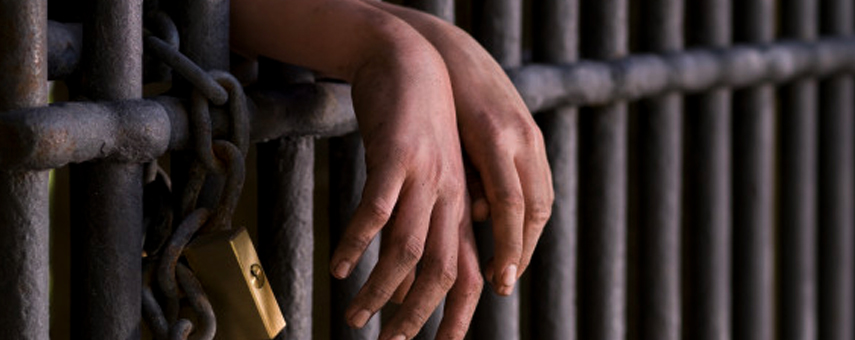
Yet another case of handling a blasphemy accused extra judicially occurred in September 2014, when Muhammad Asghar, a 70-year old British, was shot and wounded by a prison guard at Adiyala Jail, Rawalpindi. The mentally ill Asghar was sentenced to death for claiming to be a prophet.
Pakistan’s blasphemy laws continue to stoke fears. Critics often say that most of the accused usually are the victims of abuse of this law. Blasphemy is a serious offence and punishable to death according to article 295-c of the Pakistan Penal Code (PPC). Article 295-C states:
Whoever by words, either spoken or written, or by visible representation or by any imputation, innuendo, or insinuation, directly or indirectly, defiles the sacred name of the Holy Prophet Muhammad (peace be upon him) shall be punished with death, or imprisonment for life, and shall also be liable to fine.
Since the inception of blasphemy laws in 1991, CRSS report indicates that 59 persons have been extra judicially murdered in the country. Among them were nine women as well. Two of these extra judicially murdered persons were Iqbal Butt and Muhammad Imran, who were slain even after getting acquitted by the court. Meanwhile, four people were also injured in an attempt of extra judicial murder.
In 2010, Pakistan People’s Party (PPP) Member National Assembly (MNA) Sherry Rehman submitted a private member’s bill seeking amendment to Pakistan’s blasphemy laws. The bill was drafted to provide proportionate penalties for each offence by reducing terms of imprisonment and removing the life sentence and death penalty entirely. However, she later withdrew the bill which then Prime Minister Yousaf Raza Gilani said, “was according to party policy.”
In January 2011, then Governor of Punjab Province Salmaan Taseer was killed in capital city, Islamabad, by his own guard for supporting Asia Bibi convicted for blasphemy and seeking reforms to the Blasphemy laws. Furthermore, later that year in March, Shahbaz Bhatti, minister for minority affairs, was also assassinated for supporting Asia Bibi and raising his voice against Pakistan’s blasphemy laws.
Justice Iqbal Hameed-ur-Rehman Tribunal, investigating the 2009 Gojra riots when religious Zealots burnt Christian Colony in Gojra in the Punjab province of Pakistan, where 8 people died including four women and a child concluded in his report:
Although, sections 295-B, 295-C, 298-A, 298-B and 298-C were inserted in PPC but no safety valve for avoiding misuse of the same was provided in the relevant provisions of Procedural law i.e. section 196 & 196-B CrPC (Criminal Procedure Code). Misuse of the said provisions of substantive law can be avoided if adequate amendments are made in sections 196 & 196-B CrPC.
In a landmark judgment of June 19, 2014, then Chief Justice of Supreme Court Tasaduq Hussain Jilani directed that the “federal government should constitute a taskforce tasked with developing a strategy of religious tolerance, a Special Police Force shall be established with professional training to protect the places of worship of minorities, National Council for minorities’ rights shall be constituted and moreover, Federal Government should take appropriate steps to ensure that hate speeches in social media are discouraged”.
Speaking on the abuse of Pakistan’s blasphemy laws, Peter Jacob, a human rights activist, said, “Federal and provincial ministries should take the responsibility of monitoring, protecting and defending cases against persons accused of blasphemy. The successive governments are responsible for allowing abuse of blasphemy laws and pervasive insecurity and they have ignored resolving them continuously. While the state cannot be absolved of its responsibility to protect victims from extrajudicial accesses and institutional justice, defending the blasphemy victims has become an uphill task that the victims and their sympathizers cannot engage effectively. Some of the blasphemy cases, for instance, Salamat Masih, Rimsha Masih and Dr. Akhtar Hameed Khan, where government shared some of the responsibility, were handled well.”
Jacob further stated, “Civil society and human rights organizations play their part in defending false blasphemy cases but their focus is limited and they cannot reach all accused and defend them. So, there is need to legislate on the issue as well apart from maintaining a governmental institution which can oversee that laws pertaining to blasphemy are not abused.”
Political and security analyst Imtiaz Gul opines, “All blasphemy cases must be heard by at least a 3-member bench, with experts of international humanitarian law sitting there as observers. We need to improve and reinforce legislation to prevent bias creeping into judgments.”
Punishment for blasphemy is advocated in Judaism and Christianity as well. For instance, in Judaism third book of the Noble Torah, Leviticus 24:16, states that those who speak blasphemy “shall surely be put to death”. Similarly, in Christianity, “Thou shalt not take the name of the LORD thy God in vain; for the LORD will not hold him guiltless that taketh his name in vain. (Exodus 20:7 KJV). In addition, it is spoken in the Luke 12:10, where blaspheming the Holy Spirit is spoken of unforgivable — the eternal sin.
Maligning any religion is harmful and cannot be permitted whatsoever, however, alleging someone of slandering religion is a complex issue and requires deep interrogation so that an innocent life is not wasted.
Keeping in view the ten-point recommendations of Hameed-ur-Rehman Tribunal and June 19,2014, Supreme court judgment, the federal government must devise a plan to legislate on blasphemy laws taking on board the Ulema (religious scholars). Furthermore, an institution should also be established which can provide legal counsel to the accused in cases of false accusations.
Abbas Ahmad, CRSS Research Fellow