



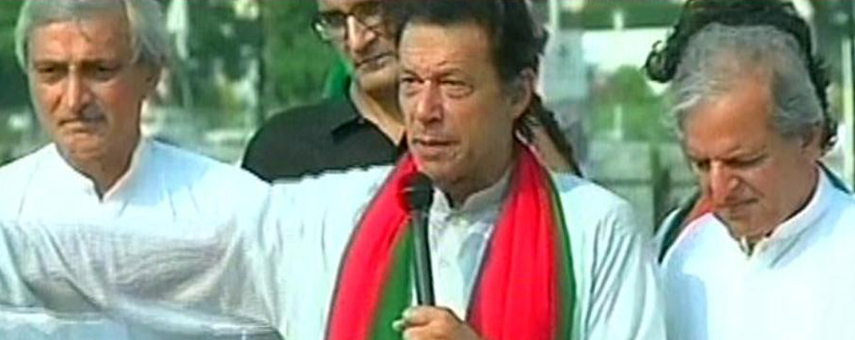
Pakistan’s current political roller coaster reached new heights when Makhdoom Javed Hashmi, president of Imran Khan’s Pakistan Tehreek-e-Insaf (PTI) party, descended like an angel to save the current government with his expose of Khan as taking “dictation” from someone behind the scenes during the current anti-Nawaz protest.
Although yet to be proven, Hashmi’s claims were a major blow to Khan’s demonstrations against the Nawaz Sharif government. But even amid these disclosures, Khan is resolute in carrying on his protest against the government, discarding Hashmi’s allegations altogether.
Khan launched his recent protest, the Independence March, on August 14, starting from Lahore and culminating in the ongoing sit-ins in front of the parliament house and other state buildings, also known as the Red Zone in Islamabad.
Khan’s PTI is also joined by Tahir ul Qadri’s Revolution March. Qadri (President of Pakistan Awami League, PAT) not only seeks to bring about a revolution, but also demands the resignation of Punjab Chief Minister Shahbaz Sharif, whom Qadri holds guilty of killing their 14 workers.
As a result of this protest, the country has already suffered a long-lasting political and economic damage. The political parties have again been exposed as amateurs, unable to solve their own issues, and have thus called upon the military to act as mediator and facilitator.
On a positive note, the opposition parties, mainly the Pakistan Peoples’ Party, are also backing the government in this situation of adversity to strengthen democracy.
It seems as if the parties on the opposition benches have learned their lesson from the past where any leverage given to the military resulted in a prolonged periods of military rule.
On the other hand, Khan’s protest should not be seen as something totally negative. His protest is probably the first major instance in the country’s history where poll rigging has been made a massive issue.
Even if Khan sacrifices his political future in this process, he has made sure that none of the ruling parties in the future could afford to manipulate poll results.
What Khan has to seriously consider is the fact that Pakistan witnessed its first democratic transition after the May 2013 elections, and any move by him that could derail the whole could take him down as a villain in the country’s history.
Khan’s supporters, on the other hand, have also had the delusion that they unlawfully lost the elections. Moreover, since the country is already going through a poor economic phase, such events would further dent the economic outlook and investment prospects.
The military and judiciary, mostly perceived as apolitical, also need to play a constructive role in solving the crisis, even if their positions have been maligned by the recent turn of events.
It would also be interesting to see which direction both these institutions lean to in terms of government, opposition and general public sentiment.
Political dissent, in a controlled and timely manner, is the beauty of democracies, and it should remain that way. However, Khan’s persistent demand for the prime minister’s resignation may further add to undermining civilian rule and democratic growth in the country.
At a moment when hundreds of people have been killed in Punjab due to torrential rains and flooding, Khan should consider at least momentarily suspending his protest, so that the government could divert its attention toward flood relief.
Only time will determine the real victor of this ongoing political crisis. However, if Khan gives up his demand for the prime minister’s resignation and uses the political leverage to initiate an impartial inquiry into the electoral fraud, followed by electoral reforms, it will obviously be a win-win situation for democracy and the people of Pakistan.
By Farooq Yousaf, Research Analyst / Program Consultant, CRSS and holds a Masters in Public Policy and Conflict from Willy Brandt School, Erfurt University, Germany.
Originally Published in Global Times, September 14’ 2014