



Current Situation
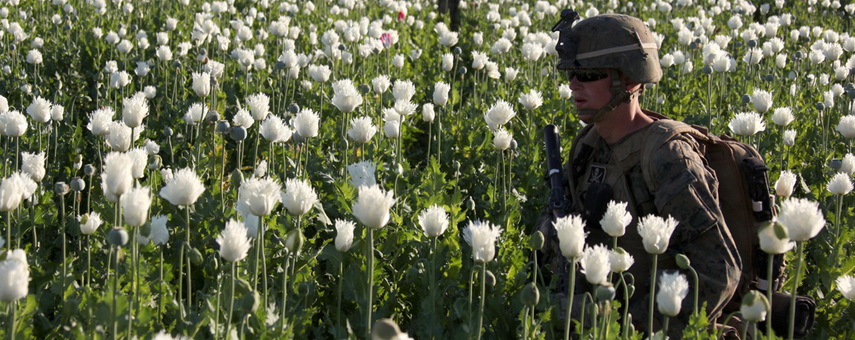
United Nations Office on Drugs and Crime UNODC says Afghanistan produces more drugs like ‘opium’, ‘heroin’ and ‘hashish’ than any other country in the world. Before 1991, Myanmar was considered to be the primary source of opium but now Afghanistan has taken the lead in this. Afghanistan holds a near-monopoly as it produces over 92% of the world’s opium.[i] Despite the little efforts made by Afghan government in reducing the production of drugs, the drastic upsurge in the production of opium can be attributed to the increased demand of the drug globally, as well as to the country’s favorable socio-politico-economic environment. This has allowed the unlawful trade and production of opium’ to become an essential part of Afghanistan’s informal economy.[ii]
This also works to the advantage of Afghan militant groups and terrorists associated with Al-Qaeda. Taliban have seen the advantages of the drug trade as, the money they are making out of it sums up to huge amounts. They see it as means of getting money for activities such as equipping themselves with advanced weapons to fight their enemies.[iii]
Boon for Non-State Actors?
Afghanistan’s socio-politically fragile conditions and the Islamist militancy offers a conducive environment for the illicit drugs’ trade. The endless warfare has allowed the abuse and trade of drugs. The Afghan government in this regard, is believed to be involved in protecting its “drug market” as this is boosting the amount of money being generated in the country. The money is being used for wrong purposes though and the involvement of Afghan government in this matter is substantial. It was speculated that Ahmed Wali Karzai, brother of the Afghan president, Hamid Karzai, was strongly believed to be involved in the narco-trafficking in Afghanistan and fueling his bank accounts by the drug money.[iv]. The drug money and its profits were so irrefutable that insurgent groups, including the Taliban could no longer overlook them. There is no clear distinction between drug traffickers and insurgents. It is believed that the corrupt government officials have also become part of this vicious trade. [v]
There are also widespread fears that US-NATO troops also partnered with some Afghan warlords and influential politicians for achieving the objectives of their anti-terror war. But they ignored that many of their partners have also been part of the cartels dealing in narcotics.
Drugs stoking international Concerns
Narco-trafficking on national, regional and global level raises concerns among many states across the world. Pakistan, Russia, China, Iran and most Central Asian states too are concerned about the drugs that originate in Afghanistan.
The Shanghai Cooperation Organization (SCO) also treats counter-narcotics as one of its core areas of regional cooperation. The SCO countries look at drug-trafficking from Afghanistan as a major regional security problem, which feeds terrorists and also affect the youth in these countries.
If we look at the experience of South American nations, it is quite obvious that the drugs’ trade has a double effect on countries’ population; drug addiction being common in the younger generation especially and then the violence and terrorism that is funded by this drug money for Taliban and other terrorist groups. The world is evolving into this malicious loop which calls for joint efforts from various international organizations and countries as well.
Pakistan’s Role
In this regard, Pak-Afghan border remains an important route for drug-trafficking across the world. The feasible route for the drug trafficking initiating from Afghanistan passes through the border areas of Pakistan and Iran.[vi] From there, it then flows into Central Asia and going on to other Western countries via Russia. Approximately 40% of Afghanistan’s heroine is trafficked each year into Pakistan; some of the drugs being brought into Pakistan are even disseminated to the local narcotic brokers and the rest is then traded to other countries. Mostly, the ultimate targets of these drugs are European and Western countries.[vii]
Given the region’s proximity to the Golden Crescent of Afghanistan and Pakistan and the closure of the traditional route via the Balkans to Western markets, Central Asia has become the main transit point for heroin bound for markets in Russia and Europe. Regional and national drug-enforcement bodies maintain the growing number of heroin seizures, particularly in Tajikistan and Uzbekistan;[viii] indicate that there are now opium refineries operating both in opium-growing regions of Afghanistan and Pakistan and in growing numbers, along the Central Asian transit route. [ix]
Ahmed Rashid, author of several best-selling books on Afghanistan and Central Asia says that although, Central Asia has advanced itself in scrutinizing and controlling the drug trade, it, however lacks resources and skilled staff in the departments of narcotics bureaus and custom services.[x] Corruption within the security apparatus such as anti-narcotics forces is another facilitating factor behind trafficking of drugs through Central Asia to Russia and Europe.
As a major transit conduit, Pakistan bears the brunt of the drug trafficking. It gets directly affected in two ways; traffickers use the Pakistani territory and bribe the security apparatus for the passage of their “cargo.” Secondly, part of this cargo stays in the country, mostly consumed by the younger population.
What needs to be done?
In this regard, Pakistan needs to have closer collaboration with such organizations that can play a positive role in countering the production and trade of narcotics. Despite the failure of Nato and US forces in Afghanistan, Collective Security Treaty Organization (CSTO) and Shanghai Cooperation Organization (SCO) may be capable enough to deal with this major problem with conspicuous results. Thus, Pakistan must form strong political ties with these organizations in particular in order to reduce the ever growing impact of drug use and wrong doings in the country.
Along with several other countries, China may also prove to be a crucial contributor towards countering drug production and trade in Afghanistan. This is because China’s financial and strategic interests in Afghanistan and the Chinese investment in the country cannot be overlooked as to how engrossed China is in this matter.
With the impending US and Nato drawdown from Afghanistan, a big responsibility falls upon the SCO countries. This again, will require efforts and cooperation from Afghan government too.
Demand reduction in the West also requires active governmental efforts. It would mean lesser possibilities of dumping drugs in the West, and thus lesser money for terrorists and drug traffickers.
Raising public awareness on the negative end-use of the drugs and the money so acquired. Such an awareness campaign holds immense importance in reducing and therefore ultimately eradicating the abuse of drugs and the money that goes to terrorist groups like Taliban.[xi]
So far, drugs originated in Afghan regions are largely controlled by NATO forces. This massive failure now represents a big challenge for Afghanistan, Pakistan and the core members of the organization to step forward and help curb the trade.
[i] https://www.unodc.org/documents/crop-monitoring/Afghanistan/Afghan_Opium_survey_2013_web_small.pdf
[ii] http://www.theguardian.com/world/2011/jul/12/ahmed-karzai-modern-afghan-warlord
[iii] http://www.irinnews.org/in-depth/63026/21/central-asia-regional-impact-of-the-afghan-heroin-trade
[iv] http://www.nytimes.com/2008/10/05/world/asia/05afghan.html?pagewanted=all&_r=0
[v] http://www.unodc.org/unodc/en/frontpage/2009/October/unodc-reveals-devastating-impact-of-afghan-opium.html
[vi] https://www.unodc.org/documents/data-and-analysis/tocta/5.Heroin.pdf
[vii] https://www.unodc.org/documents/data-and-analysis/tocta/5.Heroin.pdf
[viii] http://www.globalsecurity.org/military/world/afghanistan/opium-heroin-movements.htm
[ix] http://fas.org/sgp/crs/row/R43540.pdf
[x] http://www.irinnews.org/in-depth/63026/21/central-asia-regional-impact-of-the-afghan-heroin-trade
[xi] http://www.foreignpolicy.com/articles/2011/04/01/think_again_the_afghan_drug_trade