



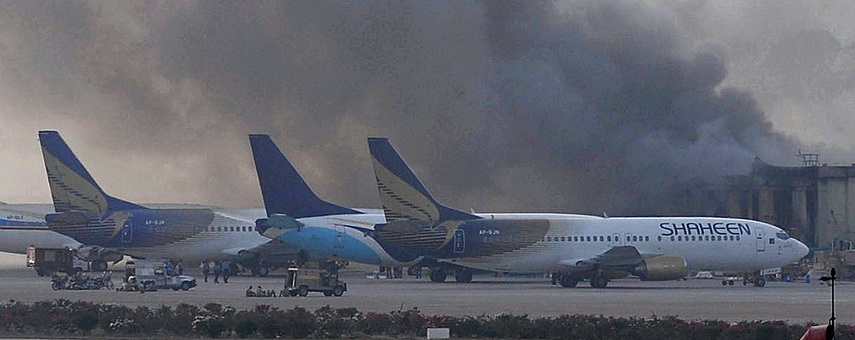
A day of deadly bombings and firefights in Pakistan claimed at least 65 lives, turning Monday( June 09, 2014) in to one of the deadliest days in terrorist violence from the north (Waziristan) to the south (Karachi) and the west (Balochistan). It also underlined the gravity of the massive security challenges that the country faces today.
Thirty-six people, including ten terrorists, were killed and over two dozen injured in a terrorist attack on the country’s largest international Karachi Airport (twenty-nine[1] bodies were recovered on Monday while another seven[2] were recovered on Tuesday). The same day, five[3] soldiers were killed in a North Waziristan suicide attack on a security forces’ convoy’s firing while twenty-four[4] shia Muslim pilgrims were brutally executed in Taftan near the Pakistan-Iran border, presumably by radical anti-Shia Sunni terrorists.
The outlawed terrorist outfit Tehreek-i-Taliban Pakistan (TTP), claimed responsibility for the airport attack.
The assault turned out to be the biggest strike in terms of human casualties in over four years and reminded of the massive security challenge that comes from affiliates of Al-Qaeda holed up in the mountainous Pakistan-Afghanistan border terrain.
In recent months, the TTP sleeper cells in Karachi have been under attack by the police and the paramilitary Rangers, provoking the terrorist group into focused attacks on security forces and strategic installations across the country.
The Pakistan International Airlines (PIA) resumed its flight operation after 17 hours Monday afternoon as the security forces swept the airport and eventually declared it safe for resuming flight operations.
Military officials said seven terrorists were put down while three blew themselves up when cornered. All of them were reportedly wearing suicide vests, a device that terrorists on termination missions usually wear.
By putting down the attackers, the security forces presumably preempted a big hostage-taking too as foodstuff like dates, chickpeas, hand-grenades and petrol bombs suggested the terrorists had come for the long haul.
“This was revenge for Hakimullah Meshud’s martyrdom (who was killed in a CIA-drone strike on November One, 2013) and a warning against the impending military operation that the government is preparing against the “helpless and innocent tribes in Waziristan,” a TTP statement sent to media via email said.
In an earlier message on their Facebook page, the TTP said: “The biggest reason for attacking Karachi airport is because it serves as the biggest air logistics centre supplying goods for the Crusaders’ war in Afghanistan and Pakistan,” referring to the Karachi Port which handles the Afghanistan-bound US-NATO cargo.
Timeline: major terrorist attacks in Pakistan
[5]On October 10, 2009, in a deadly terrorist attack on Pakistan army headquarters (GHQ), four terrorists who launched the assault with sophisticated weapons were killed whereas six soldiers including two senior army officials were martyred here on Saturday.
[6]On May 22, 2011, four people were killed in an armed attack Sunday by terrorists on PNS Mehran, a heavily guarded base of Pakistan Navy, located along Sharea Faisal, according to a foreign news agency.
[7]On August 16, 2012, seven heavily armed militants stormed the Pakistan Air Force’s Minhas airbase at Kamra during the early hours of Thursday, sparking an intense gun battle lasting almost five hours.
[8]On December 15, 2012, at least three people, including a police officer were killed and 46 others were injured in rocket attacks on the Bacha Khan International Airport and subsequent exchange of fire between security forces and terrorists on the Old Bara Road on Saturday night.
The TTP had claimed responsibility for all these terrorist attacks, attributing all these cases to its revenge for the May 2, 2011, secret US raid that killed Osama Bin Laden in his Abbottabad compound.
Background
Major General Rizwan Akhtar, the head of the paramilitary outfit Rangers, who led the operation, hinted at the possible involvement of Uzbek militants in the deadly attack.
“From their appearances they look like Uzbeks but we will wait for the DNA tests to say something with authority,” Akhtar responded when asked whether foreign terrorists carried out the assault. This is not the first time that the officials named Uzbeks.
Viewed against this, the Karachi attack has to be looked at from various dimensions.
Firstly, the TTP again appears at the centre of a terrorist pattern that ostensibly aims at hurting the country’s economic interests and isolating it internationally. Following the broad-day attack on the visiting Sri Lankan team in March 2009, for instance, all foreign cricket teams refused to visit Pakistan, thus bringing an end to international cricket in the country.
Secondly, the TTP appears to enjoy active support of fighters that belong to the Islamic Movement of Uzbekistan (IMU), a dissident group that escaped persecution in Uzbekistan and settled down in the mountainous region of Waziristan between Pakistan and Afghanistan following the Taliban regime’s defeat in December 2011.
Particularly since the killing of its leader Tahir Yuldashev in a August 2009 operation, the IMU has increasingly gravitated towards Al-Qaeda and acted as its militant arm against the Pakistani security apparatus, which it sees as the major stumbling block in its fight for survival in a country where the space on Al-Qaeda and its other foreign affiliates has increasingly shrunk.
Thirdly, the TTP and its foreign affiliates do draw support from the “enemy within.”
“Such a coordinated attack is not possible without inside information,” Jalam Hussein, a former Pakistan Air Force commodore told the CNN. “We really have to think very seriously of purging the security apparatus of such inside supporters,” Hussein said.
Fourth, the recent breakdown of the TTP talks with government also revived a new string of attacks against security and strategic targets despite a several week engagement. The talks offered by Prime Minister Nawaz Sharif in an attempt to improve internal security led nowhere.
The government and the security forces found it impossible to accept the TTP demands like enforcement of Sharia across the board, withdrawal of the army from the tribal regions and a peace zone for itself. And soon after the stalemate became evident, the army began pounding IMU and Chinese Uighur hideouts in Waziristan mountains, where the TTP provides them social cover. The East Turkestan Islamic Movement (ETIM) represents Uighur Muslims who too want an independent Xinjiang and have been reportedly waging a war on Chinese interests from the Pak-Afghan border region.
Fifth, while Al-Qaeda and its Pakistani affiliates embed their terror campaign in the call for jihad against the Pakistani government and the military by al-Zawahiri, Al-Qaeda’s current chief, Pakistani security analysts also interpret the string of high-profile attacks as an attempt to engineer the country’s international isolation.
“The only message flowing from these strikes is that foreigners and foreign airlines should not fly into Pakistan,” Talat Masood, a retired general told the CNN. He also recalled the cold-blooded execution of (Jun 23, 2013) of nine foreign tourists in an unprecedented attack in the Himalayas of Nanga Parbat, one of the highest peaks in the world. The night-time raid killed five Ukrainians, three Chinese and a Russian – in what was the worst attacks on foreigners in Pakistan in a decade.
Sixth, some officials tie the TTP-led terror campaign to the proxy war that both Pakistan and India have been involved in for quite some time. Pakistanis accuse the TTP of being an Indian proxy, while the Indian and Afghan establishments treat Afghanistan’s Taliban, particularly the Haqqani Network as Pakistani proxies.
Often, Indian officials blame the Pakistani spy agency ISI for attacks on Indian interests, including the suicide strike at their Consulate in the western Afghan city of Herat last month.
“Unless we accept these attacks as the direct consequence of the Indo-Pak proxy war, no administrative measure will be able to preempt and prevent on attacks on Pakistan’s geo-strategic interests,” a serving police official dealing with counter-terrorism.
Lastly, the Karachi attack, too, exposed the weaknesses in the early warning capacity of the Pakistani security apparatus; while forces on ground managed to engage and neutralize the attackers within five hours, restoring air traffic by noon, questions loom over the intelligence.
Hasan Askari Rizvi, a prominent security commentator based in Lahore, wonders as to how such a big number of attackers remained undetected.
“This requires a deep introspection and represents a huge challenge for the government and the entire security agencies. Counter-terrorism would require extremely close coordination which could possibly in early warning as well,” he said.
The string of terrorist attacks also triggered a nationwide criticism of the entire security apparatus, prompting critics to question their effectiveness.
“Attacks on such sensitive installations speak volumes for the inaction and incapacity of security and intelligence apparatus of the country to deal with the security challenges despite billions of rupees being spent on their maintenance. [9]Thirty-three security organizations including all the intelligence agencies, which deal with internal security, have more than 600,000 personnel that exceed the strength of Pakistan’s standing army but still terrorists have hit the Karachi airport, according to the National Internal Security Policy (NISP), asked the mass circulation The News.
(Written and compiled by Imtiaz Gul, CRSS senior research fellow)