



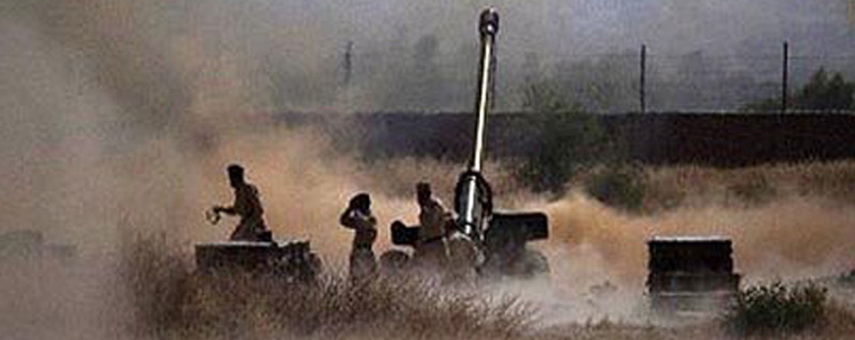
On June 4, two Pakistan army soldiers were killed in what officials claimed was an early morning cross-border attack on checkpoints in the troubled tribal region Bajaur Agency near the frontier with Afghanistan.
Officials claimed terrorists from across the border fired on Pakistani border posts at Manozangal and Mukha Tops, according to Pakistan army officials, the third such incident in less than two weeks.
On the same day, a suicide bomber crashed into a double-cabin vehicle of security forces near Rawalpindi killing two military officers and three civilians. The Inter-Services Public Relations (ISPR) department identified the two senior officers as Lieutenant Colonel Zahir Shah and Lieutenant Colonel Arshad Shaheed.
Previously, on May 31, at least 14 militants were killed when Pakistani border guards had repelled a cross-border attack on a military post in the Warra Mamond tehsil of Bajaur Agency.[1]
On May 25, five paramilitary Frontier Corps soldiers were wounded in an attack on a border check post. Security forces had claimed to have killed five militants in the retaliatory action. The paramilitary troops had chased the fleeing militants into Kaga Pass area where a check post was also set up.
Most of the attacks have been attributed to the Tehreeke Taliban Pakistan – the banned terrorist outfit – which has recently suffered a major split resulting in the isolation of a faction considered by the state security apparatus as “irreconcilably against the interests of Pakistan.”
The recent terrorist strikes (on army and para-military) thus can be as reprisals by the isolated TTP which seems to be gradually turning the heat on Pakistan because of
Context
At a traditional tribal Jirga in Miranshah, the administrative headquarters of the embattled North Waziristan, on May 25th , presumably on the instance of Gul Bahadur, the Haqqanis, and a scion of the fabled Faqir of Ippi of Waziristan namely Sher Mohammad also attended the unusual gathering. (Faqir of Ippi won fame by raising a private Lashkar to resist the British colonial rulers in 1936). Mohammad is in fact a grandson of Faqir of Ippi’s brother.[2]
During the Jirga, elders, militants spoke of the “endless miseries” that Dawar and Utmanzai Wazir tribes in North Waziristan have been facing because of the continuous military and militant operations.
Taking advantage of the raging sentiment against militarism, Sher Mohammad Ippi resurrected a theme that had served as the driving motive for his granduncle’s anti-British jihad; khpal watan , khpal Ikhtiar ( authority to rule and ones’ own land).
If foreign and local forces don’t seize their activities and do not agree to live in peace, we must wage a war in defense of Waziristan, was how Sher Mohammad Ippi argued. And this became the major rallying point for the entire gathering. It was also misconstrued as a declaration of war on Pakistan by the Waziri tribesmen.
According to another version from inside Waziristan, Sher Mohammad was demanding that the government stop the military strikes and hold dialogue with the tribesmen to restore law and order. The first of its kind in nearly a decade, the Jirga’s aim was to, “establish peace in the country in general and in Waziristan in particular”.[3]
Script Unfolding
The gathering took place to the backdrop of legitimate woes faced by Waziri tribes; massive displacements, disruption in business, destruction of livelihoods and deadly targeting of military interests in the region. They also sounded wary of the growing buzz about a military offensive in the region following a string of deadly direct attacks against and ambushes of the military and FC convoys and installations.
So it made perfect sense that women and children , young and old had all converged on Miranshah to ventilate frustrations and anger, followed by demands for definitive action against those jeopardizing peace in the region.
Did it all happen in a vacuum as a spontaneous reaction to the volatile conditions, or was it part of carefully crafted script that various stakeholders had been working on for quite some time?
Probably both; people at large appear and sound fed up with the uncertainty prevailing in the region. Also, the military’s patience with the guarantors of the 2007 peace agreement – renewed in February 2008 a day before elections – wore thin and it apparently conveyed to the Haqqanis and Hafiz Gul Bahadur to get ready for action against all those attacking and hurting the Pakistani interests. The obvious targets included several commanders of the TTP (associates of the Shehryar Group) , who had been living in those North Waziristan areas – virtually controlled by the Haqqanis and Bahadur. That also implied that despite being “friendly” to the state of Pakistanis, these warlords certainly ignored – if not approved – anti-military actions by these hostile TTP factions.
It was no secret either that Bahadur and his comrades in a brazen duplicitous way did provide sanctuaries to anti-state foreign militants from the Islamic Movement of Uzbekistan (IMU), East Turkestan Islamic Movement (ETIM) and Al Qaeda — something borne out by the recent panic among foreign militants, who have been leaving the Waziristan region for fear of strikes.[4]
No surprise that much of the anger during the Miranshah Jirga was directed at Bahadur and the Haqqanis too because a number of foreigners have been living under their wings.
This alarming situation – from the government’s perspective – necessitated correction and realignments. And hence, the following facts;
New Dynamics
Accompanying the warnings by the military was the TTP split, led by Said Khan Sajna – who wields considerable influence over Mehsud-dominated areas in South Waziriatan such as Laddah, Pirghar, Makeen to Shakai and Janatta.
Clearly, Sajna represents those Mehsud-based TTP elements which are not hostile to the presence of the military. He also favours talks within the Constitution of Pakistan, and would want the IDPs also to return home as soon as possible.
Secondly, Hafiz Gul Bahadur, despite his recent noises against the impending military action and his opposition to the polio campaign, too, belongs to the so-called “good Taliban” and has served as the guarantor of peace deals in North Waziristan.
Following the Jirga in Miranshah and his rare belligerent “brinkmanship” interlocutors persuaded Bahadur into a meeting in Rawalpindi or Islamabad end of May (according to some tribal sources). The meeting was supposed to iron out differences, but Bahadur is ostensibly striving for a better deal.
Those who know Bahadur well took his belligerence with a big pinch of salt; he is only trying to raise his stakes in the unraveling situation in Waziristan, said those familiar with the Waziri warlords, basically deriding and dismissing Gul Bahadur’s antagonism as a mere show.
Thirdly (as reported in previous TFT analysis), the TTP split, and Bahadur’s latest bargaining for “value addition” to his services may have paved way for the revival of a trilateral shura comprising Tehreeke Taliban North Waziristan (Bahadur), TTP (Sajna) and Tehreeke Taliban South Waziristan ( Maulvi Nazir group currently led by commander Salahuddin Ayubi in the Ahmedzai Wazir areas bordering Afghanistan.
And unsurprisingly, the killing on 6 of six militants in clashes between two warring factions of Tehreek-e-Taliban Pakistan in North Waziristan, also bear out the new dynamics. [5]
The dead included key commanders of the two groups – Shaheryar Mehsud and the pro-government Waliur Rehman Mehsud faction now friends with the Sajna group. Both have been fighting since April resulting in at least a 100 deaths on both sides. The infighting had begun in South Waziristan Agency , reportedly over territorial authority, and later spread to their respective strongholds in North Waziristan Agency and, mostly the followers of the slain former Taliban chief Hakimullah Mehsud.[6]
A day earlier, on June 5 , Ashiqullah Mehsud of Shaheryar Mehsud group was killed in a similar deadly clash with Sajna group commanders near in the Mirali sub-district of Miranshah, North Waziristan.
These events clearly underscore the unraveling of the fresh realignments among various pro-Pakistan factions.
Fourth, the TTP division, the Miranshah Jirga, the public hue and cry plus unrelenting pressure by the military authorities unleashed a new realignment in North Waziristan; the gradually mounting pressure and relentless bombing of Al-Qaeda-linked foreign militants had already forced upto 170 families, according to local sources to look for safe havens in Orakzai and Mohmand agencies, both being strategically near the Tirah in Khyber agency and the eastern Afghan province Kunar. Those abandoning North Waziristan included Punjabis, Uzbeks, Uighur Chinese as well as some Arab al-Qaeda remnants.
Fifth, the Maulana Fazlurrehman-led Jamiat Ulemai Islam (JUI-F) is likely to take lead in the next round of talks with the Taliban because this JUI enjoys considerable support in FATA, and it also supports Said Khan Sajna. . Some reports even suggest that during his Islamabad visit, Gul Bahadur also met with Fazlurrehman, and it looks likely that Fazlurrehman or his associates may finally spearhead the peace talks, accompanied by targeted strikes – both by the military and the pro-Pakistan militants – against terrorists.
Sixth, A 60-member delegation comprising elders from both tribes has also sprung into action to prevent an all-out military operation. They fear that such an action would massively disrupt life – displacing populations and destroying livelihoods.
Culmination?
Now that the new dynamics have practically struck off the already stalled government-TTP talks, many wonder as to what will the new realignments culminate in? Possibly in an agreement between the new tripartite Shura – all reconcilable Taliban and the government with the objective of flushing out unwanted TTP elements (associates of Hakimullah and the Sheharyar group.)
These non-state groups have been engaged in running feuds with one another over territory, resources and political clout any way and such inter-tribal hostilities actually dovetail the government strategy of reducing the social space on “irreconcilable” Taliban.
Once again, unfortunately, warlords remain part of this strategy – a dependence enforced by circumstances as well a direct consequence of a skewed security paradigm pursued by Pakistani military. By implication, regional warlords will continue serving as the instruments of a questionable peace management strategy.
(Compiled, written, and edited by Imtiaz Gul, CRSS Senior Research Fellow)
[1] http://tribune.com.pk/story/717323/4-injured-as-intelligence-agency-bus-targeted-in-rawalpindi-suicide-attack/
[2] CRSS Interviews with official and independent sources
[3] CRSS interview with journalists in Peshawar
[4] CRSS interviews with military officials in Rawalpindi
[5] http://tribune.com.pk/story/718283/ttp-infighting-6-militants-killed-in-north-waziristan/ and
http://www.dawn.com/news/1110986/seven-militants-die-in-fresh-miramshah-infighting-officials
[6] http://www.dawn.com/news/1110986/seven-militants-die-in-fresh-miramshah-infighting-officials