




A general consensus emerged on Monday at a Focus Group Discussion (FGD) that the ‘judicial assertion’ in Pakistan has impacted the imbalance that had existed between the state organs before the lawyers– movement for independence of judiciary in the country besides helping create an environment for establishing the rule of law with all state institutions without overstepping their respective domains as defined in the Constitution.
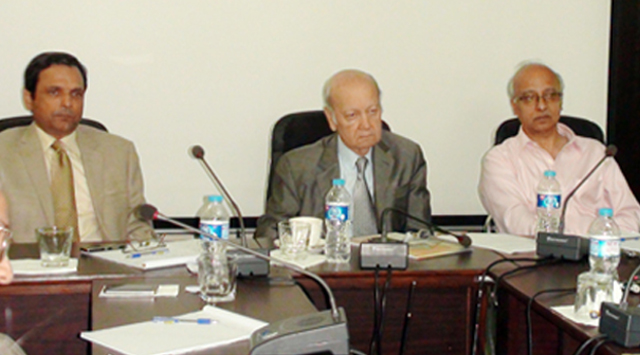
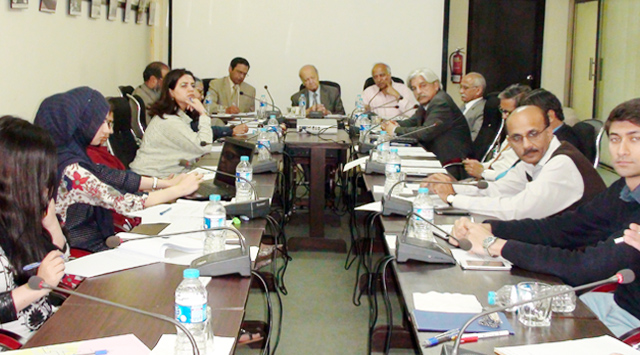
The FGD on ‘The Pakistani State, Military and Judiciary’ was organized by the Centre for Research and Security Studies (CRSS). Lt. Gen. (Retd) Talat Masood, Lt. Gen. (Retd) Masood Aslam, Mag. Gen. (Retd) Athar Abbas, Ayaz Wazir, Masood Sharif Khattak, Ammara Durrani, Dr. Moeed Pirzada, Tahira Abdullah, Brig. (Retd) Tughral Yamin, Khalid Azeem and Imtiaz Gul were among the panelists of the discussion.
Opening the discussion, Lt. Gen. (Retd) Talat Masood said that the judicial assertion challenged the monopoly of military in state affairs and the media had played a central role in the lawyers– movement for independence of judiciary. He was of the view that the politicians did benefit from the lawyers– struggle and its consequences as the parliament has become more effective. ‘They (the politicians) have become more assertive and a consensus is emerging now that the politicians should not support military,’ he said, adding that the continuity of the democratic process too suggested that the military monopoly over state affairs was receding.
Though, he said, the judiciary under Iftikhar Muhammad Chaudhry acted immaturely as it had almost paralyzed the executive, the situation was improving now with the present Chief Justice not following the footprints of his predecessor. However, he said the environment that emerged as a result of the lawyers– movement would go a long way to strengthen the democratic process.
Participating in the discussion, Lt. Gen. (Retd) Masood Aslam said all the state institutions should accept the independence of judiciary which has started benefitting the people, though very slowly. However, he said with the judiciary becoming independent, a balance had been crated among all state institutions. But, he said, as a result of the movement, the judiciary had become over adventurous and often acted immaturely. He called for a comprehensive overhaul of the judicial system. Analyzing the situation, he said the reason the military had taken a back seat was that the media and civil society had become proactive.
Masood Sharif Khattak was of the view that the situation was not as bleak as it was being depicted. ‘We have spread a lot of pessimism. I think there is a bright future,’ he said, adding that the judiciary was moving in a right direction. ‘It an impossible thing in Pakistan that you take an army chief to the court,’ he said. He said there was a need to reform the political structure of the country. ‘The state should be run by a political structure which suits this country. Your electoral process would never give you a government which would be thinking about laws or taking you to a high pedestal.’
Tahira Abdullah pointed out flaws in the judicial system, quoting examples of parallel systems that illegally existed in the country. ‘The feudal lords, most of them sitting in parliament, support this parallel system,’ she said, supporting the demand for reforms in the electoral process. Dr. Moeed Pirzada said it was not that the judicial activism started in 2007, as it had started long ago. He quoted the examples of Sajjad Ali Shah versus Benazir Bhutto and Nasim Hasan Shah supporting Nawaz Sharif.
Brig. Tughral Yamin said the judicial activism did bring about certain consciousness that no one could take judiciary for granted. ‘It did impact the relations (between the state institutions),’ he said, however, disagreeing with a notion that the military was not at the receiving end. He said the politicians should also not go to an extent of inviting reaction from the military as it would not go in favour of the nation. ‘I agree that Pakistan has a bright future but the leaders should take good decisions.’
Referring to the lawyers– movement, Ayaz Wazir said it was initially a one man reaction to the other man reaction. ‘And, he (the chief justice) said he would not resign. General Musharraf did not expect this,’ he said, adding that it was a good beginning. He said the politicians were taking advantage of this situation.
Maj. Gen. (Retd) Athar Abbas said any system which had to survive for long needed some checks and balances. ‘Political system is the mother system. When the judiciary is blamed for taking too many cases, we have to understand the context,’ he said, adding that it was a natural process of transition as power started moving from one institution to other power centers ´ the lawyers, the civil society. He said there should be supremacy of a parliament. ‘When you start interfering with the parliamentary proceedings, this raises questions.’