



Justice and Role of Prosecution?

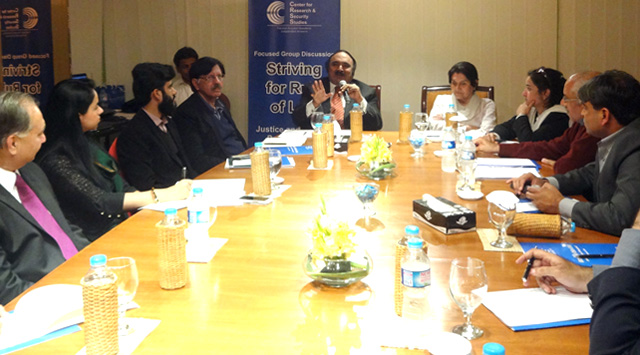
To engage the stake-holders, media and civil society in an advocacy campaign for rule of law, the Centre for Research & Security Studies organized a Focus Group Discussion (FGD) in Lahore on January 21, 2014, to emphasize the importance of an independent prosecution service in criminal justice system. The initiative is being supported by the GIZ (the German Agency for International Development).
The consultation is part of a larger project which aims at supporting the capacity and organisational development of the Punjab Criminal Prosecution Service (PCPS), created in 2006 through the Punjab Criminal Prosecution Service Act, 2006. Its purpose was to establish an independent, effective and efficient Service for prosecution of criminal cases, to ensure prosecutorial independence and for better coordination in criminal justice system in the Punjab, Pakistan most populous province, to build it as an independent, efficient and effective tool for dispensation of justice.
The participants of the FGD were: Justice (retd) Nasira Javed Iqbal, former Judge of the High Court, former Inspector General of Police Rana Maqbool, who is now Special Assistant to the Punjab Chief Minister on Prosecution, Mian Saifur Rehman, journalist, Tauseeq Sadiq, representative of the Punjab Information Department, Brig (retd) Farooq Hameed Khan, ex-official of National Accountability Bureau and a writer, Shabnam Nagi (Advocate High Court), Shahzada Irfan, writer, Ijaz Butt, Crime and Court Reporter, Abdullah Malik, President of Civil Society Network, and Irshad Arif, Columnist. Professor Dr. Amanullah conducted the FGD.
The participants highlighted the advantages and importance of an independently working prosecution service and stressed the need for mobilizing the stakeholders, in particular media and civil society, to support the development of an effective and efficient prosecution service and help create a public demand for it.
Talking about the need for an independent prosecution service, Justice (retd) Nasira Javed Iqbal said an independent (of executive and political influence) prosecution service was of central importance in the justice system to ensure that no innocent person was punished and no criminal went scot-free. Her argument was that the independent prosecution service was also essential to check the white-collar crime as such crimes largely involved the elite who used political influence to pressurize the prosecutors. She said until the broken bridges were built, the confidence of the people in the prosecution service could not be restored. She pointed out the flaws in the prosecution service and called for steps to modernize the service in line with the developed countries. She stressed the need for capacity-building of the prosecutors to ensure that they work independent of any pressures ´ social, economic and political.
Earlier, Rana Maqbool opened the discussion by introducing the Punjab Prosecution Service. He explained the role of the police as a central investigation agency and that of the prosecutor in dispensation of justice by the courts of law. He pointed out the difficulties faced by the prosecution department, created in 2005. The department is responsible for prosecution of all criminal cases before Supreme Court to Courts of Magistrates in Sub-Divisions of the Punjab.
Capacity-building and training of the prosecutors, according to him, were the major issues the system faced. He argued that improvement in methodology was not enough as implementation of the methodology was the core challenge being faced by the Prosecution Service. Talking about improvement in the Punjab Prosecution Service, he informed the FGD participants that efficiency and discipline were being enforced in the system, the results of which were yet to be determined. Besides, he pointed out the establishment of a state-of-the-art Forensic Science Laboratory in Lahore for bringing revolution in criminal justice system and act as an agent of change in revolutionizing investigations on scientific patterns and shifting reliance from eye-witness to scientific and physical evidence. This shift will not only cause improvement in conviction but also help in solving blind cases. It will help prove guilt of wrong-doers and disproving involvement of innocence person in a crime by giving testimony in courts of law based on reliable, authentic and accurate scientific analysis. It will also assist courts in imparting speedy justice.
The Special Assistant to the Chief Minister was confident that the introduction of the culture of investigating crime on the basis of forensic evidence at police stations would help the criminal justice system a great deal.
Advocate Ms Shabnam Nagi highlighted the practical difficulties faced by the prosecutors while performing their duties. She said lack of professionalism, training, absence of required infra-structure, low salaries and absence of logistical support were the issues which needed to be sorted out to ensure that a prosecutor worked professionally and independently.
The participants of the discussion agreed on the crucial role of the civil society in sensitizing all and sundry about an indepdent and efficient prosecution service. They underscored the need for a pro-active and sustained role that the civil society must play also to build pressure on government authorities for respecting and reinforcing the prosecution service as a fundamental pillar of the rule of law.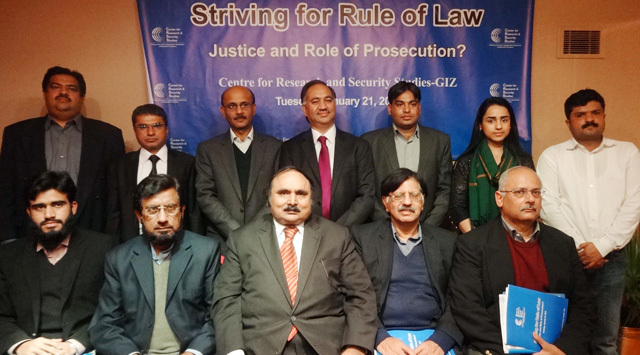
Representatives of Goverment, Civil Society, Justice System, Prosecution Service, Media and CRSS at a Focused Group Discussion titled as n on January 21 2014 at Awari Lahore
The second half of the discussion focused on suggestions for improvement in the prosecution service. The recommendations included the demand for merit-based recruitments in the prosecution department, better economic incentives for prosecutors such as decent raise in salaries, training focusing on moral, technical and psychological aspects, transparency and accountability. The participants unanimously opined that accountability needed to be ensured at the levels of the judges, prosecutors and investigators besides introduction of a mechanism to prosecute the prosecutors to prevent them from being carried away under political and financial pressures. They also suggested that in addition to an independent prosecution service, the police department should also be depoliticized in order to ensure fair prosecution.