



CRSS Security Report | Q3 2026
Q3, 2026 Security Landscape
Pakistan recorded a sharp increase in violence-linked fatalities in Q3 2026, reversing the declining trend reported in Q1 and Q2, with terrorism and counter-terrorism linked deaths surging by 83% compared with Q2. Driving this reversal, with its death toll more than tripled, Balochistan accounted for nearly 88% of the national increase and overtook Khyber Pakhtunkhwa as the worst-hit province in both fatalities and recorded incidents. Outlaws’ fatalities more than doubled and accounted for nearly three-quarters of the additional deaths nationwide. However, the combined death toll among civilians and security personnel also rose by nearly 54%, indicating that the increased losses extended across all three groups, tallied the Center for Research and Security Studies (CRSS).
Overall Tally
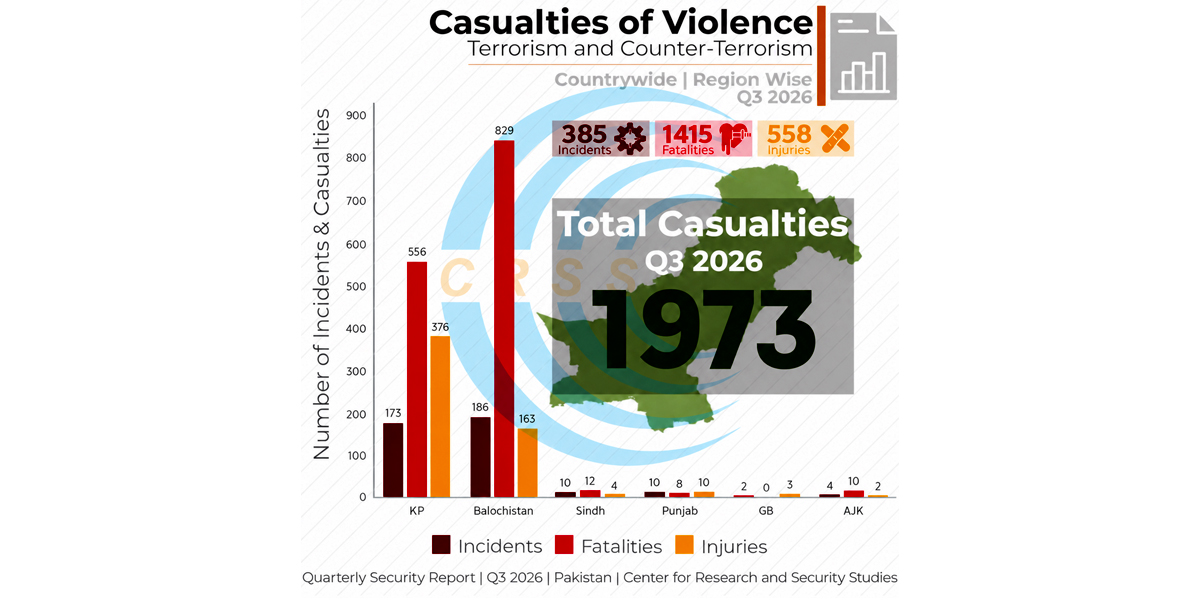
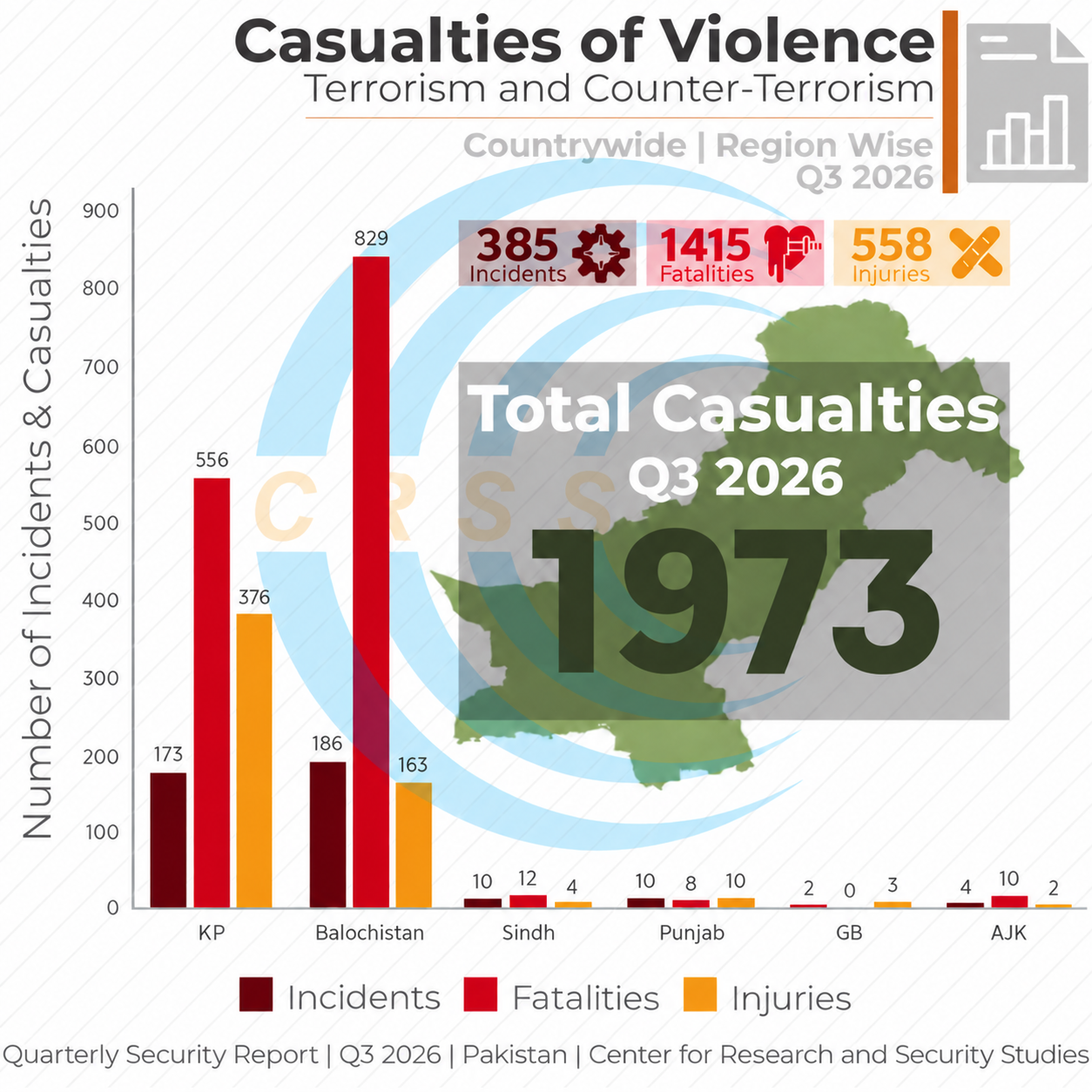
During the third quarter of 2026, the Center for Research and Security Studies (CRSS) recorded at least 1415 violence-linked fatalities and 558 injuries among civilians, security personnel, and outlaws across at least 385 incidents of violence involving terrorist attacks and counter-terrorism operations in Pakistan.
Regional Impact
In terms of regional impact, southwestern Balochistan and northwestern Khyber Pakhtunkhwa (KP) provinces were the epicentres of violence, with the former recorded as the worst-hit region during the period under review. Jointly, they accounted for 98% of all violence-linked fatalities, with almost 59% (829) recorded in the former and over 39% (556) in the latter province.
Balochistan also suffered the highest number of violent incidents in Q3, 2026, i.e. 186 (over 48%), followed by KP with 173 (nearly 45% of all incidents of violence). Moreover, KP suffered the majority of violence-linked injuries, i.e. 376 (over 67%), followed by Balochistan with 163 (over 29%).
Comparative Impact
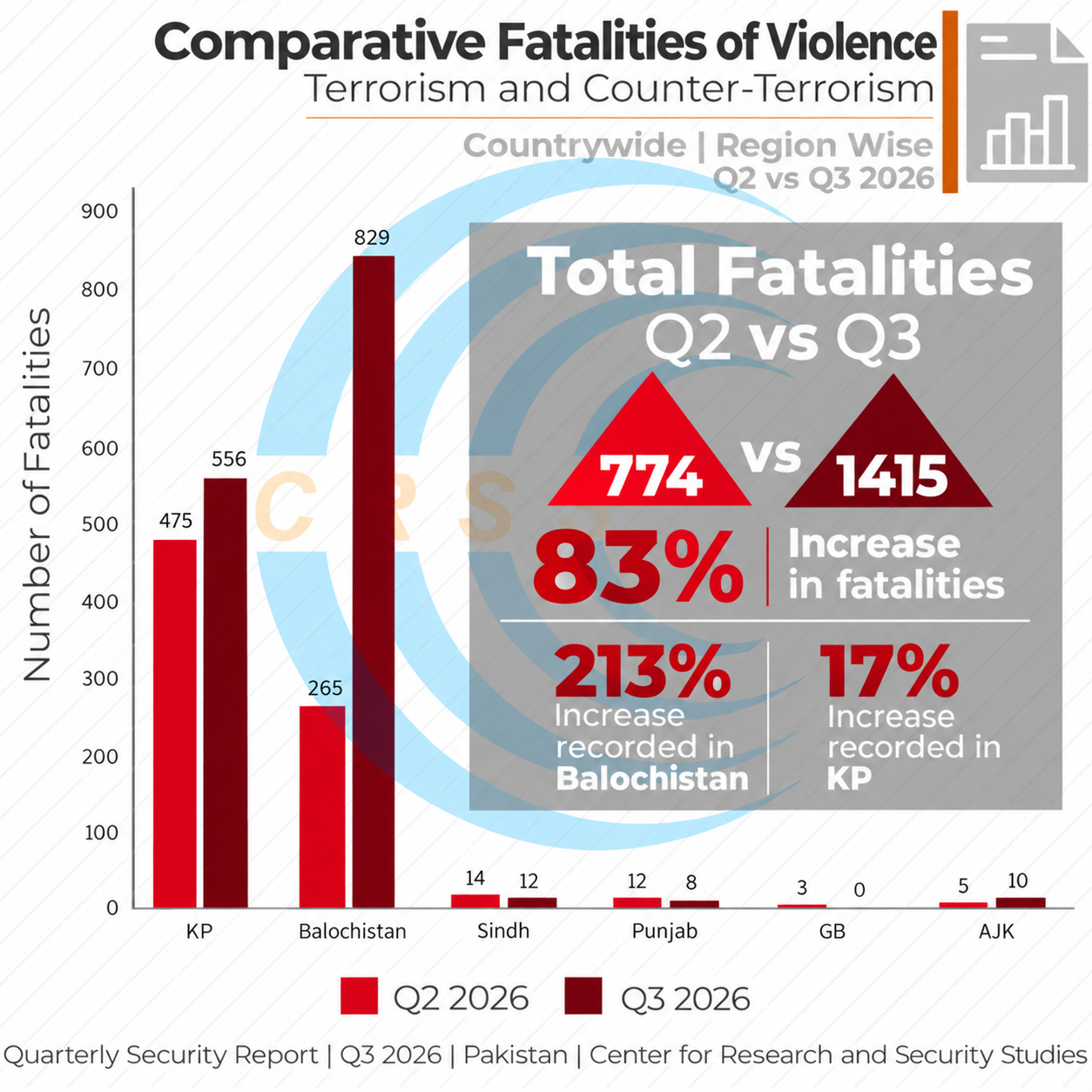
In terms of comparative impact, the country recorded a whopping 83% quarter-on-quarter surge in violence related to terrorism and counter-terrorism, marking the highest escalation since 2021 as well as discontinuing the trend of declining quarter-on-quarter violence reported by CRSS for the first and second quarters of the year.
The reported surge in violence between Q2 to Q3, 2026 (from 774 to 1415 deaths) was largely driven by the sharp escalation in Balochistan province, which recorded almost 213% more fatalities compared to the last quarter, i.e. 829 vs 265. On the contrary, in Q2, 2026, the province recorded over 40% less fatalities compared to the first quarter of the year, i.e. 265 vs 443 – Q2 vs Q1. In Q3, 2026, KP also suffered over 17% percent surge in violence – with fatalities jumping from 475 to 556.
Slight reductions were recorded in Punjab, Sindh and Gilgit Baltistan regions, with fatalities declining from 12 to 8, 14 to 12, and 3 to 0, marking 33%, 14% and 100% less violence, respectively.
In, AJK, the fatal toll rose from 5 to 10 in the reporting quarter, marking 100% surge in violence.
By Victims
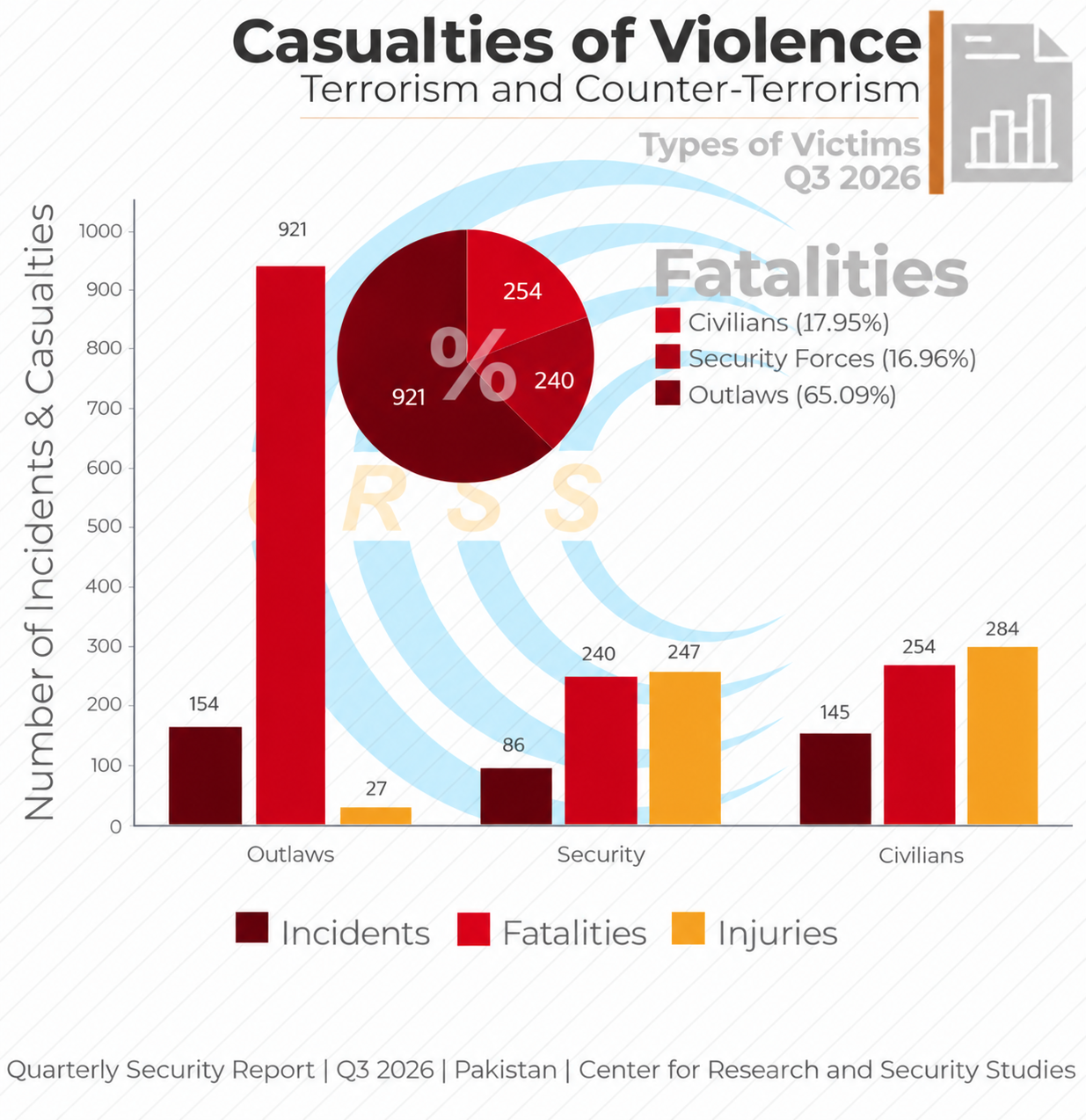
During the period under review, the majority, over 65%, of the recorded fatalities belonged to the outlaws, i.e., 921 deaths, as a result of almost 154 security operations. Moreover, the outlaws accounted for only 5% (27) of the total injuries recorded in Q3, 2026.
Civilians followed with 254 fatalities (18%) and security personnel with 240 (17%), across 145 (38%) and 86 (22%) terrorist attacks, suffering 284 (51%) and 247 (44%) injuries, respectively.
The aforementioned figures indicate the following trends:
First, a potentially encouraging feature of Q3, 2026 security landscape was the substantial rise in outlaws’ fatalities, which more than doubled – surged by over 103%, from 453 in Q2 to 921 in Q3, 2026. Nationwide, violence-linked fatalities increased by approximately 83% as reported above, with 641 additional deaths. Of these additional deaths, 468 were outlaws, accounting for nearly three-quarters of the overall increase. Outlaws thus accounted for the largest share of the sharp 83% rise in national fatalities.
Second, fatalities also rose substantially among civilians and security personnel. Security personnel fatalities increased by over 79%, from 134 to 240, while civilian fatalities rose by almost 36%, from 187 to 254, reversing the decline recorded in Q2. Their combined death toll increased by nearly 54%, from 321 to 494.
Third, the injury burden remained concentrated among civilians and security personnel. Together, they accounted for 531 injuries, or approximately 95% of the total, with civilians alone accounting for just over half.
Fourth, with the outlaws accounting for only 5% (27) of all injuries, alongside the substantial rise in outlaw fatalities, highlights the fatality of the counter-terrorism operations.
Fifth, injuries among security personnel more than doubled, rising by approximately 111%, from 117 in Q2 to 247 in Q3. Civilian injuries increased by about 39%, from 205 to 284. This shows that the injury burden grew much faster among security personnel, although civilians still recorded the highest number of injuries.
Sixth, security personnel fatalities approached the civilian death toll in Q3. Civilians recorded 254 fatalities and security personnel 240—a difference of only 14 deaths, compared with 53 in Q2.
Claims
TTP emerged as the deadliest group among those claiming responsibility for attacks in Q3 2026, with 13 attacks causing 117 fatalities and 65 injuries. BLA claimed five attacks that killed 34 people and injured 42, while HGB-IUM claimed three attacks that caused 27 fatalities and 129 injuries—the highest injury toll among these groups. Historically, TTP’s claimed attacks accounted for more fatalities than BLA’s since 2021 (706 versus 650), although BLA led the listed 2026 tally (173 versus 165).
Methods
The breakdown by method shows a clear contrast between attacks causing more deaths and those causing more injuries. Nine vehicle-borne suicide attacks caused 285 casualties—81 fatalities and 204 injuries. They produced the highest combined toll of any recorded method, considerably exceeding the 35 casualties caused by three other suicide bombings.
Armed attacks caused the most fatalities, with 147 deaths and 116 injuries across 61 incidents. Shootings were also predominantly fatal, causing 72 deaths and 18 injuries across 58 incidents—four fatalities for every injury. Meanwhile, 30 incidents involving recovered bodies accounted for 77 deaths, and a single kidnapping-and-killing incident caused 31 fatalities, with no injuries recorded in either category.
Drone attacks produced a substantially higher injury toll than death toll, causing 48 injuries and 13 fatalities across 16 incidents—nearly four injuries for every death. Alongside vehicle-borne suicide attacks, they illustrate how some attack methods caused disproportionately high numbers of injuries.