



By Engineer Muhammad Darjat
As floods, glacial melt, landslides, and cloudbursts increasingly damage irrigation systems and other essential infrastructure across Gilgit-Baltistan, cement-heavy construction is proving costly and difficult to sustain. Muhammad Darjat makes the case for combining indigenous knowledge, participatory planning, and nature-based engineering to build infrastructure that mountain communities can afford, maintain, and adapt to a changing climate.
In high-altitude mountainous watersheds across Northern Pakistan, productive physical and social infrastructure—specifically community irrigation facilities, drinking water systems and other common facilities including small bridges, pathways, village and valley roads, —serves as the core precondition for socioeconomic development.
Escalating climate volatility, rapid glacier melting, abnormal cloudbursts, and intensified monsoons have drastically increased the size, frequency and scale of vulnerabilities to soil erosion, debris and mudflows, mass landsliding and floods resulting in loss and damage of crops farmland and other utilities including off-grid hydropower stations.
This article discusses the current practices in planning, construction and management of irrigation systems in the high lands. In the mountains people have been using indigenous techniques and local materials in construction and operation of these common facilities. But more recent trends show that development interventions are focused heavily on rigid, conventional “grey” infrastructure, means use of concrete, which has a high cost and is difficult to repair and maintain when it breaks; especially due to floods and mudflows or landsliding.
At the micro-level in the mountains the grey structures, when subjected to thermal expansion, soil creep, seismic motion, or riverbank undercutting, these irrigation facilities crack, break, collapse, and fail completely. The recurrent loss and damage of these physical assets due to climate change impact create severe financial burdens, forcing an ongoing dependency on government’s financial resources and sometime looking at external donor funding for post-disaster interventions.
Unlike other provinces, in Gilgit-Baltistan, there is no government-managed irrigation department, almost all the irrigation facilities are managed by the people themselves. However, the government’s water management department along with disaster management department supports the communities by provision of construction materials including cement and pipes for restoration of damaged irrigation facilities.
In 2025, with the funding from FCDO, and technical support from the Aga Khan Foundation and CONCERN enabled Aga Khan Rural Support Programe (AKRSP) and AKAH along with village organizations in complementing the efforts of government in the humanitarian actions in Gilgit-Baltistan. In total 114 community managed irrigation channels, sixteen drinking waters supplies were rehabilitated and additionally 103 most vulnerable households have been provided grant for removing debris from their farmland to ensure cultivation of next crop mostly for consumption at home. GBDMA reports showed over 400 irrigation channels were damaged in 2025 due to climate change related impacts.
In collaboration with provincial disaster Authority, district administration and support of chief secretary office, the concerned government departments rehabilitated the lager infrastructures including the Valley Roads and bridges and irrigation channels in Danyor and Sultanabad.
This year, since June 2026, there were sixty disaster events which have damaged Valley roads, including a key RCC bridge at Haramosh village on Jaglot-Skardu Road, which connects Baltistan division with Gilgit region and rest of the country. The locals say that it is now over a week after the floods have hit the village, yet relief work has not been initiated in Khaltorow which has a population of around 300 people. People are waiting for the humanitarian assistance and only helicopter sorties can provide food and essential Medicine, because the road network has completely damaged.
The government built damaged, hydropower stations on the main road and 6-kilometer road in the deep Valley will take months to restore the supply of electricity in the village and the access valley road
NDMA’s August 1, 2026, report shows that over 329 houses have been damaged (both partially and fully) in Gilgit-Baltistan. The cumulative figures of houses damage for the four provinces of Pakistan and A & JK and GB stands at 1114 and 39% of the total houses fully damaged are in GB.
So far twenty villages have been badly impacted by the disasters, and the village name include Lous, Doyan Khichik, Losala Thore, Buner Dass, Khanbary, Darel, & Tangir; Tormik, Ganji Bala, Gursey, Marcha, Yugo, Guwari, Kuro; Haramosh, Naltar, Bagrote, Juglote, Jutal, Yasin, Ishkoman, & Barswat . Discussion with locals reveals that the Primary causes of disasters included monsoon cloudbursts, glacial lake outburst floods, accelerated glacier melt, and riverbank erosion
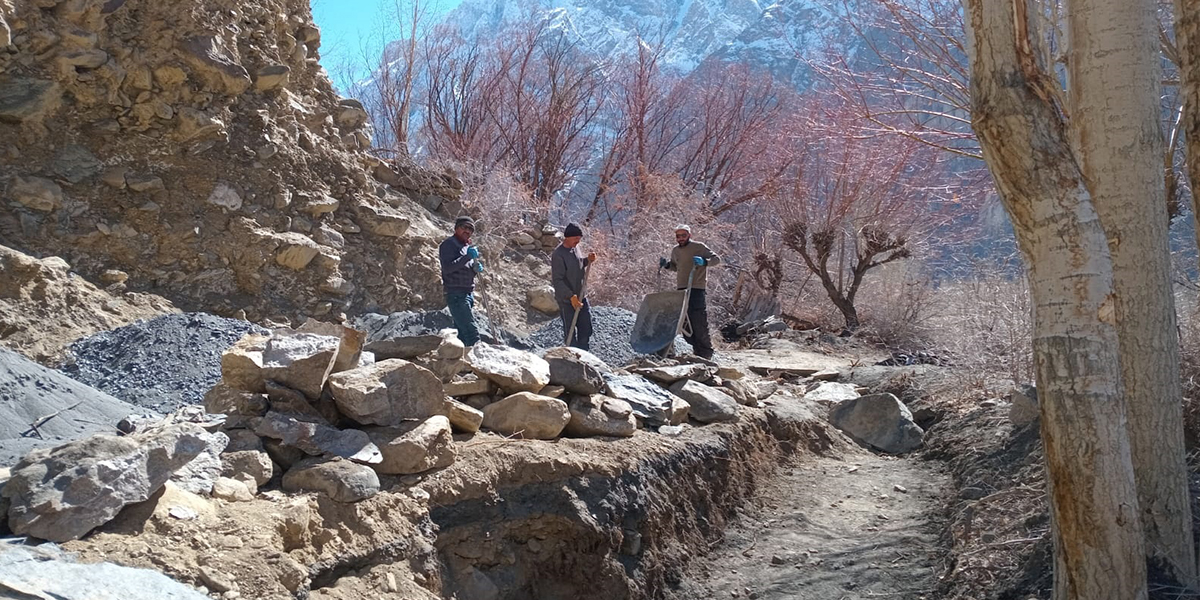
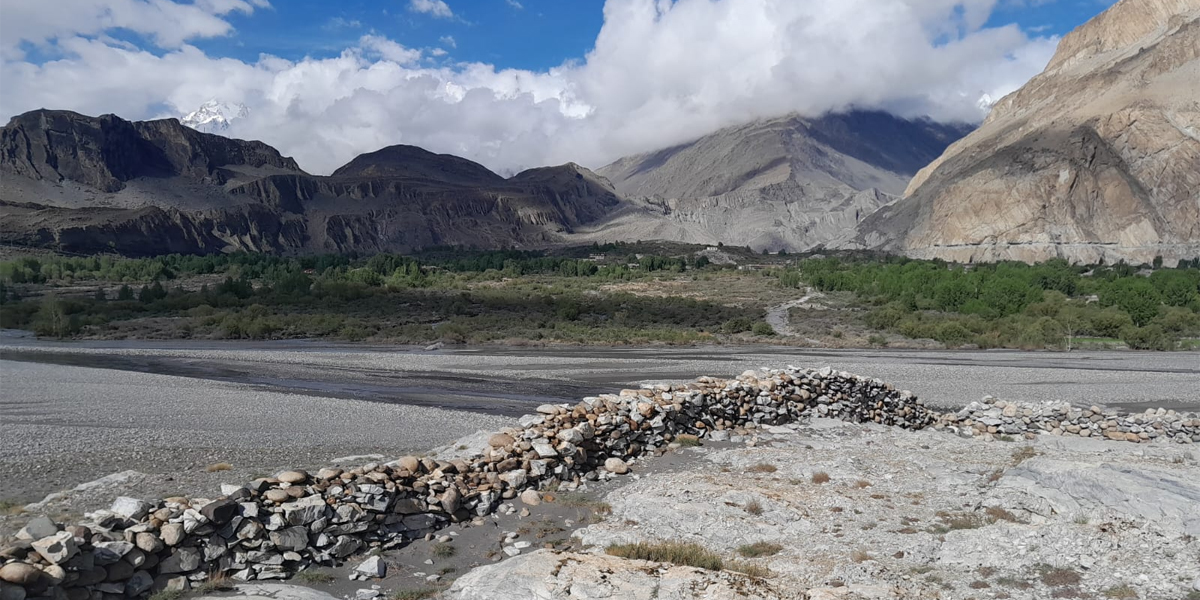
Traversing the deep valleys during the past two years what I observed is that there is a growing trend in promoting grey designs and construction with an attempt to regulate high-velocity water flow. Especially it is so when the grant comes from outside of the village. I observed that these concreate structures frequently suffer from shear cracking, breaking sediment, and high maintenance costs. But indigenous structures, especially the irrigation facilities which have been in operation for centuries have the resilience, flexibility, low maintenance cost and requires less time in restoration unless the situation requires gravity flow or syphon through HDP pipes which are most visible in those watersheds.
The dry-stone masonry, bioengineering packages and new products including geogrids, geotextiles, grafting with the indigenous practices might accommodate soil displacement and micro-settlement without total system failure. But these all needs to be debated, discussed and tested before taking them on a scale.
In a few months’ time there is an upcoming local government election in GB and certainly the elected local government will prepare budget around the micro-level projects including the rehabilitation work of irrigation systems. Therefore, there is a need to undertake participatory planning exercises which should be facilitated by experts who have the competencies in use of participatory methods in planning processes and have knowledge of climate sensitivities and nature-based solution knowledge. Otherwise, it is presumed that most of the budget will be allocated for gray structures which consume high cost and low probability of repair and maintenance and that puts pressure on the financial resources of the country. Secondly, the workplans of concerned organizations engaged in supporting communities in restoration, recovery and rehabilitation work hardly reflect capacity building needs for engineers and other staff in planning and execution of these water structures in response to the impact of climate change.
In addressing these growing climate related vulnerabilities, constraints and lack of interest of organizations in capacity building of their professional staff before devising any capacity-building framework and specialized training program for engineers and other officials at managerial positions. the need is to undertake situational analysis of the current policies and practices in physical planning, design, capacity building of officials and construction of physical productive infrastructure at micro-level.
There is also need for revisiting Aga Khan Rural Support program’s project cycle that was promoted in the 1980’s on key assumptions including effective participation of local people, transparency, and community ownership. The process used to be called “Diagnostic Approach” based on a series of organic village dialogues. The first dialogue with the village people focused on analyzing the socioeconomic situation and identifying the priority micro level need of the village that has a potential to enhance family income if that is built with grant money.
Apart from confirmation of the priority need by the villagers in a meeting, the second dialogue focused on physically traversing the site of the priority need/ project along with the community members. This visit had an objective to learn about the physical condition of the terrain including water sources, seasonal flows, and potential physical hazard vulnerabilities.
The field teams, including the engineers, social organizers and the community, must debate, discuss and agree upon the alignment of the proposed project that was to be built with the grant money and initially it was the Aga Khan Foundation seed money and later other donors including CIDA. The focus was on moving beyond concrete by designing flexible water channel linings, sizing automatic sand flushers upstream of intake gates, and inserting critical weak links to safeguard overall irrigation channel networks during major ground shifts. Moreover, physical traversing, which is the essential part of the planning exercise will not only look at the best alignment criteria including the cost-effective and high command area principal but look at the whole sum of package in minimizing the risks of damage and losses during the floods and mudflows.
Designing climate-resilient structures using nature-based solutions requires a balanced approach across five core areas. First, engineers must assess site dynamics and geotechnical baselines, evaluating key properties like soil shear strength (how well the ground resists movement), permeability and infiltration rates (how water moves through the earth), and slope geometry to respect natural stability thresholds and prevent landslides. Second, the design relies on eco-hydraulic and bio-hydrological principles—using flow velocity equations to calculate water velocity and placing targeted micro-interventions, such as bio-retention basins, to manage water runoff and control sediment retention and transport. Third, the proposed project integrates bio-engineering materials and native vegetation, prioritizing indigenous, deep-rooted plant species that naturally anchor the ground through biological reinforcement. Fourth, these natural elements undergo hybrid structural integration, blending living systems with traditional engineering to preserve overall structural integrity. Finally, the design must respect socio-ecological maintenance thresholds by utilizing local labor, local materials, and community-led operational mechanisms, hoping to ensure the physical structure remains resilient against long-term climate change impacts.
My experience with local organizations over the past four decades shows that the implementation of the action plans through a cost-effective delivery mechanism through local organizations are the best in terms of quality construction, ownership and sustainability.
To inculcate the fresh thinking and best practices through nature-based solutions among the professional staff of institutions both government and non-government including rural support programs in Pakistan, engaged in rural development humanitarian assistance would need structured training sessions. And that should follow combining technical lectures, participatory hazard mapping, and peer review of past structural failures.
Engineers can analyze climate impacts on a specific watershed, perform design calculations for bioengineering components, and critique existing regional projects. Ultimately, the training of engineers in the complete project lifecycle will equip them with insights into the best practices all over the world of having similar physical and social and institutional environment. In the eighties and nineties, I remember late Engineer Hussain Wali Khan, while heading the program operations of Rural Support Program of Aga Khan Foundation in Pakistan greatly discouraged use of external materials for two reasons the high cost of cement and peoples capacity in reconstructing the concreate structure when it breaks.
When put into practice, these fresh thinking, knowledge and skills can lead to a substantial reduction in disaster-induced asset loss, significantly lowering annual repair expenditures, efforts and time for local people and reducing pressure on financial resources of the country and the local people. And this climate adaptation action will guarantee consistent, reliable water conveyance for local crops and domestic use despite shifting discharge volumes. By shifting away from cement-heavy construction toward indigenous materials and local labor, communities gain fiscal autonomy and reduce their dependency on external grants.
Most importantly, this effort establishes a replicable model for mainstreaming nature-based solutions across at least 200 union councils for early recovery, rehabilitation and long-term climate adaptation programs in Gilgit-Baltistan and Chitral.
Way forward : The first logical step would be in revisiting the current policies, planning and implementation practices in micro-level projects with focus on water related projects and suggesting frameworks that focuses on two core actions a) investment in human capital to promote nature-based solutions and b) mobilization of financial resources at district /union council level that specifically responds to the restoration, recovery and rehabilitation of micro-level facilities those are being repeatedly damaged by the climate change outcomes in the fragile mountain ecology in Pakistan.
By: Engineer Muhammad Darjat
August 2026