



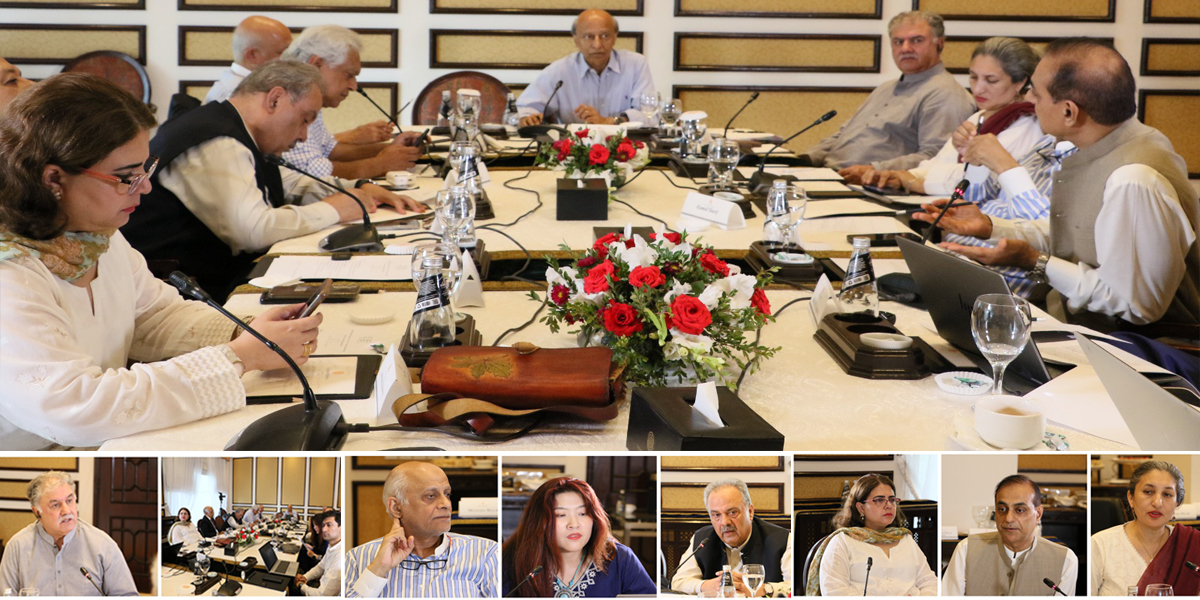
Pakistan and Afghanistan must move beyond a predominantly security-driven paradigm and instead cultivate their relationship in sustained dialogue, socioeconomic cooperation, and pragmatic regional engagement to prevent bilateral tensions from hardening into prolonged hostility, speakers said at a roundtable titled “Pakistan-Afghanistan Relations: What Next? Towards Pragmatic Policy Pathways in a Shifting Regional Order”, convened by the Center for Research and Security Studies (CRSS).
Bringing together experts and former officials from Pakistan, Afghanistan, China, and Uzbekistan, the discussion examined the persistent trust deficit, the TTP challenge, border closures, trade disruptions, and the wider implications of strained Pakistan-Afghanistan relations for regional connectivity. Participants acknowledged Pakistan’s legitimate security concerns but cautioned that prolonged border restrictions, reactive policies, and an excessive focus on government-to-government engagement risked deepening economic hardship, humanitarian suffering, and political estrangement.
The speakers called for a calibrated policy framework that combines verifiable action against cross-border militancy with continued trade, people-to-people contact, Track 2 engagement, and greater involvement of regional and multilateral institutions. They stressed that geography made sustained engagement unavoidable and that economic interdependence should serve as the foundation for a more stable and functional relationship.
Maj. Gen. (R) Inam Ul Haque argued that Pakistan-Afghanistan relations have been viewed too narrowly through a government-to-government lens, while it primarily needs to be seen through business-to-business and people-to-people ties – that bind the two countries – as the paradigm of engagement. He stressed that conflict is not the natural course of bilateral relations and called for socioeconomic considerations to take precedence over geopolitical calculations. However, he cautioned that the TTP issue remains the principal source of contention and that unless it is addressed, relations are likely to remain marked by an uneasy peace in the years ahead.
Abdul Waheed Waheed, Afghan scholar, argued that the deeper problem lies in the inconsistent and frequently changing policy choices pursued by both countries over the past five decades, which have repeatedly generated mistrust and instability. While the current terrorism challenge has placed the TTP at the centre of bilateral discourse, both sides must abandon the blame game, accept the undeniable reality of a permanent neighbourhood, and pursue solutions through sustained engagement and policy consistency.
Pakistan’s Former Special Envoy for Afghanistan, Ambassador Asif Durrani, argued that, for Pakistan, the TTP constitutes the central issue in relations with Afghanistan, with most other bilateral tensions linked to the group’s presence inside Afghanistan and use of Afghan territory to launch cross-border attacks against Pakistani civilians and security personnel. He maintained that meaningful improvement in relations required concrete action to disarm the TTP and deny it safe havens. Drawing on his tenure, he said the Afghan authorities had repeatedly offered verbal assurances, but stressed that these needed to be translated into commitments under a written and verifiable mechanism. He also described dialogue with the TTP as deeply problematic because of the group’s rejection of Pakistan’s constitutional order and its rigid ideological position.
Lt. Gen. (R) Asif Yasin Malik underscored the importance of Track 2 dialogue, citing its past contribution to resolving people-to-people issues. Drawing on his experience of dealing directly with the TTP, he said that no externally supported insurgency could succeed without a conducive domestic environment. He called for measured, consistent policymaking rather than knee-jerk reactions, arguing that Pakistan-Afghanistan relations could not remain security-driven and must instead be anchored in socioeconomic cooperation.
Ali Raza Hanjra, Project Director of CAREC-RIBS (ITTMS) at the Federal Board of Revenue, argued that trade could serve as a vehicle for progress across all dimensions of Pakistan-Afghanistan relations, but stressed that sound policy must provide the engine. He noted that chambers of commerce retained the capacity to sustain engagement even during political tensions, while identifying the absence of the Afghan Chamber of Commerce from CAREC mechanisms as a critical missing link. Since socioeconomic and people-to-people interdependence can create stakes for bilateral cooperation, he cautioned that viewing the relationship predominantly through a security lens would restrict trade, weaken connectivity, and deepen mistrust rather than resolve underlying tensions.
Haroon Sharif, Former Minister of State and Chairman of Pakistan’s Board of Investment, argued that any economic relationship that has the backing of geopolitical sentiment is not sustainable. He cautioned that regional frameworks such as CAREC could create only limited space for engagement while political and security tensions remained unresolved, and that neither China nor any other external actor would assume significant stake amid persistent instability. Future economic engagement with Afghanistan, he maintained, should therefore be structured through trilateral arrangements rather than relying solely on bilateral cooperation.
Hamza Boltaev, Head of the Center for Afghanistan and South Asian Studies at the Institute for Advanced International Studies (IAIS) in Tashkent, Uzbekistan, said Central Asian countries had shifted toward pragmatic, economically focused engagement with Afghanistan since the Taliban takeover, resulting in greater emphasis on transport projects, connectivity, and people-to-people exchanges. He noted that Uzbekistan’s political and academic circles increasingly recognised the relevance of Pakistan for greater regional stability, as a key actor in Afghanistan-related affairs, and the direct consequences of Pakistan-Afghanistan relations for Central Asian stability and economic integration. He cautioned that politicising the Pakistan-Afghanistan border was counterproductive to regional connectivity.
Dr. Ma Zheng, Senior Associate Researcher at Sun Yat-sen University, underscored that China remains a proponent of peace and stability in the Pakistan-Afghanistan region and beyond. The Urumqi process, initiated by China, has enabled open communication channels between the two countries. China did not begin this process for its own self-interest, but for regional and collective interest. China remains deeply concerned about Afghanistan’s economic and humanitarian issues. Pakistan and Afghanistan are geographically close, but politically very distant.
Ammara Durrani, senior development expert and former Assistant Resident Representative of UNDP in Pakistan, said that China, Russia and Uzbekistan, have established pragmatic relations with Afghanistan, Pakistan needs to follow suit; managing relations pragmatically despite continuing disagreements, drawing a parallel with the United States’ managed rivalry with China. She also urged multilateral and financial institutions to support functional cooperation through a dedicated financial framework that could protect existing investments and generate tangible incentives for engagement.
Dr. Salma Malik, Assistant Professor at the Department of Defence and Strategic Studies, Quaid-i-Azam University, Pakistan, emphasized that a public-backed Afghanistan policy could produce sustainable relations. Pakistan should prioritise economic cooperation, recalling China’s longstanding advice to place disputes on the back burner and focus on economic engagement.
Hamid Sharif, Former Asian Development Bank (ADB) Country Director for China and Asian Infrastructure Investment Bank (AIIB), called for a coordinated regional approach in which Afghanistan’s neighbours jointly address the threat of terrorism. He also stressed the need to reset trade relations with Afghanistan, arguing that economic engagement should remain a core pillar of regional stability.
Imtiaz Gul, Executive Director CRSS, urged policymakers to assess border closures not only through a security lens but also in terms of their long-term humanitarian, economic, and regional consequences. While acknowledging Pakistan’s exposure to cross-border terrorism, he noted that the prolonged closures were not sustainable for a country seeking regional connectivity. He highlighted the hardship faced by patients dependent on specialised treatment across the border and called for policy recalibration that could preserve security without severing essential human and economic links.