



by Islomkhon Gafarov
Afghanistan’s education system faces a critical crossroads under Taliban rule. With religious studies prioritized over secular and scientific learning, limited opportunities for girls, and chronic underfunding, the country risks long-term setbacks in innovation and development. Yet, regional partnerships, progressive Afghan institutions, and emerging online education initiatives offer avenues to preserve learning, empower communities, and bridge the gap between tradition and modernity.
The Taliban’s assumption of power in August 2021 exerted a profound impact on the socio-cultural and political fabric of Afghanistan. The ensuing politico-spiritual transformations reverberated across the country’s economic sphere and the of its social life. The system of primary, higher, and postgraduate education found itself in a precarious position, shaped by the abrupt shift in political and ideological orientation following two decades of American presence. In effect, instability in the educational sector emerged as a direct consequence of the transition from a Western-oriented model to an Islamic conception of education. This transformation is poised, in the long term, to generate a complex set of socio-political and economic challenges for Afghan society.
Current Situation and Challenges
The contemporary education system in Afghanistan faces a range of profound structural and institutional deficiencies.
The Taliban administration in Afghanistan has placed a clear priority on the religious dimensions of education over secular and scientific disciplines. Consequently, theological subjects occupy a central position in curricula – often as compulsory components – while the development of natural sciences and technical fields remains severely constrained. This imbalance impedes the formation of an innovative environment and hampers progress in strategically significant domains such as information technology. Over the long term, in an era defined by global competition and digital transformation, such limitations are likely to undermine Afghanistan’s competence and competitiveness on the international stage.
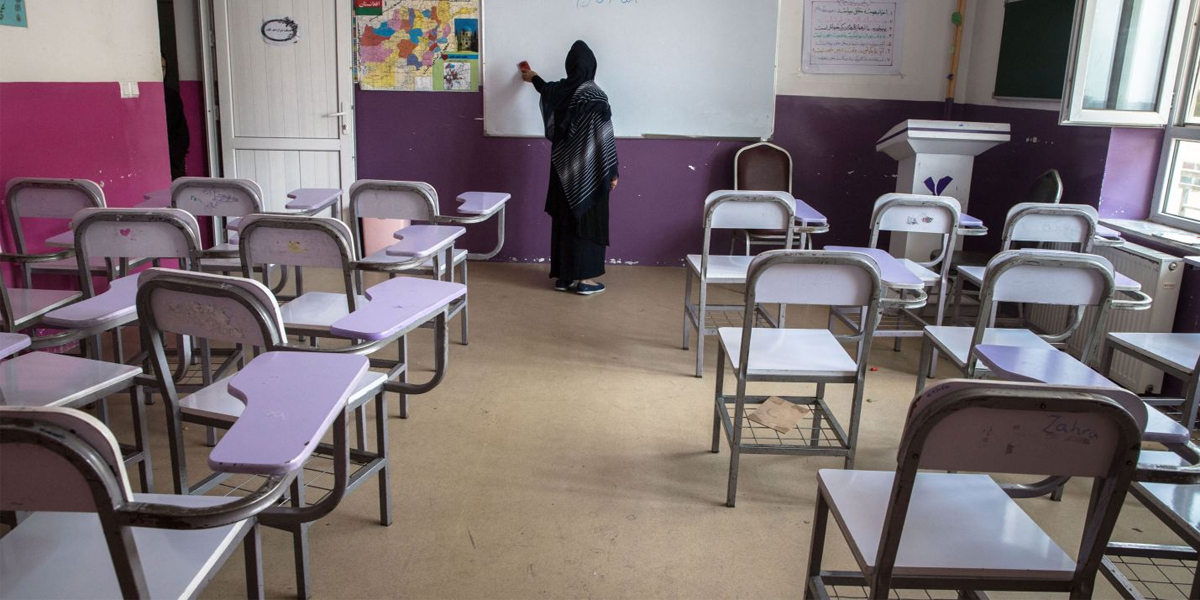
A second major challenge, which has drawn considerable attention from the international community, concerns the restriction of educational opportunities for women and girls. Under the prevailing regulations, girls are permitted to attend school only up to the sixth grade – a policy with the potential to generate serious social problems over time. This is particularly acute in critical sectors such as healthcare, where the absence of female professionals could precipitate a systemic crisis. Given the prevailing religious and cultural norms that prohibit interaction between male physicians and female patients, the shortage of qualified female medical personnel is becoming chronic, thereby exacerbating existing deficiencies in the national healthcare system.
Also, there exists a pronounced misalignment between prevailing pedagogical methodologies and contemporary educational standards and requirements. Over the past four decades – amid conditions of political instability and armed conflict – curricula and syllabi have undergone extensive ideological infusion, with a pronounced emphasis on concepts such as “jihad” and “mujahid”. This has entrenched a religious-political paradigm within the educational process. In the post-war context, there is a pressing need to adapt pedagogical approaches to the country’s evolving socio-political realities. Continued reliance on shaping students’ worldviews primarily through the prism of jihad heightens their vulnerability to radical propaganda and facilitates recruitment by terrorist organizations such as the Islamic State Khorasan Province (ISKP) and al-Qaida, which promote the ideology of global jihad.
Furthermore, the education system also suffers from chronic underfunding, which constrains its capacity to modernize infrastructure, develop scientific programs, and ensure the effective training of personnel.
The outflow of qualified professionals remains one of Afghanistan’s most pressing challenges: many educated Afghans seek to leave the country at the earliest opportunity, resulting in a persistent “brain drain” and a further erosion of the nation’s developmental potential.
Moreover, the insufficient level of support for scientific research –particularly in the areas of policy consulting and the formulation of governance solutions – exacerbates the shortage of institutional competence and diminishes the effectiveness of the state apparatus. Expert assessments point to an acute need within the Taliban’s political leadership to develop managerial and administrative capacities, a factor that has prompted the partial recruitment of personnel from the former administration of Ashraf Ghani. Nevertheless, the movement’s leadership generally exhibits limited interest in institutionalizing such domains: the establishment and advancement of research infrastructure, as well as the creation of expert-advisory mechanisms, remain outside the priority agenda, thereby impeding the long-term strengthening of governance capacity.
Progressive Forces
A number of progressively minded Afghan institutions are actively seeking to improve the national education system, viewing this process as a key driver of the country’s development. In their perspective, Afghanistan once stood as one of the centers of the Second Renaissance, a legacy vividly reflected in the creative and intellectual contributions of such eminent figures as Alisher Navoi, Kamoliddin Behzod, Abdurahman Jami, and others. Today, institutions including the Academy of Sciences of Afghanistan, Kabul University, Jami University, and several other academic and educational centers demonstrate sustained interest in modernizing education, expanding cooperation with international partners, and attracting external expert support. Notably, on 21-22 September, an international conference entitled “Evaluating and Enhancing Quality Assurance System in Higher Education” is scheduled to take place, aimed at advancing Afghanistan’s higher education system through the adoption of leading international practices.
International Assistance
Afghanistan’s system of higher education remains largely oriented toward cooperation with member states of the South Asian Association for Regional Cooperation (SAARC), particularly Pakistan, rather than with the countries of Central Asia. Within Afghan society, Pakistan is perceived as a more “kindred” partner compared to its Central Asian neighbors. Islamabad, in turn, leverages this perception as an instrument of soft power, providing substantial educational support to Afghanistan. In 2025, Pakistan offered approximately 4,500 scholarships to Afghan students, 33 percent of which were designated for women and girls. In addition, in September of the current year, around 100 Afghan master’s students and 50 doctoral candidates are expected to arrive for study at Pakistani universities.
Nevertheless, despite these initiatives, there is a persistent trend of Afghan students not returning home upon completing their studies. Many graduates remain in Pakistan or emigrate elsewhere, thereby reducing the effectiveness of international academic assistance programs and limiting these specialists’ contributions to Afghanistan’s reconstruction and development. With regard to the education of girls and women abroad, under the gender policies of the Taliban regime, women are permitted to leave the country for study only if accompanied by a mahram (a male guardian), a requirement that significantly restricts opportunities for pursuing education overseas.
With regard to India, the country is seeking to seize diplomatic initiative. It is also preparing for the potential official recognition of the Taliban regime. India has already offered 1,000 scholarships for the online education of Afghan citizens. This policy by New Delhi may serve to reorient Kabul in its favor.
Following the Taliban’s ascent to power in Afghanistan, China intensified its engagement in the country’s educational sector. Current data indicate that approximately 1,000 Afghan students are enrolled in institutions of higher education across China. In addition, the Confucius Institute at Kabul University provides Chinese language instruction to 200 students. However, in the subsequent period, Beijing’s foreign policy toward Afghanistan has undergone a noticeable shift. This change is likely attributable to the Taliban regime’s inability to offer China reliable security guarantees – particularly with regard to threats emanating from extremist groups operating within Afghan territory. As a result, China has gradually begun to distance itself from cooperation with Afghanistan, including in the educational sphere.
With regard to Uzbekistan, the country hosts the Afghan Citizens Training Centre, which provides Afghan nationals with technical training as well as instruction in the Uzbek language and literature. In addition, Uzbekistan has initiated a project to establish a madrasa in the city of Mazar-i-Sharif with a capacity for 1,000 students. These measures reflect a comprehensive approach that seeks to promote both religious and secular education among the Afghan population. In the long term, such a policy has the potential to foster a positive perception of Uzbekistan within Afghanistan, aligning with the broader strategy of employing soft power in international relations.
Conclusion
The current situation in Afghanistan calls for the development and implementation of a distinctive pedagogical methodology that integrates both Islamic and secular values. Regardless of learners’ gender, the fields of pedagogy, engineering, and medicine remain the most in demand across the country. One interim solution to the challenge of educational accessibility – particularly for girls and women – may lie in the expansion of online courses.
India has already implemented a number of successful online educational programs tailored to Afghan audiences. Following a similar model, the Central Asian states, as well as Pakistan, which possess greater cultural affinity with Afghan society, could introduce their own digital educational initiatives. However, the further development of distance learning in Afghanistan faces significant technical obstacles, foremost among them the need to ensure stable Internet access – an acute shortage that continues to hinder the country’s educational advancement.
Islomkhon Gafarov, PhD in Political Science and policy analyst at the Center for Progressive Reforms, Tashkent, Uzbekistan.
Disclaimer: The views expressed are those of the author and do not necessarily reflect the position of the Center for Research and Security Studies (CRSS). CRSS, however, provides and encourages scholarly exchange on regional and international issues and promotes policy-oriented discussion.