



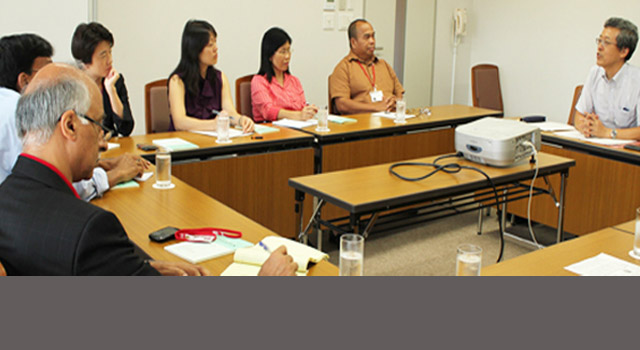
A general overview of what happening around the developing world: what is new politics in democracies craving for change or those in democratic transition? And what are the evolving challenges to traditional governance and political structures i.e. dissatisfaction with the status-quo? This was the objective of the paper read by Imtiaz Gul at the symposium, organized by the Japan Foundation and International House of Japan, on February 6, 2013.
Various stake-holders at the lower rung i.e. people and groups at large through a rights-based approach i.e. are challenging the inefficient governments through advocacy and debate on public forum for rights and justice. The facilitators are media and the civil society at large. Electronic and social media in particular and is acting as a multiplier of socio-political messaging. The question arises why are these challenges emerging?
a) Failure by the elites to deliver on governance/justice and economic fronts, and
b) More openness and ever increasing access to information
It means that state failures and shortcomings create space for non-state entities i.e. civil society, business groups, technocrats, professionals and academicians. While governments in as diverse political cultures as India and China, or Pakistan and Egypt, or Bangladesh, continue to represent the upper echelons of the society i.e. the ruling elite trying to preserve and consolidate its hold on power, while the middle and lower tiers of the society appear to be striving for breaking out of the clutches of the status quo.
In retrospect, this struggle between the forces of status-quo and those striving for change looks and sounds so familiar because the ruling classes keep preserving their hold on power ´sometime in the name of public interest, sometime in the name of national security and at times, invoking arguments that hardly favour the common man.
As far back as 1760s, French Enlightenment writer, historian Voltaire wrote in his Philosophical Dictionary 1764, Page 138: “Moralists should address their sermons to the legislators, and not to individuals ….., because it is in the order of possible things that a virtuous and enlightened man may have the power to make reasonable laws, and it is not in human nature for all the rich men of a country to renounce through virtue procuring for themselves for money, the enjoyments of pleasure or vanity.’
Then in the early last century the Italian writer, politician, political theorist, Antonio Gramsci, (1891-1937) in his prison notebooks provided an insight into the dynamics of the kind of crisis that Pakistan and many other countries are facing at the moment: “At a certain point in their historical lives, social classes become detached from their traditional parties …When such crises occur, the immediate situation becomes delicate and dangerous, because the field is open for violent solutions, for the activities of unknown forces, represented by charismatic `men of destiny’.”
And during the last 100 years or so did so, we have witnessed unusual political turmoil all over, revolutions, freedom struggles, with the result that the number of United Nations numbers has risen to 193. But does that put discontent or the craving for freedom at rest? NO, simply because the conflict between the haves and have-nots, the privileged and the non- or under-privileged has existed and exists in one form or the other:
Moreover Robin M. Williams Jr, the American sociologist, sums it up this way in his The Wars Within, ‘We confront at the dawn of the 21st century a globalized world of economic inter-dependence, of mass media and extensive networks of nearly instantaneous point-to-point communication, of numerous governmental and non-governmental organizations that crisscross state borders. At the same time we observe fierce nationalisms, fragmented and collapsed states, warlordism, ethnic cleansing, and attempted genocides’[i]
Another latest work on the pressures that traditional power structures confront today is ‘Why Nations Fail’ (by Daron Acemoglu and James A. Robinson). It speaks of the exploitation by the ruling classes that foment resentment among masses.
‘Nations fail today because their extractive economic institutions do not create the incentives needed for people to save, invest and innovate. Extractive political institutions support these economic institutions by cementing the power of those who benefit from the extraction,’[ii] Authors used this analogy to illustrate the crisis of corruption and governance as it obtains today in most African and Asian countries ´ Angola, Cameron, Chad, Haiti, Liberia, Nepal, and Sudan ´ yet it also equally applies to Pakistan and Afghanistan as well as parts of India today. In most countries a certain class of political and economic kleptocrats embodies political power and uses it for self-preservation and the benefit of its extended community. The most common tool that they invoke for doing so is democracy, while the change is painfully slow for the majority of masses.
The Arab Spring was just one manifestation of the discontent and anger with the status-quo. While many questions hang over the fate of the Egyptian Spring, a primary question remains: Can democracy be rushed down unwilling throats, or can a democratic movement i.e. peaceful protest for change, bring traditional socio-political structures down?
The way President Morsi of Egypt has attempted to entrench his Muslim Brotherhood through strict presidential orders offers an example of how delusionary such expectations can be. But what is the problem in India or Pakistan? Why are people at large crying out? Basically because there is little people-focused policy planning. The governance structures have failed to address the common man plight. For example Pakistan offers a unique example of civil society movements.
i. Human Rights Commission of Pakistan (HRCP) emerged in early 1980s despite the worst ever martial law. It has seen eight general elections since 1985.
ii. It boasts more than 100 TV and radio channels and over three thousand daily, weekly, monthly political publications
iii. Pakistan Centre of Philanthropy says more than 100000 Civil Society Organizations (SCO) and Non-governmental Organizations (NGOs) are working in Pakistan.
iv. Many Pakistani models of community development have received world recognition which includesAdult Basic Literacy Education, Leprosy Reduction Initiativeof Dr Ruth Pfau,Orangi_Pilot_Projectof Dr. Akhter Hameed Khan, AKRSP model of Shoaib Sultan Khan, andSindh_Institute_of_Urology_and_TransplantationProgram of Dr. Adeeb-ul-Hasan Rizvi.
The role of civil society was even more pronounced when former dictator General Musharraf dismissed Chief Justice Iftikhar Chaudhry in March 2007, and cross-sections of the society joined hands to demand restoration of Chaudhry and 60 other judges Or when young Malala Yousafzai was attacked by militants.
But, unfortunately, governance and economic institutional structures and the conduct of public policy have produced an elite-based political and economic process that has served to extract resources, largely for the benefit of the well-entrenched elite coalition ´ both civilian and military, resulting in mass poverty and acute inequalities.
Media despite being a mirror and monitor on the society and a crucial member of the civil society, even the mainstream media owners have also become partners in this neglect of the masses. Although media is thriving off intense socio-political debates, most media czars themselves have become stake-holders in the power structures. For instance Maverick Dr.Qadri launched an anti-government march in January and media pocketed tens of millions from Qadri for playing his campaign. At the same time media houses accept massive commercial campaigns from the army and the government.
Challenge for the Civil Society:
Whether Pakistan, India, Egypt, or any of the troubled African countries, challenges for the civil society remain as to how to articulate and lobby against systemic injustices through a suffocating bureaucracy, an indifferent political elite, economic inequalities, miscarriage of justice, deficient justice, and also how to offset impact of increasing globalization that is threatening labour rights as well as environments in developing countries.
How to serve as a beacon of hope and guidance when corrupt and inefficient public sector management led by self-serving ruling elites are incapable of providing the minimum public services necessary for a dignified life to the majority of the population? In a country like Pakistan, the challenge is even more pressing because the ruling political and military elite is compromised also because of external competing geo-political interests such as the role of the United States and NATO, their conflict with Iran and China, and involvement in Afghanistan.
In this context, the need for the civil society in societies that are going through democratic transition becomes even more crucial. While the US-led western engagement and lead of the civil society in developing countries may partially be the consequence of geo-politics, one would hope that countries such as Japan, and other prosperous members of ASEAN take lead in mentoring and helping civil societies across Asia network and work more closely for alleviation of some of the socio-political problems mentioned above.
One big challenge for the civil society in Pakistan and other Muslim world ´ over 1.6 or about 23% of theworld population is how to de-stigmatize the perception of a practicing Muslim, a perception that directly resulted from Samuel P. Huntington Clash of Civilizaions.
But hope is there as Leymah Gbowee, the 2011Nobel Peace Prize winner, offers an illustrious example of how women as part of the civil society made a difference in Liberia transition from civil war to the democratic rule Her Memoirs ‘Mighty be our Powers’ written together with Carol Mithers, Gbowee says: ‘The work is hard. The immensity of what needs to be done is discouraging. But you look at communities that are struggling on a daily basis. They keep on ´ and in the eyes of the people there you are a symbol of hope, and so you, too, must keep on. You are not at liberty to give up.'(p. 230)
Likewise ‘Long Walk to Freedom’ ´Autobiography published by ABACUS states that ‘….. The truth is that we are not yet free; we have merely achieved the freedom to be free, the right not to be oppressed. We have not taken the final step of our journey but the first step on a longer and even more difficult road. For, to be free is not merely to cast off one chains but to live in a way that respects and enhances the freedom of others…..’ This is what we must all as members of civil society strive for.
[i] Robin M. Williams Jr, The Wars Within: Peoples and States in Conflict, Cornell University, p. 1.