



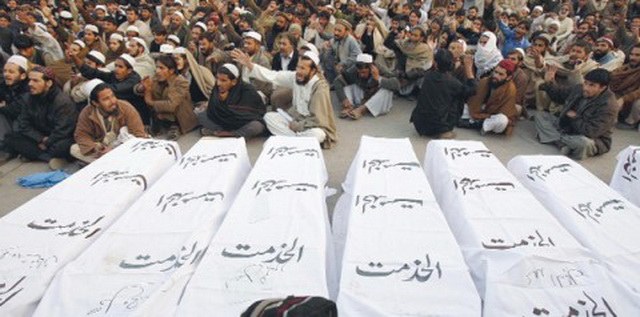
 The inhumane killing of 18 tribesmen on January 15, 2013 in Bara tehsil of Khyber Agency of Federally Administered Tribal Areas, should serve as a wakeup call for all the parties in the on-going war against terrorism in Pakistan. The recovery of these mutilated dead bodies underline the scale and level of utter disregard for human lives by the actors involved in this conflict.
The residents of the area, enraged by the indiscriminate violence and atrocity committed with their loved ones; took all the corpses of these 18 dead people to Peshawar and finally lay them outside the Governor House of Khyber Pakhtunkhwa (KP) to mark a protest. They claimed that security forces were involved in the incident while the security forces forcefully denied the accusations and alleged that militants committed these atrocities to defame the security forces.
In the recent years Khyber Agency has become a center of malicious activities led by various militant outfits and armed militias funded by unknown sources. The name of the infamous killer, Mengal Bagh (the head of Lashkar-i-Islam, a pro-Taliban militant group) is not unfamiliar to the people of the locality who introduced his own version and interpretation of highly reactionary and regressive form of religion and also devised his own way in which areas like Bara, and adjoining regions under his control, would be administered and governed. A classical example of non-state funded militias working within the boundaries of the state though not conforming to the state laws.
Therefore, the security forces have been highly engaged in battling this lethal militant outfit in these areas including the Valley of Tirah (Khyber Agency) for quite some time, where it is assumed that all these rogue elements have gone into hiding due to the favorability of the terrain, a highly rugged mountainous area with dense greenery. If one has to inquire about the evidence of security forces’ activity in the region, the best people to ask would be those living in Peshawar, especially in Hayatabad (KP). Most of their nights resembles and can be easily paralleled to any night spent in a war zone area with the sounds of heavy artilleries, rockets, tank fires, and mortars not an aberration.
These are just the problems of those who are living far away from the real areas where these offensives are taking place. Only victims like these, the corpses of whose relatives were lying in front of Governor House, can give us a better narrative of the ongoing military operations. Many have lost their sources of incomes, their shops have been closed down, some have moved to urban areas like Peshawar, where they can barely afford the rising rents of houses and the increasing prices of basic utilities for sustenance. There are still others who have in the rush of hours and basic instinct for survival has left their homes, properties and lands without making any sort of arrangement for taking them out.
However, it should be a partial and biased analysis, if the sacrifices of our armed forces are not acknowledged in this scenario where every day we hear stories and news of our security forces been battered, ambushed, kidnapped and massacred viciously by militants dwelling in these areas.
This is the dilemma of this on-going war against terrorism which always haunts our intelligentsia as well as those who are at the helm of affairs in the country. That is, how to avoid and tackle the problem of collateral damage (an euphemism which is more often used by the U.S. military to describe the loss of innocent lives during military operations)?
A moralist would ask what is the crime and fault of such innocent people who are sandwiched between the states– armed forces and the non-state militias and militants. Why are they deprived of their fundamental freedoms, rights and safeguards guaranteed under constitution for all the citizens of the state?
This paradox and jigsaw puzzle of this highly crucial but at the same time controversial Global War Against Terrorism is what many would fail to comprehend and solve. For the moment, the respectable governor of the province has announced monetary benefits for the affected families along with an announcement to set up a judicial commission to probe the incident. Furthermore, our police and security personnel have also done well to keep the protest silent and thwarted by firing tear gases and aerial shots to spread the protesting masses of students and civil sector.
But this is not a long term solution and for how long such tactics will endure only time and circumstances can tell. At the moment, what the government and our security establishment needs to do is to devise a clear cut policy to tackle this menace of terrorism once and for all by calling all the concerned civil-military concerned quarters to sit together and develop a clear strategy for it. Moreover, to reach a consensus and by also attaching a time frame to it as to how this highly critical issue afflicting and alienating a major part of our population will be tackled efficiently and effectively.
Because without such a clear consensus among all major political parties and our military leadership, we are only giving breathing space and room to the agenda of these non-state actors, who would be able and willing to hire anyone among these bereaved families to join their cause. And all it will need a little rhetoric and convincing along with a handsome monetary incentive.
Contributed by Fahad, guest writer for CRSS.