



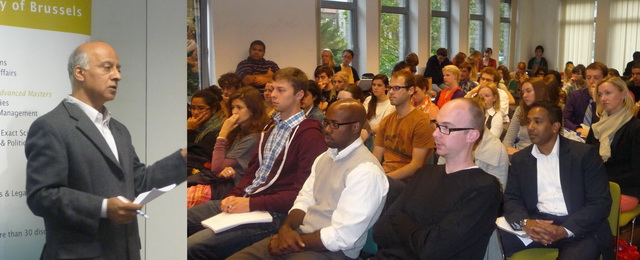
Brussels: Addressing the first of the European Peace and Studies Programme Lecture Series of 2012, at Free University of Brussels , Imtiaz Gul, Executive Director CRSS, said conflicting interests of various actors in the extended South Asian region ´ India, Pakistan, China, Iran and the United States ´ do not augur well for peace and stability in the region. Nor will these competing interests make the Afghan reconciliation any smoother. The days ahead in the region are likely to be overshadowed by the Presidential elections in the United States as well as generals elections in Pakistan a few months later. Domestic political compulsions ´ both for President Barack Obama and President Asif Ali Zardari plus the Pakistani military ´ are for the time being biggest obstruction in the way of the peace process in Afghanistan. The short-term objective of the US to pullout bulk of its troops from Afghanistan in July 2014 and the long-term interest of Pakistan not to antagonize the Afghan Pashtoon tribes inhabiting both sides of the Pak-Afghan border are mutually exclusive and thus rule out a synergy of action of these two countries, particularly because the United States as the sole super power wants to fix everything in its own way and on its terms, which result in friction with Pakistan. Also, the US antagonism with Iran casts its shadow on its relations with Pakistan. At the same time the Indian influence in Washington and Kabul, works as a discomforting factor for Pakistan, and thus holding it back from whole-hearted cooperation in efforts for regional peace. Conflicting American and Pakistani narratives on the region, Gul said , essentially lie at the heart of frictions and the lack of trust between the two countries. The mistrust flows from Pakistan alleged involvement with the India-focused militant group Lashkare Taiba and the Afghan Haqqani Network , recently designated by the US as a terrorist group.
As long as the bilateral relationship were defined by this mistrust, and both attached unrealistic expectations of each other, Washington and Islamabad would remain at loggerheads, and thus continue negatively impacting regional peace.
Imtiaz Gul, however, underscored that improving dialogue between India and Pakistan could substantially impact the regional power dynamics. If both countries could continue this momentum, this could be the game-changer not only for the region but also for the Pakistan-US relations.