



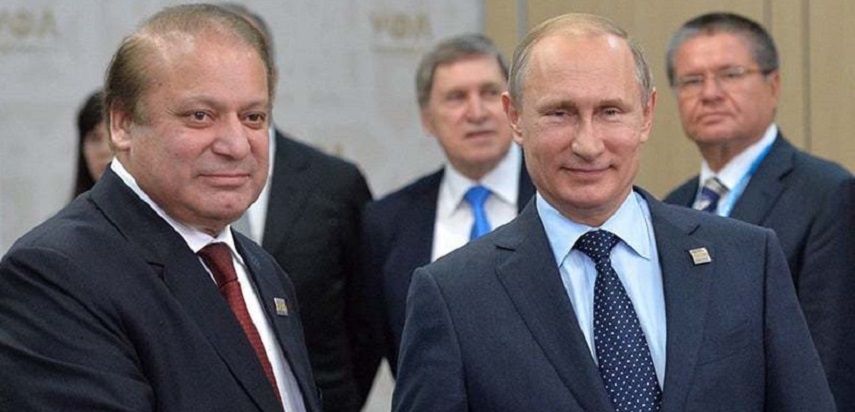
State-to-state relationships are not grounded in emotions. These are based on shared interests. No one is a friend or a foe forever; the convergence or divergences of mutual interests decide the nature of the relationship between two countries. Though, the relations between Russia and Pakistan have remained turbulent over the years, they have been warming up over the last decade with top political and diplomatic rendezvous. Moscow is reaffirming its assertion in its immediate domain and beyond, whereas Islamabad is seeking new avenues of opportunities lessening its reliance on the United States in particular, and the West in general.
Between 1947-50 and 1965-69, the two countries were engaged in the spheres of trade, education, and cultural exchanges. The 1996 Tashkent Summit between Pakistan and India also materialized due to the labors of Soviet Prime Minister Alexi Kosygin. Pakistan Steel mills remain a towering reminder of well-intentioned Pak-Russo bilateral relations. Nonetheless, the Soviet efforts were diluted by Soviet Union itself when Soviet condemnation of Pakistan’s position in the 1971 war with India deteriorated bilateral relations, and many people of Pakistan assumed that the August 1971 Indo-Soviet Treaty of Friendship, Peace and Cooperation encouraged India’s invasion of East Pakistan. Ensuing Soviet arms sales to India, amounting to billions of dollars on concessional terms, strengthened this argument. The USSR also kept vetoing each resolution regarding the East Pakistan situation that Pakistan brought to the United Nations. During the cold war, Moscow-Islamabad relations had seen many ups and downs. Incidents such as Soviet Union support for Afghanistan on Pashtunistan issue and the U-2 episode shuddered the mutual trust. The two sided relations experienced a nose dive and touched the lowest ebb during 1980s Soviet’s occupation of Afghanistan, in which Pakistan sided with United States – the Soviet’s Cold War arch rival to obstruct the furtherance of Soviet expansion and its knocking at Pakistani borders. In 2003, Russia re-established a political contact after the disintegration of USSR in 1991, when President Musharraf visited Moscow.
Presently, in the wake of contemporary regional and international challenges Pakistan and Russia are forging closer relations. In the year 2007, Russian Prime Minister Mikhail Fradkov paid a three day visit to Pakistan and discussed the prospects of economic cooperation. Few years later Russian Prime Minister Vladimir Putin in 2011, publicly endorsed Pakistan’s bid to join the Shanghai Cooperation Organization (SCO). That year Kremlin also condemned the NATO strike on Salala check post in Pakistan and termed stated it an assault on the state’s sovereignty. Moscow also offered assistance in expansion of Pakistan Steel Mills, provision of technical support for Guddu and Muzaffargarh power plants and disclosed interest in Thar Coal Project too.
Likewise, Russian Council General Mr. Demdov Andrey Vladimirovich, while speaking at the 65th anniversary of diplomatic relations between the two countries on May 01, 2013, stated, “The history of our bilateral relations saw both good and not so good. But irrespective of the state of then relations, both countries always felt the necessity to maintain good contacts.” This implicitly shows the maturity of Russian diplomacy and its cognizance of geopolitics and realpolitik. Moreover, General Ashfaq Parvez Kayani received Colonel General Vladimir Chirkin in 2013, here in Pakistan and mutual defense and security cooperation was discussed. After two months in October, both countries pledged to jointly control the production and trafficking of drugs and narcotics. Defense collaboration between Russia and Pakistan got a new stimulus, when Russia lifted embargo on arms supplies in 2014. It enraged India which was opposing the sale of Mi-35 helicopters to Pakistan. Later in November, defense ministers of both countries signed an agreement to expand defense and military ties. On December 23, 2014, Pakistan and Russia inked the much needed energy deal of $1.7 billion for laying a liquefied natural gas (LNG) pipeline from Karachi to Lahore. Then next year in June, former Pakistani Military Chief General Raheel Sharif paid three day visit to Moscow where he was warmly received in Kremlin; both sides held crucial military talks in the backdrop of emerging regional re-alliances.
The expansion of Russo-Pak ties would help in bringing stability and prosperity in the region. For Russia, Pakistan is significant in two dimensions. Firstly, because it serves as an outlet for Central Asian Republics and Kremlin would never desire instability there. Secondly, it’s the strategic location of Pakistan; it can connect Central Asian region with the middle East and Indian ocean, thus Russian goods can approach the international market very conveniently through Pakistan. Moscow also wants to invest in Pakistan’s agriculture, technology, drip irrigation and desert farming.
Pakistan can benefit from Russian defense industry – the Russian military equipment is cheaper than that of American. Russia has banned agriculture imports especially food from Europe. Pakistan in this scenario can be a competitive source of agricultural and textile goods for Russia, which offers $16 billion market in agriculture sector alone. Energy is another potential sector through which Pakistan can reap huge benefits by fashioning good friendly relations with Kremlin.
Approaches of both Islamabad and Moscow seem very pragmatic in the wake of contemporary challenges. Russia is flexing its muscle again defying the uni-polar world dominated by United States for few decades. It wants to assert its influence in the region anticipating the departure of US and NATO from Afghanistan and the resulting developments. By conducting joint military exercises and signing of Defense Pact, Russians may also be signaling India a caution over its intimacy with United States. They have been nurturing relations with India for so long, and will not let go such significant partnership that easily, but the move will give the Indians an indication that Russia has other options in the region too.
On the flip side, Pakistan has to diversify its diplomatic and strategic portfolio. It is acting practically by extending towards Russia. Islamabad wants a respectful treatment by United States and on an equal basis other than just its ‘’do more” chant. Otherwise, Pakistan is demonstrating to the US that it has other allies in the area and also ones that the US may not like. Russia is Pakistan’s natural ally. The regional block of China, Russia and Pakistan can be a win-win game for regional peace, stability and robust trade. If this block is actualized, then there is a distant possibility of Russia and China playing a positive role in mediating between Pakistan and India and also between Pakistan and Afghanistan. It’s the need of the time to procure mutual benefits in the wake of realignments of mutual interests.
The author Saddam Hussein is a research intern at the Center for Research and Security Studies while pursuing his M Phil. in Public Policy from School of Public Policy, PIDE Islamabad.
Russia and Pakistan's Reluctant Romance
TOP STORIES
TESTIMONIALS
“Fiscal empowerment, robust trade, and economic connectivity can act as buffer against radicalisation and extremism.”