



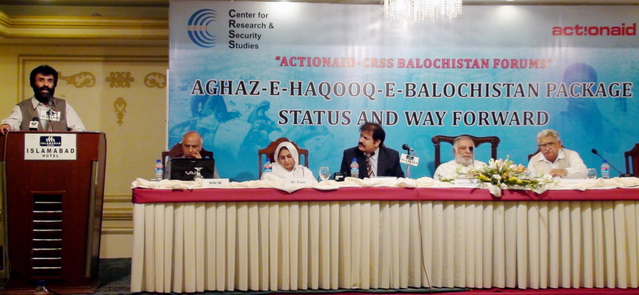
Almost all speakers at a policy dialogue titled¿Aghaz-e Haqooq-e Balochistan Package (AHBP): Status and Way Forward– organized jointly by the Center for Research and Security Studies [CRSS] and ActionAid Pakistan on June 30th, demanded quick and sincere implementation of the rights– package that the prime minister Yousuf Reza Gilani had announced for Balochistan in November 2009.
A former federal minister from Balochistan, Ayatullah Durrani, as well as a Senator Haji Adeel Khan from the Awami National Party (ANP), agreed that the implementation of the 39-point package, which was a response to the long-standing demands of Baloch nationalists, was slow and insufficient at the moment. But both also emphasized that rather than looking at the ‘glass being half empty,’ critics should look at the ‘glass being half full ‘ which had become possible under a political government and through a grand political consensus in and outside the parliament.
BothMr. Durrani and Haji Adeel pointed out that the tripling of federal financial resources for Balochistan for the fiscal 2011-2012 beginning first of July would not have been possible without the AHB Package.
Holding the Balochi Sardars / tribal chieftainsresponsible for the injustices to the Balochi people, Ayatullah Durrani, who represents the Pakistan Peoples Party in the federal parliament, questioned as to ¿why not a single educational institution has been constructed by Jogezai, Jamali, Achakzai, Bugti and Raisani ? (names of big Balochi and Pashtoon tribes in Balochistan).
For more details on the socio-political structures of Balochistan, please see the CRSS publication ‘ Pakistan Security Challenges’- available on the CRSS website in PDF Format).
Mr Durrani said that getting involved in subversive activities is not the way to get rights but to engage with the Centre and press it for fulfilling its promises to the Balochi people.He said that the present government believes in dialogue with the Baloch dissidents but there are also many criminals, dacoits, thugs among the people who are residing in mountains.– He defended government policies and also dismissed some of the allegations made about the role of the security forces and the intelligence agencies in the province, saying political authorities and the security establishment were handling Balochistan jointly.
Admitting to the fact that Balochistan resources had been exploited by the federal government for over 63 years, Senator Haji Adeel said that the present government has at least got it approved from the parliament through Aghaz-e Haqooq-e Balochistan Package that the Baloch people need be given their due rights, and also compensated for years of neglect by the Centre.
Some of the speakers also demanded a change in Islamabad’mindset towards Balochistan,’ a metaphor used to describe the high-handed approach that successive civilian governments and the military establishment have adopted vis a vis Baloch nationalists.
Blaming Islamabad for continuously treating Balochistan with discrimination for decades, Central Vice President National Party, Dr. Ishaq Baloch said that until federating units are truly recognized, federation cannot be saved. He said that the Balochs have been given constitutional guarantees of protection to their rights under the 18th amendment, but the laws still remain unimplemented.
‘Until the rulers accept and respect ethnic diversity in the country giving them right on their resources, the issue of Balochistan will not be resolved’, declaredIshaq Baloch.
Endorsing this viewpoint, former Deputy Speaker National Assembly Wazir Ahmed Jogezai, who chaired the event,said that the Balochistan assembly lacks true representation due to political polarization in the province. He underlined the need for the establishment of an independent Election Commission which could be key in holding free and fair election to replace the current provincial government, which lacks integrity and legitimacy. (Most nationalist parties had boycotted the Feb 2008 general elections.)
Pointing to the lack of implementation mechanism of Aghaz-e Haqooq-e Balochistan, Raza Narejo, expert on Balochistan affairs, said implementation mechanism for all political, administrative and constitutional matters must be in place, and tracking implementation should also be easily accessible.
Farida Baloch who is working on women uplift programs in social development sector in Balochistan said that the women affected by conflict and calamity in the province need psycho-social support and the basic health facilities. She said that women and children are the worst affected communities in the target killing and other violent incidents in the province. She pointed out that Aghaz-e Haqooq-e Balochistan has no mention of women rights.
Aziz Jamali, a government officials working on the AHB Package implementation pointed out that although the pace was slow, yet the government has managed to implement some of the promises of the Package like providing more than 5000 jobs to the unemployed from Balochistan as well as increased flow of financial resources to the provincial government.
The Policy Dialogue was part of the CRSS- ACTIONAID campaign to raise awareness on the Rights– Package and lobby for its comprehensive and timely implementation.