



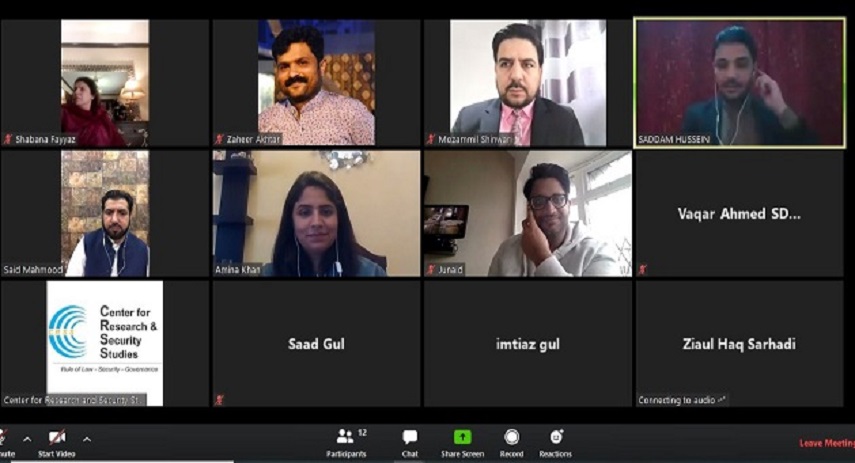
The Center for Research and Security Studies (CRSS) and its sister organization Afghan Studies Center (ASC) conducted a virtual Focus Group Discussion (FGD) on “Pak-Afghan Bilateral Trade and Transit vis-a-vis COVID-19 and the Way Forward” on April 29, 2020 via Zoom.
The panelists were of the view that both the Governments of Pakistan and Afghanistan agree on the flow of some bilateral and transit trade, despite the testing times of COVID-19 and that is why the Pak-Afghan border is now allowed to be opened three days a week. However, at present, due to limited capacity on both sides, over 7000 containers are stuck at Karachi port, while only 100 at maximum are allowed to pass into Afghanistan a day through Torkham and Chaman border crossing points.
Afghanistan relies heavily on Pakistan for transit as well as bilateral trade necessary for the livelihood of its people as well as its business community. So, when the flow from Pakistan in both cases gets halted, it not only causes inflation inside Afghanistan due to shortage of commodities, but also a lot of difficulty for the people. Pakistan has now provided special permission to resume the handling of Afghan cargo at Gwadar port under the Afghanistan-Pakistan Transit Trade Agreement 2010 to help in early clearance and quicker transportation of sugar, wheat, and fertilizer to Afghanistan. However, Gwadar port can be utilized more optimally for trade and transit for Afghan side for other goods as well.
It is pertinent to note that, the Prime Minister of Pakistan Imran Khan is keen on liberalizing measures at the Pakistan-Afghanistan border for trade, and has often issued directives, but still there is lack of clarity around the Standard Operating Procedures (SOPs).
The experts, thus, formulated the following policy recommendations:
- There is a need to establish a high-powered working group at the level of both governments with representation from the business community and relevant think tanks which can advise the government on how to continue to conduct transit trade for Afghanistan in the coming days, especially in times of a prolonged lockdown.
- The business stakeholders have requested the Government of Pakistan to follow the container inspection regulations as per Afghanistan-Pakistan Transit Trade Agreement (APTTA). Currently 100% of cargo inspection is being carried out which is resulting in delays and traffic congestion.
- Both governments should adapt safe transit trade protocols which is currently being followed by many countries across the globe
- In the absence of air cargo, movement of people should be considered following certain protocols. Apart from bilateral and transit trade, trade in services has been also reduced between Afghanistan and Pakistan, which can be normalized by the movement of people under certain SOPs
- Mistrust amongst both countries at the state-level still exists due to historical baggage. Thus, traders along with the governments should introduce tangible steps to curtail smuggling and undocumented trade, so as to avoid the adverse impact of mistrust of economic activity between the two sides
- Business stakeholders should be taken on board whilst devising any new trade policy as they are aware of the ground realities
- One window operation should be introduced for both bilateral and transit trade movement. Furthermore, this window should be responsible for each step required for the movement such as driver’s visa clearance, health and safety protocols checking etc.
- In these challenging times, border officials have a critical role as they are best placed to understand how much the border facilities are well-endowed and capacitated in terms of preventing a localized outbreak and taking care of compliance with SOPs and ensuring that necessary human resource to keep a check on the right kind of transit flows is available at the border post.
- Both sides should have separate terminals/counters for traders and their consignments, so to beef up the smooth mobility, lowering the transaction cost; hence more economic gains across the border
- Both countries ought to implement APTTA whole-heartedly as it already contains all the aspects required for transit trade as per World Trade Organization (WTO) rules and regulations
- There is an opportunity in COVID-19 crisis as well and the Pakistan must respond to that, i.e., look into COVID19 related needs of Afghanistan and how it can quickly increase exports to Afghanistan – such as exports of Personal Protective Equipment (PPE), health products, pharmaceutical, and so on. There is also an opportunity of increasing health services trade with Afghanistan, such as providing increased diagnostic facilities
- Central banks in the region have been holding their own meetings to keep regional trade going. This calls for an opportunity; meeting between the central banks of Pakistan and Afghanistan would be beneficial
- Lastly, safety and economy should go hand in hand. There is a need to adjust to the COVID-19 which is becoming neo-normal now. One cannot wait for COVID-19 to end and then kick-start the economic activity. The wheel of the economy must keep moving, though with safety protocols to minimize the risk of COVID-19 spread. We need to keep the economies from going into shut-down mode, which will have unprecedented negative spill-over effects. So, there is a catch-22; however, smart approaches can help.
The panel of experts included Dr. Vaqar Ahmed, Joint Executive Director, Sustainable Development Policy Institute (SDPI); Mozammil Shinwari, Former Deputy Commerce Minister, Afghanistan; Dr. Shabana Fayyaz, Head of Department, Defense and Strategic Studies, Quaid-i-Azam University, Islamabad; Zia ul Haq Sarhadi, former Senior Vice President, Pak-Afghan Joint Chambers of Commerce and Industry; Said Mehmood, Chairman, Harris Company and Honorary Consul General of Tajikistan; Faiza, Secretary General, Pakistan-Afghanistan Joint Chamber of Commerce and Industry (PAJCCI); Amina Khan, Senior Research Fellow, Institute of Strategic Studies (ISSI) and Imtiaz Gul, Executive Director, CRSS.