



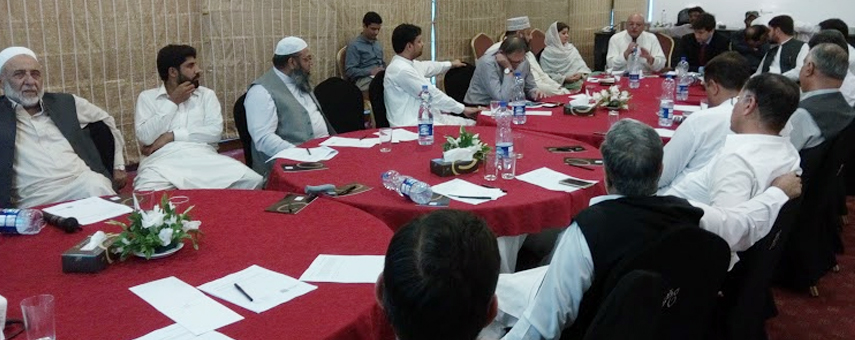
The Center for Research and Security Studies (CRSS) organized a high level policy discussion “Fostering Public Private Dialogue for Economic Reforms” between private sector and political parties’ representatives on May 20, 2017 at Pearl Continental, Peshawar.
Mr. Zahir Ali Shah, former Minister Health KPK and a parliamentarian from Pakistan People’s Party (PPP) remarked that in the previous government of PPP, Pakistan not only attained self-sufficiency in wheat production but also exported it, due to timely announcement of wheat support price by the government. Investment in renewable energy resources is systematically discouraged as it has less scope for corruption, he added. He also proposed to have a charter of economy between KPK Chambers of Commerce and politicians in the province.
Miss Shagufta Malik, former MPA of Awami National Party (ANP) emphasized on the importance of women in development. She told the quorum about the remarkable talent in women of Khyber Pakhtunkhwa. Lots of women want to work. They should be provided soft loans. CPEC ought to give space to women too, she added.
Ex-senator Mr. Ghulam Ali gave the suggestion to carve out a long term strategy for commerce and industry to flourish. Short term planning is damaging our economy.
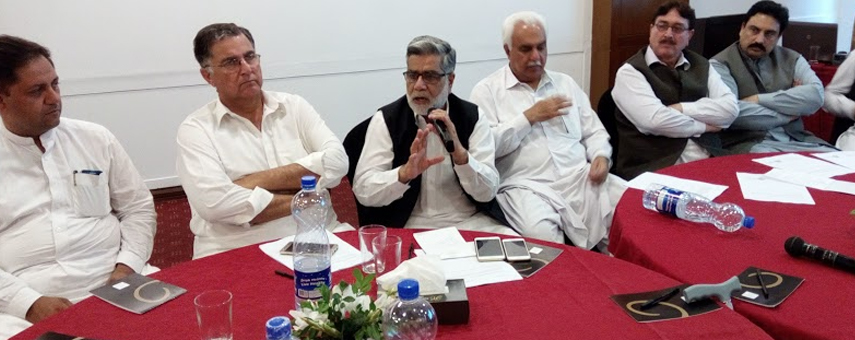
Lastly, Mian Iftikhar Hussain Shah, ex-minister of ANP said that there seemed to be more politics in business community itself rather than amongst politicians. This needs to stop. Legal protection to corruption is another impediment in the way forward. He expressed hope in Afghanistan, as it was the viable potential market for Pakistan in the region. Economic relations must not be affected by political relations between Afghanistan and Pakistan, he commented.
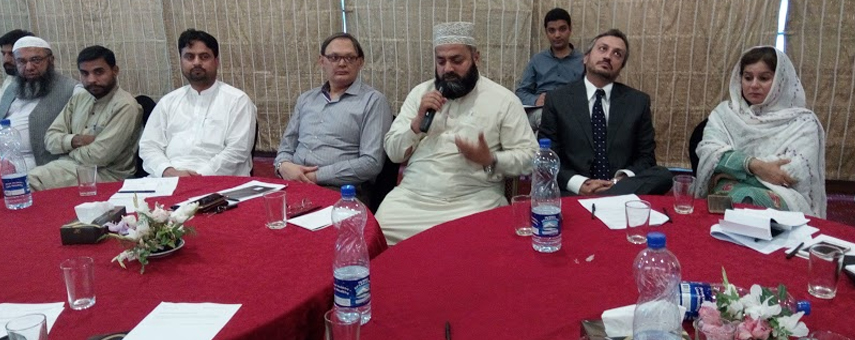
Members of business community – including Khyber Pakhtunkhwa Chamber, Mardan Chamber, Kohat Chamber, Tribal Chamber, FPCCI and other private sector representatives – thanked CRSS efforts for providing them with a platform, where they can give feedback to the politicians in formulating their respective parties’ economic manifestos. They highlighted the significant impact of government policies on trade, industry and small businesses. The members pointed out the low ranking of Pakistan’s Ease of Doing Business rating by World Bank which stands at 144/190, shows non-seriousness of government towards this sector of the economy. They impressed upon the government a sense of urgency to implement ‘one window operation’ practically. Overlapping of federal and provincial taxes after 18th amendment needs to be sorted out to prevent businessmen from bearing high transaction costs leading to an unfriendly economic environment, subsequently lowering investments in the long run. China Pakistan Economic Corridor (CPEC) may be a game changer, but without prior consultation with business community it would flush out local businesses. As it can be observed that trade deficit with China was about $2 billion before singing Free Trade Area (FTA) agreement in 2006; currently it rose to more than $6 billion. The case would have been different if proper homework had been done after proper consultation with stakeholders. Commenting on establishment of economic zones in Khyber Pakhtunkhwa, members said that none of these has been materialized yet, except for little development in Hattar. Though pronouncing security and stability a must for any development; some opined that Gadoon industrial area has become a sick unit, not because of security issues but due to poor and non-consistent government policies. Most of the fellows also complained about non-compliant of behavior of federal government.
Mr. Malik Mustafa, Team Leader, CRSS during his opening presentation shared measures to promote exports, investment, agriculture and food security, rural economies & jobs, women entrepreneurship, Social Enterprises (SEs), and for Energy Sector and Tax Reforms. These potential economic reforms areas had been identified in the draft economic manifesto developed in consultation with the business community across Pakistan.
Suggesting measures to promote exports, he said that the Cabinet Committee on Exports should be restructured. There is need for inter-provincial working group on taxation. The government should encourage export diversification through the promotion of intra-industry competition. The Budgetary measures for promoting services trade.
For provincial tax reforms, he suggested harmonization of sales tax regime. The tax registration and monthly filing of returns with multiple revenue authorities has also increased the cost of doing business. This has prompted micro businesses not to register and continue operations in the informal sector. To encourage formalization and reduce compliance costs of existing businesses it is recommended that: a) tax rates and bases on which rates are applicable may be decided by the provinces themselves, b) single tax return should be filed once all revenue authorities are virtually integrated, and c) collection of tax should be sole task of a single collection company or delegated institution.
Suggesting measures to promote investment, he said that one window operations at SECP and FBR need more effective functioning. With relevant changes in Finance Act, a certain share for SMEs may be protected in all public procurements at federal and provincial levels. There should be improved coordination for investment diplomacy across various economic ministries.
The event was a part of series of dialogue for a, aimed to provide platform to the private sector to discuss with political representatives the economic issues and challenges hampering the economic growth, and solutions and framework for economic reforms. The discourse is hoped to generate critical feedback for the economic manifestos of participating political parties.