



Balochistan Rights– Package and the State of Balochistan Economy
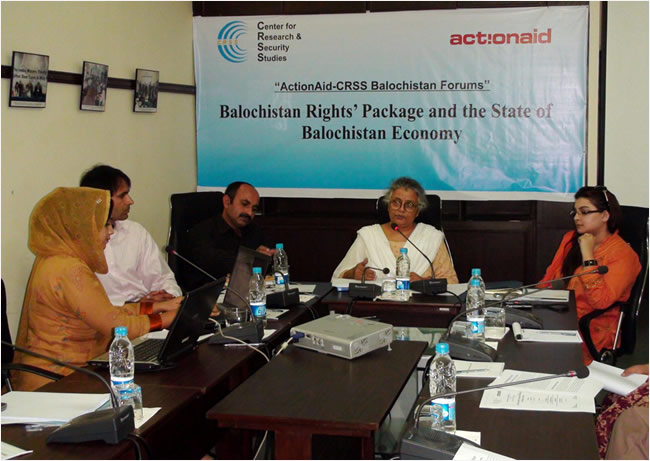 ISLAMABAD: ISLAMABAD: Poorly governed and extremely under-developed Balochistan requires urgent intervention by the Center to mitigate grievances of the Baloch people. The authority should also move from the para-military forces to the civilians to address simmering political grievances.
Underlining the urgency of the situation in Balochistan, speakers at a roundtable discussion forum jointly organized by ActionAid Pakistan (AAPK) and Center for Research and Security Studies (CRSS), said that an accelerated implementation of the ‘Balochistan Rights– Package’ could work as the urgently-needed panacea in the province that is currently reeling under ethnic and sectarian violence. Economic infrastructure development accompanied by a political reconciliation process by the federal government must take priority if the Centre is sincere in ending the isolation of the Baloch people.
Prominent PPP leader, and former member of parliament, Syeda Abida Hussain blamed the tardy socio-economic progress in Balochistan on ‘political and bureaucratic issues which are holding back the province.’ We must all join hands to break the politico-bureaucratic hold on Balochistan, she said.
Dr Rehana Siddiqui, Director of recently established Centre of Environmental Economics and Climate Change (CEECC) at Pakistan Institute of Development Economics, Islamabad, pointed out that most of the people are caught up in ‘bewilderment and are only discussing the outcomes of injustices to Balochistan,’ while neglecting the indigenous causes of prevalent sorry state of affairs in the province. Discussing some of the economic indicators, Dr. Siddiqui reminded the participants that Balochistan mining share in GDP declined from 2.7 per cent in 2004 to 2.4 per cent in 2011, while the coal production has dropped by 10.6 %. It is primarily because of the ongoing security instability and political unrest in the province. She said Reko Diq and gold projects could be beneficial for the province if properly exploited. Citing figures from different sources, she explained that the rise in poverty is higher in Balochistan as compared to other provinces, and the existing mistrust in the province towards the federation is the root cause of this depressing economic state. Also, she underscored that Balochistan needs to perform better in revenue collections so as to generate money from indigenous sources. While people have genuine complaints of the federal government, one cannot ignore how the Baloch sardars treat their own people. This way they are equally responsible for the current plight of the Balochistan province in general and the Baloch people in particular.
Ms. Mahrukh Khan, a research fellow at the Institute of Strategic Studies, Islamabad said that the federal government should ensure the just distribution of local resources in Balochistan, so that Baloch people could take ownership of their land and resources. Mr. Faisal Nadeem Gorchani, advocacy coordinator at Islamabad based Sustainable Development Policy Institute, recounted the importance of Balochistan and also highlighted some of the pressing reasons for economic backwardness and disparities. Gorchani said that so far the Center has not owned Balochistan ‘as a proper federating unit despite mercilessly exploiting its resources.’ This exploitation has taken place at the cost of local peoples– political and economic rights. Gorchani pointed out that despite the approval of NFC award and much talked about Agahaz-i-Haqooq-i-Balochistan Package; there is no substantial change on ground in Balochistan. He proposed that the government of Pakistan should share Baloch resources more generously with the people of the province. Also, he alluded to the fact that Balochistan has emerged as a ¿mouth watering– entity for the regional and extra-regional players. And Pakistan must watch these developments with open eyes and ears, and ensure to develop and protect the province as an integral federating unit. Its dividends must flow down to the common Baloch, he emphasized.
Most of the participants of the Round-Table disapproved the continued hold of the security forces on Balochistan. It is lamentable, they said, that even under the rule of a democratic government; the security establishment was calling the shots in Balochistan. While the security apparatus is essential to meet with the security challenges, the province needs to return to civilian authority, the participants said.