



The present report provides an update on the activities of the United Nations in Afghanistan, including significant humanitarian, development and human rights efforts and was submitted pursuant to General Assembly resolution 68/11 and Security Council resolution 2274 (2016), in which the Secretary-General is requested to report every three months on developments in Afghanistan. It also provides a summary of key political and security developments and regional and international events relating to Afghanistan. The annex to the report contains an assessment of progress made towards the achievement of benchmarks and indicators in accordance with Security Council resolution 1868 (2009).
Relevant Developments
The Government continued to face significant political, economic and security challenges. The President of Afghanistan, Ashraf Ghani, and the Chief Executive, Abdullah Abdullah, continued to engage in bilateral discussions to improve their working relationship. An investigation into the role of the First Vice-President, Abdul Rashid Dostum, in the alleged illegal detention and abuse of a former Governor of Jowzjan Province was launched. Several key government positions remain vacant. The newly formed electoral management bodies took initial steps towards implementing electoral reforms and preparing for future elections. The Government also continued to advance its anti-corruption agenda. In parallel, the implementation of the peace agreement with Hizb-i Islami Gulbuddin advanced, including the lifting of sanctions against Gulbuddin Hekmatyar, but there was no discernible progress on peace talks between the Government and the Taliban. There was an increase in multilateral engagement at the regional level. The security situation continued to worsen, with armed clashes between security forces and the Taliban reaching a record high in 2016 and continuing at that pace in 2017. High levels of violence against civilians continued to be recorded as a result, with a significant increase in casualties among children and in internal displacements. Service delivery remained challenging given the difficult security situation. The economic situation remained fragile, with persistently low rates of economic growth and low investment rates.
Political Developments
- Since the previous report, the President and the Chief Executive continued their efforts to improve their working relationship. The two leaders discussed a mechanism to consult on senior appointments, share power and delegate responsibility among senior government officials.
- On 13 December, the former Governor of Jowzjan, Ahmad Ishchi, publicly accused the First Vice-President of illegally detaining him for several days in late November and alleged that he had been sexually abused while in custody. The Government announced an investigation into the allegations, and, on 21 December, the Attorney General formally named Mr. Dostum a suspect. The First Vice – President has so far refused to comply with the Attorney General’s summons for questioning. Prominent figures within the First Vice-President’s political party, Junbish-i Milli, accused the Government of attempting to marginalize the ethnic Uzbek community and organized demonstrations to protest the Government’s treatment of the First Vice-President.
- The President continued his outreach efforts to critics and opposition figures, including two of the country’s largest political opposition groups, the Afghanistan Protection and Stability Council and the High Council of National and Jihadi Parties, as well as the Governor of Balkh Province, Atta Mohammad Noor. Opposition groups maintained pressure on the Government to make appointments and other concessions, but toned down their public criticism of the President and the Chief Executive.
- The future of the seven ministers who were the subject of votes of no-confidence in the National Assembly in November remained uncertain. Six continued serving in their positions, while a Supreme Court decision on the constitutionality of the votes of no-confidence remained pending. Several positions within the Government remained occupied by acting officials, including the Minister of Mines and Petroleum, the head of the Independent Directorate of Local Governance, the Minister of Information and Culture, the Minister of Information and Communications Technology and the Minister of Tribal Affairs.
- On 21 January, the Chairperson of the High Peace Council, Pir Sayed Ahmad Gailani, died. At the time of his death, the Government was reportedly planning to formulate a new Afghan national peace and reconciliation strategy.
- There has been no discernible progress towards a peace process between the Government and the Taliban. The implementation of the peace agreement of 29 September 2016 with Hizb-i Islami Gulbuddin advanced with the removal of the group’s leader, Gulbuddin Hekmatyar, from the list of individuals sanctioned under resolution 1267 (1999) on 3 February, following a request from the Government of Afghanistan submitted on 13 December. Representatives of Hizb-i Islami Gulbuddin continued negotiations with the Government on issues such as the release of prisoners and accommodation arrangements for affiliates expected to return from Pakistan. The prospect of Mr. Hekmatyar’s return to Kabul has been cause for concern among his political rivals, who believe that a united Hizb-i Islami Gulbuddin under his leadership could become the country’s largest political party. Human rights advocates have expressed their concern about the agreement, given its failure to fully address victims’ grievances and suspected human rights violations.
- The United Nations Assistance Mission in Afghanistan (UNAMA) facilitated a number of events in support of local peace initiatives during the reporting period to address, inter alia, long-standing land disputes and other sources of tension and conflict.
- The Independent Election Commission and the Independent Electoral Complaints Commission, appointed in November 2016, took the initial steps towards implementing electoral reforms and preparing for future elections. The Independent Election Commission began its work, which included a technical study on electoral constituencies for submission to the Government, proposals on voter registration, the reallocation of polling centres and an electoral timeline. It also held consultative meetings on electoral constituencies and voter registration with stakeholders on 17 and 30 January. The Independent Election Commission publicly reaffirmed its commitment to establishing polling centre-based voter lists, in accordance with electoral law, and its spokesperson announced that electronic national identification cards will not be used for voter registration. On 10 February, the Independent Election Commission spokesperson announced that parliamentary and district council elections would be held in 2018. The Independent Electoral Complaints Commission reached out to electoral stakeholders, and, on 30 January, signed a memorandum of understanding with civil society organizations that outlines terms for their future cooperation.
- The Independent Election Commission also commenced the recruitment process for the position of Chief Electoral Officer. On 12 January, the Commission recommended three candidates to the President in a letter signed by only four of the seven commissioners. On 26 January, a spokesperson for the Chief Executive publicly stated that the three nominees were unacceptable owing to their alleged lack of qualifications and ties to previous commissioners. On 3 February, election watchdog groups criticized the Government for its silence and called for a decision preserving the independence of the Commission.
Security
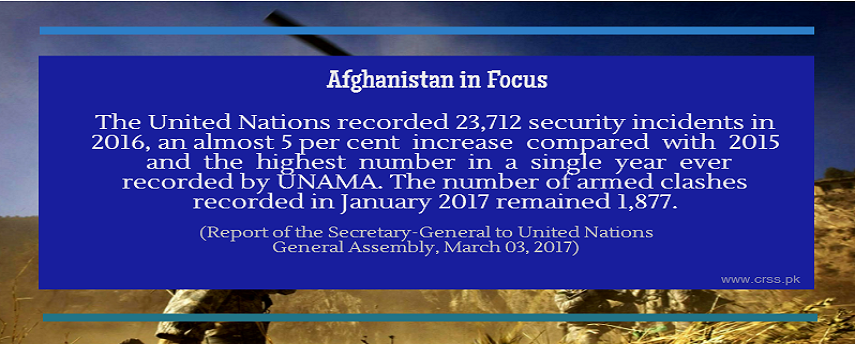
- The overall security situation continued to deteriorate throughout 2016 and into 2017. The United Nations recorded 23,712 security incidents, an almost 5 per cent increase compared with 2015 and the highest number in a single year ever recorded by UNAMA. While the fighting remained particularly prevalent in the five southern and eastern provinces of Helmand, Nangarhar, Kandahar, Kunar and Ghazni, where 50 per cent of all incidents were recorded, the conflict spread in geographical scope, with increasing Taliban activities in northern and north-eastern Afghanistan, as well as in Farah in the west. The Taliban continued to put pressure on the Government’s control of the provincial capitals of Farah, Kunduz, Lashkar Gah, Helmand Province, and Tirin Kot, Uruzgan Province. International and Afghan air support and the deployment of Afghan special forces remained critical to the holding of these cities. In late November, the Taliban captured the Ghorak district administrative centre of Kandahar Province, bringing to 14 the total number of districts claimed by the Taliban to be under their control. In addition, the control of a number of districts has been contested, with some reports claiming an increase in the percentage of Afghan territory under Taliban influence. The fighting evolved further in character as the number of armed clashes between the Taliban and Government security forces increased by 22 per cent in 2016, accounting for 63 per cent of all security incidents, the majority of which were initiated by the Taliban. Improvised explosive device attacks continued to decline in 2016, however, and were 25 per cent lower than during the previous year.
- Between 18 November 2016 and 14 February 2017, the United Nations recorded 5,160 security-related incidents. This represents a 10 per cent increase compared with the same period in 2015 and a 3 per cent increase compared with the same period in 2014. The number of armed clashes recorded in January 2017 increased by 30, compared with January of 2016, and reached 1,877, the highest number recorded by the United Nations for that month. Improvised explosive device attacks increased by 11 per cent compared with the same period in 2016. The Taliban also increased the pressure in Helmand Province, including through heavy fighting in the district of Sangin in late January and early February.
- On 10 January, an improvised explosive device detonated at the residence of the Governor of Kandahar during a dinner he was hosting for visiting diplomats and dignitaries, killing 13 civilians, including 6 diplomats from the United Arab Emirates, and injuring 19 others. On 15 February, the Ambassador of the United Arab Emirates, who was injured in the attack, died from his wounds. No group has claimed responsibility for the attack.
- The Afghan security forces continued to face significant challenges, in particular regarding operational capacity. Shortcomings in the areas of command and control, leadership and logistics, and high attrition rates, have a significant impact on morale, recruitment and sustainability. The intensifying conflict resulted in increasing casualties among both the security forces and the Taliban. Re-enlistment and retention rates are too low to compensate for the losses incurred through increased casualties and desertion. By February, the numbers of army troop members and Afghan National Police officers stood at 86 per cent and 94 per cent of projected levels, respectively.
- Islamic State in Iraq and the Levant-Khorasan Province (ISIL-KP) maintained its presence in southern Nangarhar Province, as well as in Kunar and Nuristan Provinces. Notwithstanding the clearing operations of the Afghan National Defence and Security Forces, with the support of international military forces, by the end of 2016, the group reportedly returned to the areas from which they were cleared. 18. During the reporting period, there were 21 incidents involving United Nations personnel, including seven incidents of intimidation, one improvised explosive device-related incident, seven criminal related incidents, and the theft of one United Nations vehicle.
See the full Report of the Secretary-General to the General Assembly Security Council, dated March 03, 2017.
Disclaimer: Views expressed in the article are not necessarily supported by CRSS.