



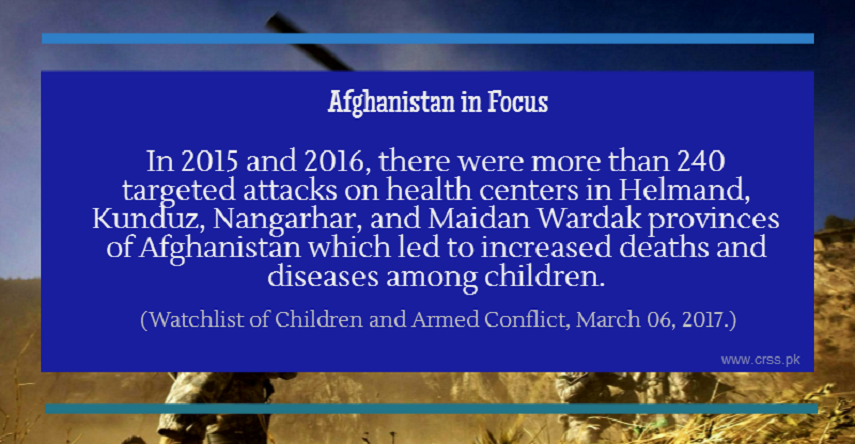
Ongoing conflict in Afghanistan and increased targeting of medical facilities and personnel by parties to the conflict has further eroded the country’s already fragile health care system. As of November 2016, more than 30 percent of Afghanistan’s population of more than 33 million lacks health care access, according to the ministry of public health (MoPH).
While there are more than 2,200 medical facilities throughout Afghanistan’s 34 provinces, frequent or ongoing conflict has significantly limited access to health care due to road closures, irregular delivery of medical supplies, and shortages of medical personnel. Access to health care has also been restricted and in some cases blocked due to targeted attacks on medical facilities and personnel. Many of the attacks documented in this report fall within the definition of attacks on hospitals and related protected persons provided by the United Nations guidance note on security council resolution 1998 (guidance note).
Prompted by many reports of these attacks, Watchlist conducted a research mission to Afghanistan in November and December 2016. Watchlist interviewed humanitarian actors, health workers, community shura (council) members, and current and former patients to investigate attacks on medical facilities and personnel and their impact on children’s livelihoods. Watchlist also conducted a systematic desk review of UN and non-UN organizations’ reportage of attacks on health care as well as the delivery of humanitarian aid and public health. While attacks on medical facilities and personnel have occurred in at least 20 provinces during the reporting period of January 2015 to December 2016, Watchlist focused its inquiry on Helmand, Kunduz, Nangarhar, and Maidan Wardak.
Parties responsible for the attacks on medical facilities and personnel include armed opposition groups (AOG), including the Taliban and the Islamic State in Iraq and the Levant-Khorasan Province (ISIL-KP); Afghan national defense security forces (ANDSF), including the afghan local police (ALP), Afghan national army (ANA), afghan national police (ANP), afghan special forces (ASF), and national directorate of security (NDS); and international military coalition forces. The secretary-general’s 2016 annual report on children and armed conflict documented 125 targeted attacks on medical facilities and personnel in 2015. Between January 1 and December 31, 2016, the United Nations assistance mission in Afghanistan (Unama) documented 119 conflict-related incidents targeting or impacting medical facilities and personnel; 95 incidents were attributed to AOG and 23 incidents were attributed to ANDSF.
Watchlist found that in the focus provinces and throughout Afghanistan, parties to the conflict have forced temporary or permanent closure of medical facilities; damaged or destroyed medical facilities; looted medical supplies; stolen ambulances; threatened, intimidated, extorted, or detained medical personnel; and occupied medical facilities for military purposes. Watchlist also found that disruptions in health care access from these attacks have compounded challenges to children’s health, which were already exacerbated by the escalation of the conflict in 2015. In the past two years, an increase in conflict and targeted attacks on health care have led to more children directly injured and suffering from acute malnutrition, diarrheal disease, and vaccine-preventable diseases (e.g. polio and measles).
Finally, Watchlist found that in Afghanistan, medical personnel are on the front lines of the conflict. In many provinces, AOG control or influence vast swaths of territory outside the provincial capital. As such, dozens of medical facilities run by international nongovernmental organizations (INGO) and nongovernmental organizations (NGO) are in areas controlled by AOG. Frequent and in some cases ongoing negotiations with these groups are required to try to ensure continued provision of health services; community leaders and health Shura members have been key mediators. But despite the negotiations, some medical facilities have been closed for days, weeks, or months due to either occupation or an order issued by AOG. A health director of an NGO that provides health services in a number of provinces said, “Some attacks are not being reported from the field because they are happening so frequently—there are too many incidents to recall.”
See full report: “Every Clinic is Now on the Frontline.”
Disclaimer: Views expressed in the article are not necessarily supported by CRSS.