



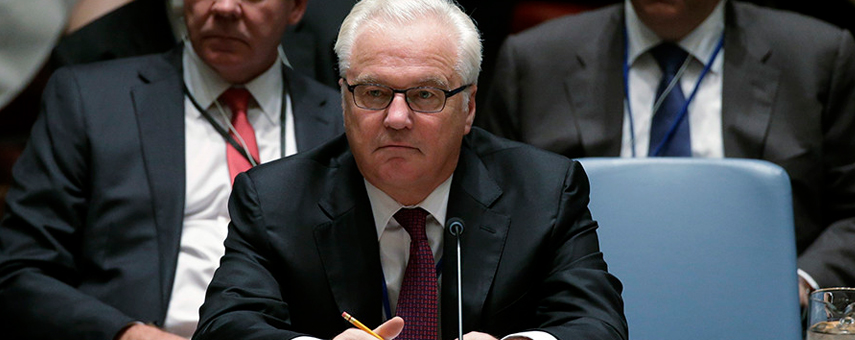
Dateline: United Nations Security Council, 7844th meeting, December 19, 2016.
“We are following the security situation in Afghanistan very carefully. We are concerned by the fact that it has sharply worsened; especially in the north of the country, where recently the Taliban have become increasingly active. Eliminating the leader of the Taliban, Mullah Mansoor, has strengthened the influence of irreconcilable radicals which only compounds the current situation in the country. The recent attacks by fighters against the American military base in Bagram and the German Consulate in Mazar-e-Sharif are very sharp examples of this. We support the course of the Government of Afghanistan to achieve national reconciliation. We stand ready to help in moving the negotiating process forward, including through a flexible approach to the possible easing of the sanctions regime by Committee 1988, if this does not run counter to the national interests of Afghanistan.
We took into account the fact that the peace agreement was signed between the Government of Afghanistan and the Hekmatyar party. A lot depends on how this will be implemented in practice. The main goal of the national reconciliation process is to involve the Taliban in the peace process and, so far, this goal has not been attained and the four party contact group format has not arrived at a breakthrough. Unfortunately, the main goals the international military contingents had for themselves in the last 15 years are still unresolved. This refers to the previous NATO international security assistance force in Afghanistan which led the country and this also applies to the current Resolute Support Mission. We would especially like to underscore that only the Afghan security forces can provide for the stabilization of the military and the political situation in their country, and that is why we are providing them with multi-dimensional support. The Ministry of the Internal Affairs of Russia has provided ten thousand automatic rifles and 2.1 million cartridges free of charge to Afghanistan. We have agreed to re-export into Afghanistan from India four combat helicopters Mi25. We are going to continue building a combat capable army and police in Afghanistan. We will continue to help prepare their personnel through our law agencies.
Large scale drugs production in Afghanistan is a serious threat to the stability of Afghanistan itself as well as the region and the world. In addition to just being nefarious in and of itself, narcotics production is something that provides financial support for terrorism. In this regard, we think what is necessary is to make more active the efforts by international community to fight drugs’ trafficking in Afghanistan. We are concerned by the sharp growth in narco-culture’s planting, in particular, in the north of the country, and by a greater harvest of opium poppy this year. We are worried that the growth in this kind of income will lead to even greater activity on the part of terrorists. We do not quite understand the attempts to diminish the threat of ISIS in Afghanistan. This is at variance with various assessments, including NATO’s assessment. Sometime ago, the Commander of US and NATO Forces in Afghanistan, General Nicholson, stated that the terrorist organization Islamic State of Iraq and the Levant (ISIL) had set itself the goal of creating a Caliphate in Afghanistan and the fighters of the Islamic Movement of Uzbekistan (IMU) joined in with so-called Khorasan Velayat. We expect that this information will be duly reflected and assessed in the UN documents, including in the quarterly reports of the Secretary General.
As far as we know from what we were told by the representatives of Afghan leadership, the number of ISIL fighters in their country is several thousand people. There are also confirmed reports of links with the IMU, of the Taliban Movement; especially in the north, and Lashkar-e-Taiba (LeT) movement. There is also information about the presence of ISIL camps and safe harbors in Afghanistan where people from Central Asian States and Northern Caucasus’ republics are being trained, and where 700 terrorist families from Syria have already arrived. The intensive nature of hostilities in Syria and Iraq make fighters look at Afghanistan increasingly frequently because they can find refuge there and can find a new platform for expanding their influence on neighboring countries. We are somewhat perplexed by the recent statement by General Nicholson about the support that Russia, according to him, is extending to the Taliban; thus, undermining the efforts by Washington, the North Atlantic Alliance to combat terrorism. This kind of a statement reflects an attempt what we call in my country the shifting of blame.
We would like to point to the fact that some of our partners are not averse to contacts with the extremist and terrorist groups existing in Afghanistan. We know many events when ISIL fighters were re-deployed into the northern provinces of Afghanistan by helicopters without any identification signs. We need to find out who is doing that and why. There are also many questions having to do with the mass attacks of the Taliban against the administrative centers in the provinces of Badakhshan, Helmand and Farah.
Once again, we reiterate that Russia is not conducting any kind of behind-the-scenes negotiations which could undermine the national security of Afghanistan. Our contacts with representatives of Taliban are limited to the task of providing for the security of Russian nationals in Afghanistan, and also aimed at moving the Taliban towards joining with the process of national reconciliation; all the while making sure that the leading role is held by the officials in Kabul in this.
We view positively the fact that the international community reaffirmed its commitment to support Afghanistan at the international donor conference in Brussels in October. We do hope that this new financial package will play a positive role. At the same time, we note the fact that the Government of Afghanistan has been presented with a number of conditions and if these conditions are not met then the volume of this assistance could be reduced.
We also note that there is an increasing understanding in the world of the regional context of Afghan settlement and increasing the number of regional fora which are focused on this issue. At the same time, we think that it is important to make sure that within the work of that format the leading role needs to be played by the regional actors themselves. We are convinced that help to Afghanistan should be carried out while using the proven existing structures. First and foremost, the Shanghai Cooperation Organization. As we know Afghanistan is an observer and has been an observer since 2012. In 2015 at the Summit in Ufa, Afghanistan officially applied for becoming a fully-fledged member of the Shanghai Cooperation Organization. At this stage, in order to make the process more dynamic, we think it would be advisable to restore the SCO–Afghanistan contact group mechanism. We also see good prospects for strengthening counter-terrorism and anti-narcotics drugs cooperation between Afghanistan and the CSTO. Thank you very much, Mr. President.”