



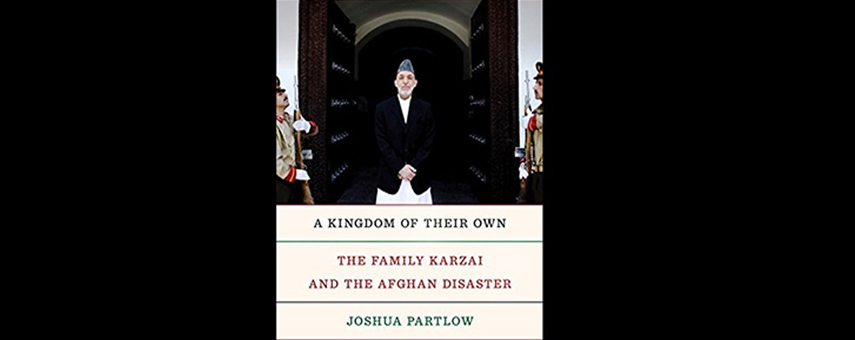
From 2009 through 2012, Washington Post reporter Joshua Partlow covered the war in Afghanistan and the United States’ frustrated efforts to turn a former terrorist haven into a modern state.
In his no-nonsense writing style, Partlow explains in “A Kingdom of Their Own” how Washington ended up supporting the extended family of Hamid Karzai, its choice for president in a country that had never held a Western-style election for its highest office.
He also tells why, after 15 years and America’s longest war, a well-functioning, modern and responsible government has remained out of reach in the rugged southwest Asian country.
A reader may wonder why this country has spent billions of dollars and several thousand lives to bring a sort-of democracy to Afghanistan.
The answer is simple: Afghanistan was where Osama bin Laden and al-Qaida hatched plans to attack the United States on 9/11. The George W. Bush administration wanted to create a stable government and ally there.
The U.S-led NATO alliance in Afghanistan has accomplished several things. Primarily, it has kept the Taliban from re-establishing a national government, though the fighting has been hard and the results tenuous. (The Taliban is what originally allowed al-Qaida to use Afghanistan as a base.) Second, with intense U.S. oversight, NATO allowed an elected president, Karzai, to assume power for the first time in Afghanistan’s history.
Yet the tribal nature of Afghan life continues to confound national unity.
“President Karzai’s dream throughout his presidency was to find a peaceful resolution to the conflict with the Taliban,” Partlow writes.
“He mentioned that goal when he was sworn in for his second term, and he pursued the prospect of peace talks until he left the palace. The record of those efforts has not been written; most of it took place in the shadow worlds where spies and militants intersected.”
Karzai’s goals were not what Washington wanted. The Bush and Obama administrations sought to turn the Afghan military into an effective fighting force that could defeat the Taliban. Karzai believed this ultimately wouldn’t be possible. He continued to believe that, at some point, Washington and NATO would abandon his country. He sought ways to make accommodations with the Taliban.
However, Karzai may have had the right stuff, considering the history of his country and the condition it was in when his second term ended.
As his term came to a close and NATO troops planned to remain in Afghanistan, a status of forces agreement had to be hammered out. That agreement would state that NATO forces would be subject to the laws of their own countries, not Afghanistan’s.
Karzai balked at signing, which he wanted his elected successor to do. For a time, it seemed that NATO forces would leave and military protection and training with it.
Eventually the new president, Ashraf Ghani, assumed the presidency, with the man who nearly beat him at the polls, Abdullah Abdullah, becoming No. 2.
Afghanistan remains a fragile experiment in creating democracy where none existed. Was Karzai the right man to be president during the crucial years of laying the foundation? Former Ambassador Ryan Crocker thinks so.
“‘I don’t think there was a better choice than Karzai,’” Partlow quotes Crocker as saying.
With this book, Partlow removes some of the doubt Americans may have about the long and costly effort in Afghanistan although the country’s long-term governance remains unknown.
If nothing else, Partlow has changed the popular image of Hamid Karzai from inept, corrupt leader who accomplished nothing. It may be that he was, as Crocker said, the right man for the job at the time.
This article originally appeared on www.stltoday.com, 12 November, 2016. Original link.
Disclaimer: Views expressed in the article are not necessarily supported by CRSS.