



A report issued by the Centre for Research and Security Studies (CRSS) on Thursday shows a sudden increase in incidents of violence and casualties of civilians and law enforcement officials.
However, the report – which focuses on the third quarter of this year – also found that militant casualties have fallen compared to the first two quarters.
The head of CRSS, Imtiaz Gul told Dawn the increase in casualties is linked to relations with India and Afghanistan.
“Whenever tension builds with India, it starts creating problems in Balochistan to build pressure on Pakistan. During the third quarter, we saw the incident of an attack on lawyers due to which casualties increased. In the fourth quarter, an attack was held on the police which will increase casualties in the fourth quarter,” he said.
In response to a question, Mr Gul said once tensions with India normalise, casualties will also drop.
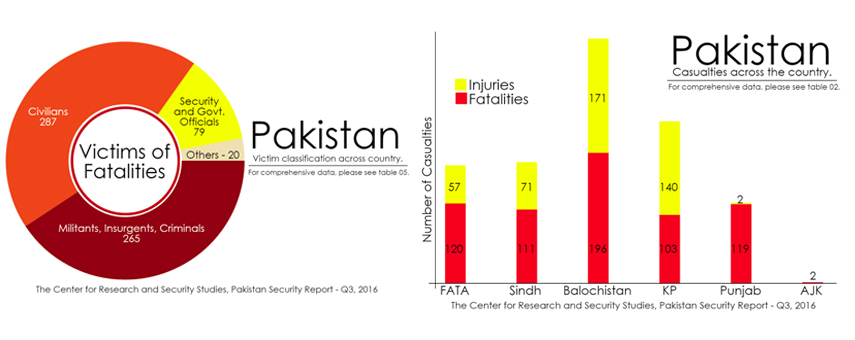
The data shows that during the third quarter of 2016 from July to September, 1,092 casualties including 651 dead and 441 injured , were recorded. This is 19.4pc more than the previous quarter.
In addition, 265 militants, criminals and insurgents, including foreigners , were killed and 386 non-combatants including security officials died in this period. The largest group of killed non-combatants was civilians at 287.
Largest group of non-combatants killed in third quarter of 2016 were civilians
In the previous quarter 172 civilians lost their lives, compared to this quarter’s 287. The number of militants, insurgents and criminals killed fell, from 475 in the last quarter to 265 in this quarter.
Therefore, the report surmised that civilian deaths saw a sharp increase to 58pc, while the loss of life of militants, insurgents and criminals saw a sharp decrease of 56pc.
Out of the total non-combatants killed, civilians accounted for 44pc, security officials for 11pc, political activists for 2pc, government officials for 1pc and religious party members, religious persons, foreign religious persons each accounted for 0.3pc of total casualties this quarter. Militants’ casualties accounted for 21pc of total casualties.
According to the report, Balochistan witnessed an upsurge in violence-related casualties during the third quarter, and a nearly 18pc increase (166 in the second quarter vs. 196 in the third quarter) was seen in fatalities. Like the second quarter, Balochistan had the highest number of fatalities during this quarter as well.
In comparison to the last quarter, a 90.5pc rise in fatalities was seen in Fata, with 120 casualties recorded this quarter compared to 63 reported dead in the second quarter. Khyber Agency had the highest number of fatalities – 69 with 22 injured.
Khyber Pakhtunkhwa saw a 13pc increase in violence, with 103 dead in the third quarter compared to 92 dead in the second quarter.
In Punjab, a 52.5pc increase was recorded in this quarter compared to the second quarter.
Sindh saw another reduction in fatalities in violence-related activities – falling from 138 in the second quarter to 11 in the third. While the average number of fatalities recorded in Sindh per month in 2015 was around 100, this number fell to 48 people a month in the second quarter and fell again to 37 a month in the third quarter. Karachi, in particular, has seen a 21pc reduction in violence – with 104 fatalities from violence reported in the third quarter, compared to 133 in the second.
No incidents of violence-related fatalities were reported from Gilgit-Baltistan and Islamabad. In Azad Kashmir, two Pakistan Army soldiers were killed in firing by Indian forces along the Line of Control.
Violence-related activities involving sectarian groups rose dramatically in the third quarter, from 16 fatalities in the second quarter to 52 in the third. Fatalities due to sectarian violence were reported in Fata (3), KP (6), Sindh (6) and Balochistan (4) in this period. Punjab and Islamabad were the only areas not affected by sectarian violence. Of the 52 fatalities, 40 were recorded in September, five in July and seven in August.
According to the report, the fight is far from over and the unconditional implementation of the rule of law should be the paramount objective moving forward.
This article originally appeared in Dawn News, 28, October, 2016. Original link.