



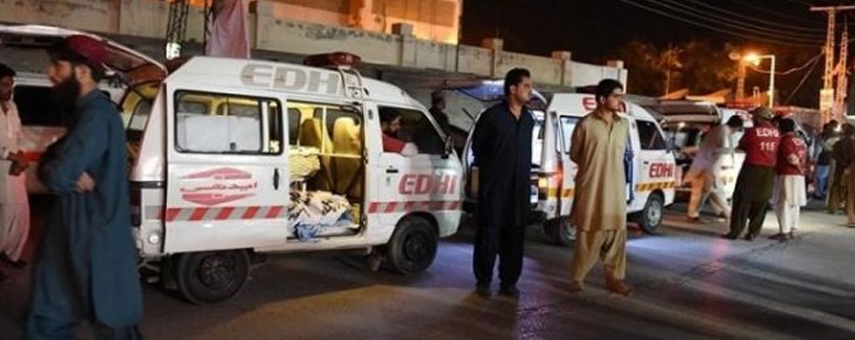
The deadly terrorist raid on the New Sariab Police Training College near Quetta, the capital of Pakistan’s Balochsitan province does not come as a surprise. It has claimed 60 security personnel, by far the largest in terms of fatalities among those carried out against Pakistan’s security apparatus. It had been in the offing in view of the excessive bleeding of the number of unusual fatalities among the Afghan National Security Forces (ANSF) since early this year.
The Quetta attack is reminiscent of the two attacks in March and October of 2009 at the Police Academy at Manawan outside Lahore; typical suicide missions with the objective of inflicting as much damage as possible.
The latest blood-spilling can be interpreted in two ways. First, that it’s a strike either by the Pakistani or Uzbek proponents of Daesh, i.e., Lashkare Jhangvi or different splinters of the TTP. Second, that it is a reprisal attack by all those who see Pakistan’s security establishment as the patron, supporter and harborer of the Haqqani Network, which is seen as the major source of unusual attrition within the ANSF, resulting in a staggering 3,500 losses until August this year, including nearly 2000 in July and August alone. Since early this month, the ANSF losses in Helmand alone have been over 150 with fighting raging in a number of districts and provinces around Helmand.
General Nicholson, however, places the blame on both sides. In a brief Q&A NBC TV a day earlier, General John Nicholson, the head of Resolute Support Mission, responded to the question “Is the border with Pakistan secure,” the following way:
“It’s still a very porous border region and we do see insurgents moving both ways across the border, some from Afghanistan to Pakistan and then of course the Haqqanis and the Taliban moving from Pakistan into Afghanistan.”
To the question whether the Afghan government had any plan to actually secure that border, Nicholson offered this explanation:
“The Afghan border police are present along the border but the numbers of border posts probably need to increase, the coordination procedures between the Afghans and the Pakistanis [need to improve]. We are working on a bilateral basis and we are going to continue to work to improve this over the next year.”
General Nicholson’s statements resonates a largely realistic ground situation, with both Kabul and Islamabad apparently helpless in preempting and preventing attacks of this kind.
What is clear though is that the Haqqani Network remains central to the Afghan-American narrative as much as the Indian narrative on the Lashkar-e-Taiba (LeT)/Jamaat-ud-Dawa (JuD). Pakistan let the Haqqanis, like the Afghan Taliban, shelter in Pakistan’s western tribal region. Many American soldiers have been killed by the Haqqani, and in 2011 the Haqqanis even assaulted the U.S. Embassy in Kabul. The Haqqanis were also blamed for the 2008 bombing of the Indian mission in Kabul that killed 58 people – and since it hit India, it may have been something that may have been perfectly all right with Pakistani intelligence, the Forbes Magazine had written in August this year.
As late as October 24, the top US commander in Afghanistan John Nicholson made a similar reiteration in an interview with The Indian Express:
“We see, on the one hand, a stated aspiration for reconciliation (on the part of the Pakistan government, by bringing the Taliban to the table for peace talks). While on the other, the Haqqanis still enjoy sanctuary and can operate freely from inside Pakistan and this continues to be a concern.”
At the same time Nicholson, who commands a US-led coalition of about 13,000 troops from several countries in Afghanistan, gave “great credit” to the Pakistani government and the army for mounting an operation against terrorists and other insurgents, called ‘Zarb-e-Azb’, in the borderlands between Afghanistan and Pakistan.
So what is Pakistan doing to eliminate this threat? “Gradual squeeze” is the new phrase Pakistani officials are invoking when responding to questions on what they are doing to blunt the Taliban ability to plan and organize operations inside Afghanistan. Taliban leaders are being told to move families and businesses elsewhere and refrain from cross-border operations. Either join the talks or leave the country to save us the embarrassment, is the message being put across by the top Pakistani leadership.
Recent arrests in Balochistan of several Taliban leaders, including Ahmadullah Muti alias Mullah Nanai, Suleman Agha alias Samad Sani, and Mullah Sani appeared to be part of this squeeze, which also prompted three Taliban leaders to rush to Pakistan from Doha, their political office.
Taliban were told, officials said, to close ranks for the peace process and follow the path that the Hezb-e-Islami chose for its peace with Kabul. Sartaj Aziz, the foreign affairs advisor, also believes the peace deal could serve as a good model for other Taliban factions to follow suit as Pakistan presses these factions to focus on talks instead of fighting.
But will such statements dispel and correct the deep-seated perceptions of the nexus between the Haqqani Network and the Pakistani establishment? Fearful of a possible backlash by the Pakistani Pashtoon-Punjabi militants stalking parts of mainland Pakistan, officials nevertheless remain extremely careful. They would not want to directly take on all those dubbed and denounced by the Afghan government as the “enemies of innocent Afghan women and children.” This begs another big question; if stymied by the fears of a blow-back, will Pakistan still be able to convince Afghan or American officials of its “squeeze on Taliban?”
And more importantly, will reiterations of support for the Afghan peace and reconciliation prevent gory attacks such as the one on the Police Academy in Quetta, or the one that left nearly 13 dozen lawyers dead end of June this year in the same town. Probably not, for the simple reason that Pakistan is damned if it does. And it is damned if it doesn’t.
Anwar-ul Haq, spokesman for the Balochistan government, encapsulates this Catch 22 situation; the allegations are that we are not doing anything against the Taliban in the province of Baluchistan. And if you do and you try to apprehend some individuals over there then we are accused that you are sabotaging the peace process, he said to the context of arrests in Balochistan.
Such ground facts often go missing or purposely glossed over in bilateral discourses; even during a recent Pak-Afghan Track 11 dialogue called Beyond Boundaries, Pakistan’s support for the Taliban and its administrative measures, some of them extremely counter-productive, consumed most of the time. The dialogue ended on a largely positive note but Pakistan’s current and past role vis-a-vis the Haqqani Network remained a contested issue.
Regardless of how you look at it, central to terrorism in Pakistan and Afghanistan are known instruments of destabilization and instability i.e. TTP, IS/Daesh and LeJ Al-Alam, and the Islamic Movement of Uzbekistan (IMU). They are the handy pawns in the proxy war that is currently underway in the region.
The only plausible explanation for such termination missions is a tit for tat strategy born out of the perception that Pakistan needs to do more to neutralize and uproot the Haqqani Network. Until Pakistan is seen doing so, its security apparatus is likely to remain under attack – both by the international players as well as by their instruments of terror and instability.
The author Imtiaz Gul is the Executive Director of Center for Research and Security Studies (CRSS).