



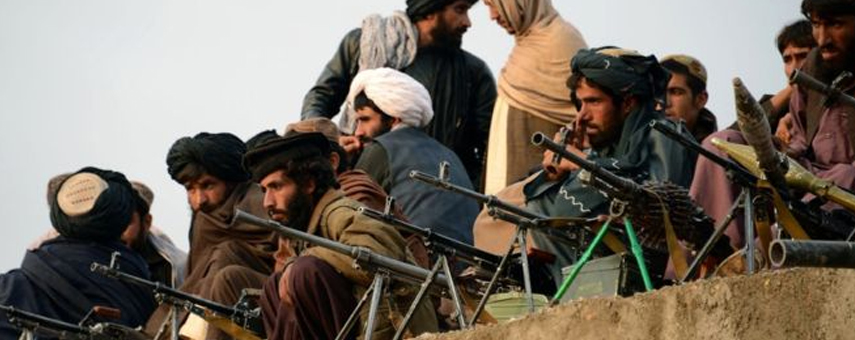
On the 15th anniversary of the US invasion of Afghanistan, talks between representatives of Taliban and the Afghan Government have taken place in Doha, Qatar. Several rounds of talks had been held in late September and early October. The Afghan side was led by Mr Stanikzai, Afghan chief of Intelligence, while the Taliban team also included brother of the late Mullah Omar. A US representative also participated in the negotiations.
Taliban agreeing to meet with Kabul government’s and US officials is a slight modification of their stance on the issue of parleys with the Afghan Government. After the death of Mullah Mansoor, the movement had resolved not to sit for talks with government representatives or with the Americans. It appears that those in favour of entering into negotiations have prevailed. An important dimension of the interaction is the near-absence of Pakistani mediators. The Doha round of talks has been preceded by arrests, in Pakistan,of a number of top ranking leaders of the Taliban movement mainly in Balochistan’s Pakhtun areas.
The direct contacts between Taliban and the Kabul regime also show that communication channels have been established between the two entities—bypassing Islamabad. This is seen as a major victory for Kabul in its endeavours to seek direct access to the Taliban leadership without soliciting help from Islamabad. The Doha talks also show the deepening distrust between the Taliban and Pakistani officials. A breakdown of Islamabad-Kabul contacts is another factor that forced Ashraf Ghani’s government to intensify efforts to engage the Taliban in negotiations.
Perhaps the most important cause of the Kabul government’s keenness to open talks with the Taliban is the relentless offensive launched by the latter in recent weeks and the impending fears of the fall of many towns both in North Afghanistan as well as the Taliban’s strongholds of Helmand, Kabul is also genuinely worried about any escalation in the number of defections from the army and the police in the wake of the Taliban advances into government, held areas across the country.
But the Doha engagement would pose problems for the Taliban if the talks don’t deliver any tangible outcome. That is highly doubtful. Because the fundamental issue is a timetable for withdrawal of all foreign forces. The US Administration and the Kabul government are not desperately keen to organise the withdrawal of coalition forces for a host of reasons. Unless there is a change of policy or perception, either in the US or in the Afghan Government on this critical issue, there is no hope of any convergence of views between the Taliban and their interlocutors.
But as mentioned earlier the Taliban would face a dilemma, whether to remain part of a process that does not hold any real promise for reconciliation and risk losing volunteers or to withdraw and focus on continuing their struggle to score military victories in the face of heavy odds.
If the talks continue without any signs of real progress, the Kabul regime could use the interregnum to establish links and try to wean some Taliban activists from the main body led by Haibatulla Akhunzada. The regime could also tap into the differences in the Taliban hierarchy and help cause wider disaffection. On the other hand, the faction that does not support any contacts with the government could, in the event of prolonged and protracted negotiations, mount pressure on the top leadership for a boycott of the political process. In either case if the Taliban unity is in jeopardy — it will be a tremendous morale booster for the regime and its forces.
There is no immediate prospect for any significant development in the reconciliation endeavours. But for both sides so much is at stake in terms of whether each side would be able to demonstrate to the people and to the world that it has achieved a degree of success at the expense of the other. This has more serious ramifications for the Taliban than the Afghan Government because Kabul is not seen as the sole arbiter of decisions relating to the insurgency. On the other hand, the Taliban are now viewed as taking their own decisions after Islamabad launched a drive to arrest the movement’s leadership.
Pakistan losing its leverage with its erstwhile allies will have many implications as the Afghan conundrum escalates with Islamabad not having any clear vision or formula on how to help mainstream the Taliban on terms that are mutually agreeable to all. It is a failure that will haunt Pakistan for years to come.
Taliban ‘too strong’ to enter peace talks with Kabul

The Taliban have denied reports they had held talks with Afghan officials in Qatar. Many experts also believe it’s unlikely that the insurgents could have resumed peace negotiations given their recent territorial gains.
On Wednesday, October 19, the Afghan Taliban denied reports of secret peace talks with Afghan government officials in Qatar, stressing that the group’s “stance about peace negotiations has not changed.”
The Guardian reported about alleged secret talks on Tuesday, claiming that the meetings took place in September and October. According to the British newspaper, Afghan officials and high-ranking Taliban commanders, including Mullah Abdul Manan Akhund, brother of former Taliban leader Mullah Omar, participated in the talks. Masoom Stanekzai, head of the Afghan National Security Directorate, and Hanif Atmar, National Security Advisor to Afghan President Ashraf Ghani, attended the meetings in Qatar, the newspaper claimed.
The representatives of the Islamic Emirate have not met with Stanekzai or any other [Afghan] official,” Taliban spokesman Zabihullah Mujahid told the AFP news agency.
When contacted by DW, Jawed Faisal, a spokesman for Afghanistan’s Chief Executive Abdullah Abdullah, declined to comment on the British newspaper report.
Afghanistan experts also say it is unlikely that the Taliban would have engaged in any negotiations as they currently have an upper hand on the battleground. The Islamists now control more Afghan districts than at any other time since 2001.
“I don’t think the Taliban are interested in peace,” Michael Kugelman, a senior associate for South and Southeast Asia at the Washington-based Woodrow Wilson International Center for Scholars, told DW when asked about the peace talk reports.
Wahid Muzhdah, a Kabul- based expert and a former Taliban official, is of the same view. “The insurgents would not engage in any peace talks at this point. They are stronger than before, and the Afghan government is weak,” he said.
According to Muzhdah, it is likely that the Taliban members might have met with Afghan officials in Qatar, but he stressed that peace negotiations could not have been on the agenda.
“Recently, many Afghan troops have disappeared from different provinces. Afghan officials and the Taliban commanders might have therefore discussed issues related to war prisoners,” Muzhdah told DW.
Such meetings, the expert pointed out, are facilitated by the United Nations and the Red Cross, and they take place on a regular basis.
“Mullah Abdul Manan Akhund doesn’t have the authority to undertake such important negotiations,” Muzhdah underlined. “Akhund’s opinion does not carry any weight among the Taliban leaders,” he added. Siegfried O. Wolf, a South Asia expert at the University of Heidelberg, suggests that even if a meeting was held to discuss a peace deal with the Taliban, the peace process will face the same challenges as it did in the past. “It is the problem of negotiating the non-negotiable,” Wolf told DW.
‘Exaggerated reports’
The reports of alleged meetings should be looked at in the context of the upcoming US elections, Muzhdah said.
“I believe the reports are aimed at creating a successful picture of the US strategy in Afghanistan,” he said.
The Afghan government, too, wants to show that a peace deal with Gulbuddin Hekmatyar’s Hezb-e-Islami has encouraged Taliban members to join the Afghan peace initiative, he stressed. “Both Washington and Kabul need a success story.”
The Afghan government recently inked a peace deal with warlord Hekmatyar, whose group has been accused of attacking Afghan and foreign troops across the war-torn country. Hezb-e-Islami’s role in the Afghan war has faded out in the recent years, but Afghan officials hope that the peace agreement with Hekmatyar could encourage other insurgent groups like the Taliban to follow suit.
This article originally appeared in The Express Tribune October 19, 2016. Original link.
This article originally appeared on www.dw.com. October 20, 2016 Original link.
Disclaimer: Views expressed in the article are not necessarily supported by CRSS.