



(Special Contribution to CRSS)
Abstract
Being neighbor and close friends, both China and Pakistan continues to weave a mutually beneficial and lasting friendship. Close cooperation between the two states ranges from economic to security and culture. Yet the emerging geo-political and geo-strategic realities have put both the states in a closer and mutually cooperative settings. The most salient evidence of this reality is the conceiving and construction of China-Pakistan Economic Corridor (CPEC) in recent years. In this backdrop, this study seeks to analyse the CPEC with special focus on the new challenges arising out of new geostrategic scenarios in the region and extra-region. One of the most serious observation of this study is that CPEC is confronted with growing complexities of ground realities, particularly conflicting desires and roles of major players in the region.
Introduction
CPEC was launched in the backdrop of 9/11, wherein after an initial reign of geo-politics, geo-economics is taking root in the international arena. Claimed as a game-changer move in the region, the Corridor was officially unveiled by the Chinese leadership led by Xi Jinping in 2013, when he was paying an official visit to Pakistan. The Corridor has emerged as a pivotal component of the now famous “One Belt One Road Initiative “(OBOR) in the region and Asia at large. The Initiative took shape within two years after Chinese new leadership took office. But as a matter of fact, the Initiative underwent a series of strategic thinking and designing, before it was finally composed. In 2012, when China convened the most historical event—18th Party Congress, Beijing’s new leadership felt a compelling need to frame and shape China’s brand-new reform agendas and diplomacy. The responsibility thus shifted to China’s top scholars, intellectuals and politicians to help shape policies and to find the right answers to how China should promote her stability at home, as well as national interests and stature abroad. In that particular juncture, China was embarking on a path to build a welfare-oriented region, under the larger mottos of ‘peace, development, and cooperation’, which shall be ‘win-win’ game play for everybody. Thus, the idea of communities of shared destinies was thrust into limelight.[1]
The idea of OBOR initiative, or China’s new Silk Road, is tentatively used by the Chinese government to act as a catalyst in promoting China’s developments, interests and image. At the initial level, China announced that ‘CPEC is China’s flagship OBOR project’.[2] In May 2013, shortly after the 18th Party Congress took place, Chinese Premier Li Keqiang, in his visit to Pakistan, officially floated the idea of China-Pakistan Economic Corridor. Later on, in September 2013, Premier Li proposed “Silk Road Economic Belt”.
In October 2014, during a speech at the Indonesian Parliament, Chinese President Xi Jinping for the first time, officially proposed 21st century Maritime Silk Route. In this regard, China has incorporated Silk Road Economic Belt and Maritime Silk Route into OBOR—stretching within China’s heartland southwards and westwards respectively. OBOR initiative is supposed to connect China with 65 countries in Asia, Africa and Europe. Chinese President Xi Jinping and Premier Li Keqiang made sustained efforts to articulate OBOR in various avenues. At the same time, China is reaching out to different countries to anchor consensus on OBOR, stressing that it will cater to needs, demands and interests of partner countries. Central theme of Chinese President’s meeting with foreign leaders remains OBOR in recent years. In November 2014, China made another announcement that it will set up Asian Infrastructure Investment Bank (AIIB). Such a move helped China capture global attention. AIIB was officially launched on 16 January, 2016. It is a China-led international financial institution that aims to support the building of infrastructure in Asia-Pacific region. The bank has 57 member states—all founding members. So far, China has been inking agreements over the development of Eurasian Economic Union with European Union, Kazakhstan, Mongolia and Indonesia. China is even promoting projects along China-Mongolia-Russia economic corridor, Eurasia land bridge economic corridor and Bangladesh-China-India-Myanmar economic corridor apart from CPEC.
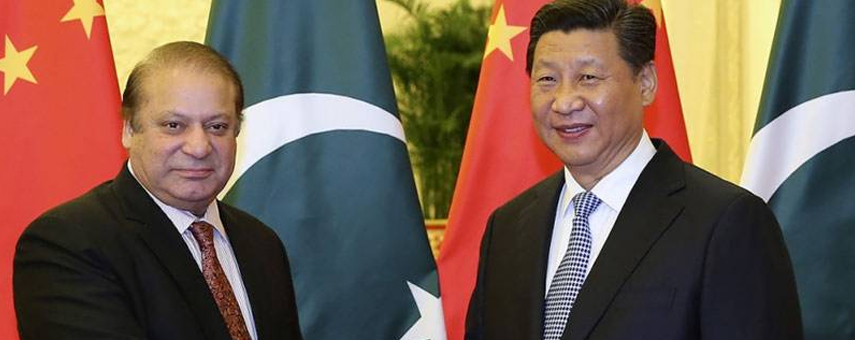
Due to the fact of time-tested relations between China and Pakistan, China has strategically made CPEC a harbinger of OBOR. China and Pakistan have maintained very unique relations in contemporary history. In the post-withdrawal era (in context of Afghanistan), China and Pakistan have decided to stand shoulder to shoulder in strengthening strategic interests, deepening economic cooperation and broadening people-to-people contacts. CPEC, in eyes of both countries, should be kept on fast track. Pakistan desires to benefit from CPEC socio-economically, politically and militarily. The use of the word “game-changer” by the Pakistani top leadership fully demonstrates keen desire on Pakistan’s side to make CPEC a vehicle of stability, security and development in the region. Taking into consideration rising militancy in the region, China attaches greater importance to Pakistan in her search for a more stable western frontier. The projects under CPEC have been taken on by the strategic cooperative partnership between Pakistan and China.[3] Physically, the corridor is a 2,700-kilometer highway that stretches from Kashghar to Gawadar through Khunjrab. In essence, the corridor will further strengthen the existing bond of brotherhood between the two brotherly states.[4] According to plans outlined by both governments, along the corridor, several economic zones will be set up, with building of ports and road infrastructure. China also announced that it was committed to huge investment worth $46 dollars on CPEC.
Growing Geo-strategic Complexities
The following sections shall discuss the major factors which, in the view of the writer, constitute salient determinants of geo-strategic complexities to the CPEC. The center of gravity of international politics is shifting from Europe to Asia.[5] It never happened in recent history that Asia was given such a degree of importance in the world arena. Evidently, Asia is the center of transformation of global power. Coincidently, right in Asia, there is an existing society marred by economic, political and cultural diversities. However, the prevailing globalized world has made Asia increasingly interdependent. Meanwhile, great powers are turning to Asia in the quest for dominance in the regional and international orders. In this backdrop, the geostrategic landscapes has changed forever.
Emergence of China as a Major Power
China’s rise is a reality in today’s world.. The effective role of China in multiple dimensions is much debated nowadays. It is commonly believed that China’s rise is set to shape the sphere of her influence. As mentioned earlier, the globalised world has made Asia increasingly interdependent. The current scenario is that china and the rest of Asian countries share a relationship of growing interdependence. China, with rapidly growing economic power, is reframing its political, economic and security policies in a visible way. In the last 10 years, China’s economy has enjoyed high-speed growth. It is producing around three-fifths of the world’s clothing, two-thirds of shoes and four-fifths of toys. Besides this, China is the largest producer of cars. Hence, China has become the workshop of the world. Four years back, China has overtaken Japan as the second-largest economy on the planet. Roads and bridges built by Chinese are used by more and more people in the world. China’s high-speed railway line is the most shining label of modern world. Apart from being the biggest consumers of energy, Chinese is spearheading current trend of innovation—the development of green economy, namely clean energy and renewable energy.
With huge economic strength in place, China is in pursuance of greater regional and global role. China’s policy of secure and stable world is enhancing its role at regional and global levels. As a leader of the developing countries, China is accumulating support of other developing countries to efficiently push for reforms at the international political and financial governing institutions. At the same time, by actively contributing to global economic growth, prosperity and financial stability, and some other global challenges, China is getting a more prominent share in global governance. By doing that, China is taking more prominent stances and making clearer voices over the issue of global order, challenging the existing order decided by the West.
China’s greater role in global affairs is dramatically taking effect. Without China’s crucial contribution to global challenges, such as the financial crisis in 2008 and the fight against climate change, our world may have been heading toward another direction. In other cases, the management of transnational issues critical to human race can not be accomplished. To name few, the fight against terrorism and climate change are the salient ones.[6] What is worth mentioning is that in the last decade, China is visibly tilting toward or attempting a policy of “active performance”. That means China is departing from its previous policy of “hide capabilities and bide her time” (TAO GUANG YANG HUI ). China is exploiting its mass increase in “power” to realize its interests. China is expanding its hard power, for example, in recent years, building its first aircraft carrier. In the spheres of soft power, China has spent millions of dollars on Confucius Institutes across the globe. These steps in the realm of soft power are accruing results. In fact, these days Chinese language learning is getting more attractive in many countries, even in the United States.
In a nutshell, China has arrived at a historical moment to strengthen its role in global affairs.. Most importantly, China has embarked onto a path of shaping an international order that will render most benefits to China and others. To do that, China realizes that she has to take pro-active stances on regional and international levels. China will never accept the reality that decision regarding its economic and security are being decided by big powers. On the other hand, in shaping the world order, China demonstrates her will to defend and uphold the principles of peaceful coexistence and development. China is demonstrating her respect for fundamental human rights, the rule of law and most importantly, rights of each and every country in the world. China also makes it clear that she is to cherish and promote unity in diversities—characterized by a modern world. And the world is deeply impressed by China’s role to promote cooperation and social cohesion thereby engendering a sense of belonging among the people.
For centuries, China and the rest of Asian countries shared close economic and cultural bonds. In history, there existed among China and South East Asian countries the Tributary System. The system dates back to the Ming dynasty. It is commonly believed that Chinese tributary system was based on mutually-beneficial economic relationships. Member states of the system were autonomous. The tributary system did facilitate frequent economic and cultural exchanges. In current phase, Beijing’s new found clout is easily felt by neighbors. The connections and commonality of interests between China and the rest of Asian countries is recognized by most countries in the region. China and the rest of Asia not only enjoy geographical proximity, but also living environment, ecology, and beyond that ,economic interdependence.
The rise of China is a phenomenon with global ramifications. In practical meaning, the launching of OBOR initiative carries far-reaching meanings in several aspects. In the first place, it is a manifesto that China is to build on the interdependence among all the states in the region, to create more harmonious exterior environment for China’s development. By finding out the right solutions to better sharing and managing natural resources, technologies and markets, China and the rest of Asia can enjoy long-lasting economic prosperities. That will turn into strength for China’s internal growth which is important for stability at home.
Secondly, OBOR is revolutionary in that it is a strategic tool to transform the existing world order. In the near term, China is to capitalize on OBOR to push for a new mode of regional global governance. In this particular aspect, OBOR is not merely promotes deeper economic interaction among China and other countries, but prosperity as well. For example, China has launched the AIIB. China is also determined to change the trade rules set by the United States. Chinese government is increasingly attempting to recast the world order. In particular, the monetary and trading systems-on her own terms.[7] At the same time, China is pushing to have renminbi added to the basket of currencies that determine the value of IMF’s reserve asset, the special drawing right.
To illustrate, China and other countries will initiate more fruitful cooperation on capacity building and industrial development. By doing that, China will be influencing many countries in the sphere of economic development. In other words, China is to create new institutions, policies and patterns of developments. As I believe, that might be China’s strategy over OBOR.
In the case of South Asia, one can easily come to the conclusions that South Asian issues are more complex. In the last six decades, South Asia has been in volatile situations due to a series of happenings, for example, the Soviet invasion of Afghanistan in December 1979, wars and tensions between Pakistan and India.Those events, however, resulted from big powers’ quest for dominance in regional affairs–namely US and former Soviet. Both sides were firm in exercising the policy of balance of power. And South Asia was turned into the battle fields , since then, South Asia has been faced with detrimental challenges. Many challenges are in the forms of persistent inter-state.
South Asian security issues are complex and multifaceted, requiring much attention from China. Pak-India conflicts has deeply affected China. Under certain circumstances, involved actors of conflicts are both important to China, for example, Pakistan is the all-weather ally of China, but China still desires to improve relations and develop cooperation with India. China is eliciting India’s support to counterbalance the United States and defend the interests of developing countries—which according to China is quite crucial for remolding both the international political and economic orders. Needless to say, due to geographical, economic, political, security and ecological linkages, security issues have been the matter of concern for China.
Strategically and practically, OBOR is intended to develop long-lasting peace between China and South Asia, based on sustainable development, or among South Asian countries themselves. As a matter of fact, South Asian countries are in dire need of development in all realms of life. On that account, China takes OBOR as a both economic and political tool that will be transformed into a new way of co-existence and long-time prosperity.[8] That new way has great potentials of influencing the ways countries live together.
On CPEC, it contains megaprojects that are intended to promote cooperation between China and Pakistan in all fields. It is actually a plan outlined by China to tackle the energy “dilemma” which has been baffling China for years. As energy imports may grow in the future, China wants to ease dependence on several sea routes for energy import, namely Malacca straits and Taiwan Straits across the harsh chokepoints.[9] Under the short-term plan of CPEC, Islamabad and Beijing will develop Gawadar port, in a bid to make it a hub of economic activities. Oil and gas pipelines are also part of the economic corridor over the long run.
The Decline of US and Policy Readjustment
Soon after President Obama took power in 2009, the United States announced the Af-Pak policy. As time went on, it became clearer that the United States aims an exit from Afghanistan and a strategic shift to Asia Pacific, the emerging center of center of world power as well as rivalry. Two years later, the United States announced that the country would deploy 60 per cent of her warships to Asia—a major component of its pivot to Asia Policy. And coincidently, at the 2011 APEC summit, the United States announced establishing of permanent military presence in Australia. A clear-cut indicator that the United States is apprehensive of its weakening role in the Asia pacific region due to the rapid rise of China.[10]
It is without doubt that the United States suffered badly from the financial crisis and its aftereffects in 2008. After that, it faced much pain in the recovery process. Meanwhile, China has emerged as the most powerful economic entity. By employing the economic strength, China is trying to a renew its objective, and that is to rise rigorously. Whatsoever, Beijing is converting her rise to power transition which undermines the United States lead in global system. Therefore, China’s rise presents challenges for the United States hegemony.[11] One of the grave challenges include loss of primacy to China. According to some scholars, to counterstrike China’s rise, most importantly, to sustain and even expand dominance of its power, the United States unveiled the grand strategy which advocates the United States to pursue hegemony and control international system economically, militarily and politically.[12] However, OBOR, as a cluster of economic, political and cultural plans, shows that China is taking bold measures to obstruct the supremacy of the United States. Therefore, both states are heading towards a collision course.
Logically, the United States is the only global superpower. Measuring the economy by per capita income, China can only compete with the United States in 30 years. In terms of both hard and soft power, there is a noticeable gap between the United States and China. China is building its first aircraft carrier, while the United States has 12 aircraft carriers. The image building of China is not as efficient as that of the United States. To add to that, soft power comes from certain entities, like NGOs, which is something China is still weak in. Unfortunately for the United States, its prolonged military involvement in Iraq and Afghanistan raises the uncertainty about its ability to remain the global leader.[13] The hard reality is that, with the rise of militancy in those countries, it will take the United States some more years to exit from those battlefields. In consequence, the United States has to entrench herself deeper in the fight against Islamic State which is famous for shockingly harshness. Strategically and politically, the United States efforts to turn those warring states into “an arch of democracy” have prove counterproductive. Even worse, with the unaccomplished work in Iraq and Afghanistan, and in whole Middle East, the United States soft power is rapidly waning, even though the United States military superiority is maintained well so far.[14] It is believed that the United States is causing both imperial and terror malaise to the region. Across the globe, it is believed that the American leadership is faltering in the face of multiple challenges.
Geographically speaking, OBOR transpands territories of Eurasia. Eurasia is strategically important for the United States. As Brzezinski points out, the time has come for the United States to formulate and prosecute an integrated, comprehensive and long-term geo-strategy for all of the Eurasia.[15] And Eurasia is the globe’s central arena. What happens to the distribution of power on the Eurasian will be of decisive importance to America’s global primacy and to America’s historical legacy.[16] Prior to 1992, the State Department of the United States had a bureau of Near Eastern and South Asian Affairs, which covered parts of today’s Bureau of South and Central Asia. Then the Bureau of South Asian Affairs was established dictated by Foreign Relations Authorization Act of 1992. In 2006, the Bureau of South Asian Affairs absorbed the Office of Central Affairs, creating the Bureau of South and Central Asia.
In 2011, while meeting foreign ministers of Afghanistan and several European countries in Istanbul, then Secretary of State Hillary Clinton announced an ambitious plan for the future of Central Asia—“New Silk Road” initiative. As the United States is calling it a “Strategy”, it would link the infrastructure-roads, railways, power lines of Central Asia southwards through Afghanistan, Pakistan and India. The hope is that this would produce a flowering of East-West overland trade akin to the original Silk Road, by which China traded with the Middle East via Central Asia trade centers like Kashgar, Bukhara and Samarkand.[17] As pointed out by Lynne M. Tracy, Deputy Assistant Secretary, Bureau of South and Central Asian Affairs of the United States, “we (Americans) the practices, regulations, legislative bases and international agreements in the areas of trade and transit that allow goods and services to flow efficiently from country to country across the infrastructure”.[18] In this initiative, the United States is trying to originate dynamics what may have a more transformative effect onto her relations with regional countries. Also announced in this initiative is that Afghanistan will be turned into a overland bridge for the region. Road and energy connectivity efforts are also originated. This new pragmatic strategy was designed to avert regional countries’ attention back to US, and most importantly, “the origins of the plan lie in geopolitics rather than economics”.[19] To undertake that new “strategy” and to ensure profitable results, in 2014, the United States announced “new silk road 2.0” .
As mentioned earlier, China is capitalizing on OBOR to influence South Asian region’s process toward stability, cooperation and development. Then one issue arises accordingly: how does the United States view OBOR? To answer that, one should remember that the United States taking her geostrategic interests more seriously now. From “Rebalancing Asia Pacific” policy, we easily come to the conclusion that the United States is assuming strong and firm positions on geostrategic issues. What I mean exactly is that Rebalancing Asia Pacific is a product of the United States geostrategic policy. The hard-nosed recognition is that the United States will never allow herself losing ground to China in geo-strategic competition. As noted earlier, the vastness of Eurasia and the hard fight against militancy in the region limit the depth of American’s influence over many events.
Given the importance that the United States is attaching to geo-strategic issues, South Asia naturally falls into the scope of geostrategic concern of the United States. In this vein, South Asia plays an important role in United States reinvigorating economic, political and military linkages as envisioned by the “New Silk Road”. Even though OBOR is a new-born baby, Maritime Silk Route directly conflicts with United States Indo-Pacific strategy. Right after China and Pakistan signed CPEC agreements, the United States have already come up with the agenda of Indo-Pacific Economic Corridor (IPEC) to encounter OBOR.
In the recent tour of President Obama to India, IPEC got afresh oxygen when US and India had very fruitful discussions on how to counter One-Belt which is the brainchild of China to support the increasing economic linkages among South Asian countries and with Southeast Asia by collaborating on physical infrastructure, trade, and human and digital connectivity. The United States is backing India in the aforementioned projects after the first-ever US-India Strategic and Commercial Dialogue held last year to ensure Indian market control in South Asia. But it is widely presumed that the United States new silk road initiative failed to gain desired results. CASA-1000 and TAPI are both getting stuck somewhere.
It is clear that US is trying to salvage its position. It has been working with enthusiasm on regional complementarities for trade and economic cooperation among the Central Asian Republics (CARs – defined for purposes of this paper as Kazakhstan, Kyrgyzstan, Tajikistan, Turkmenistan, and Uzbekistan), Afghanistan and Pakistan. To that end, US is providing technical Assistance for Legal Policy Framework to Facilitate Trade and Transit. In August 2015, with the push and assistance of US, Pakistan acceded to TIR Convention.[20]
Rise of India
Notably, with mass accumulation of economic strengths, India is now performing bigger role in regional affairs. On water front, India is increasing talks with Bangladesh, Bhutan and Nepal over water-sharing and energy connectivity. India is also looking for other strategies that can help India emerge as a “super power” pertinent to amazingly high economy. In recent years, India is building intra-regional trade with neighbors, with energy, water cooperation on agenda.
During the previous two decades, India has been making efforts to implement “Look East policy” and last year, with the backing of the United States, “look East policy” gained new momentum and was turned into “Act East policy”. On maritime issues, during the Naval Commanders Conference held in New Delhi on 26 Oct, 2015, Indian defense minister Paarikar released new Maritime Doctrine titled “ensuring secure seas: Indian Maritime Security Strategy”. It supersedes the 2007 strategy, expanding the areas of interest southwards and westwards by bringing in the South-West Indian Ocean and Red Sea within her “primary area”. This reflects India, as a rising power also, highly cares about the geopolitical trends happening in the regional and global arenas.[21] Mostly importantly, Indian leadership is highly influenced by the ideas of geostrategic specialist Alfred Thayer Mahan and his famous saying “Whoever controls the Indian Ocean dominates Asia”.
South Asia is of tremendous importance to India. India regards Afghanistan as a critical strategic issue, of which India is a major stake-holder. Since the end of the Manmohan Singh era, India has been trying to exert influence on Afghanistan issue. Historically speaking, India and former Northern Alliance shared good relationship. That relationship makes it possible for India to play a certain role. Soon after new Afghanistan government was formed, India took the chance to ink relations with CEO Abudullah Abudullah and some factions of Afghanistan. As relations between the United States and India evolve, the United States is looking towards India for support in delaying or obstructing the rise of China. Due to the role of India in geostrategy, the United States is supportive to the idea that India should play important role on Afghanistan issue. India, while seeing Afghanistan’s crucial geostrategic significance, exploited this situation and wasted no time to garner support from the United States.
It is Indian state–of–art to pursue hegemony in South Asia. It is trying to influence its neighbors; Bangladesh, Myanmar, Nepal, Sri Lanka and Bhutan for supremacy in South Asia. While enhancing her ties with neighbors is a proactive step, India wants the region to harbor suspicion to China’s role in the region. As a result, India questions China’s motivation of OBOR, especially CPEC. Quite contrary to democratic values upheld by India openly, India will never want to see the increase of China’s influence in the region. According to String of pearls mindset, CPEC is willfully planned by China to expand its political and economic influence to counter India. Hitherto, India has remained cold to the idea of BCIM which is a shining part of OBOR. Additionally, India feels these corridors as a threat for its connectivity to Central Asia and to the rest of the world and follows a hedging strategy towards China.
Apart from that, India is most apprehensive to China’s developing Gawadar port in Pakistan’s territories adjacent to India. In this case, India not only made many hues and cries, but also reached out to Iran. Indian Prime Minister Narendra Modi visited Iran on 22-23 May 2016 and signed 12 agreements. The most noteworthy of the 12 agreements signed between Modi and Iranian President Hassan Rouhani included: India’s investment of $500 million into developing Iran’s Chabahar port, considered an important port leading to Afghanistan and onward to Central Asia.[22] In addition a trilateral transit agreement between Iran, India and Afghanistan was also signed with the purpose of boosting trade and easing the passage of goods between the three countries. Some experts believe that the political importance given to the Chabahar project made it clear that it would not be just a commercial deal but would have a strategic relevance. Similarly, China objects to India’s NSG membership and India in return, on NSG and some other issues, thinks that China is determined to delay and obstruct India’s rise. The trust deficit between two countries is growing.
Conclusions
As explained, OBOR is not only geo-strategic pivotal but geopolitically catalytic. CPEC is by any means a catalyst for China to expand cooperation with neighboring countries. It is natural and a ground reality that in the post-Afghanistan war era, fierce tug of war is gaining force in South Asia. Thus, CPEC can be a test case for power competition.
However, I strongly advocate a closer look at co-existence and win-win cooperation. Due to the blurring of complex and multi-faceted challenges that South Asia is facing, any transnational development project is monolithic. The United States China and India should not adhere to zero-sum mindset toward each other’s increasing activities in South Asia as a whole. As Brzezinski pointed out, “in some areas of Eurasia, a Greater China may exercise a geopolitical influence that is compatible with America’s grand geostrategic interests in a stable but politically pluralistic Eurasia”.[23] Similarly, all actors, including the United States, China and India, should look into potentials for meaningful cooperation. For example, Iran-Pakistan-India pipeline can only be a possible idea if the three sides concerned start meaningful talking and find solutions to initiate the construction.
For Pakistan, recently political discourses at home and conflicts between federal and provincial governments pose a hindrance to CPEC. Evidences have shown that “hidden hands” are trying to foil CPEC. Whereas Pakistan is fully committed to CPEC, while at the same time Pakistan is a member of American’s “New Silk Road “. The United States- Pakistan relationship is complicated. To most people’s belief, the stability and prosperity of Pakistan carry great meaning to the whole region. The fact that Pakistan’s efforts against terrorism have largely been unrecognized by Washington, has served to clarify that the United States is reluctant to shift from her previous policy towards Pakistan. Also, the interactions between the United States and India presents the case succinctly: out of motives to counterbalance and encircle China, the United States is and will be giving more importance to India than to Pakistan. The United States never devotes full attention to redressing the grievances and true desires of Pakistan even though the United States is claiming Pakistan is strategic gateway for Central Asia-South Asia connectivity. And according to some scholars, to enhance the effectiveness of Pak-US partnership various steps should be taken, United States must sign a deal that encourages trade between India and Pakistan, support Pakistan’s economic growth and normalize its relations with its’ neighbor, launch a diplomatic dialogue between India and Pakistan to reduce prospects for regional clashes, incorporate Pakistan into East and South Asia.[24] But unfortunately, the United States is acting out of the “balance of power” doctrine. To offset, encircle and contain China is the deep-rooted motive. Pakistan is an ally for China. As I believe, that surely hinders Unites States’ options for handling Pakistan.
In this backdrop, it is submitted that Pakistan and China are both set to achieve great results from CPEC. It is politically and economically motivated by Pakistan to make CPEC a “power amplifier” to obtain tangible and intangible economic, political and military results, even though the United States and India are not pleased. Still, greater efforts are needed before China and Pakistan attain that goal.
Keywords: China-Pakistan Economic Corridor, emergence of China, decline of US, geo-strategic realities
The author, Ms.Chen Qin is a research fellow of Hainan Institute of World Watch, a think-tank in China. She focuses on South Asia and Pakistan Studies.
____________________________________________________________________________
[1] “China vows to build community of common destiny with ASEAN,” China News, 3 October 2013, available at English.news.cn
[2] For details, see in Mario Esteban, “The China-Pakistan Economic Corridor: A Transit, Economic or Development Corridor,” Strategic Studies, Vol. 36, No. 2 (Summer, 2016), pp. 63-65.
[3] Yousra Nasr, “Pakistan-China Economic Corridor: A game Changer,” available at transcoder.baidu.com (access 9 October 2016)
[4] Esteban, “The China-Pakistan Economic Corridor: A Transit, Economic or Development Corridor,” p. 64.
[5] Zhang Jun, “China’s Pursuit of a New Economic Order,” Research Institute of Chinese Economy, Fudan University, 4 June 2015.
[6] Esteban, “The China-Pakistan Economic Corridor: A Transit, Economic or Development Corridor,” p. 67.
[7] Muhammad Khan and Arshama Jamil, “The New Grand Strategy of United States,” Pakistan Journal of American Studies, Vol. 33 (Spring, 2015), p. 3.
[8] Esteban, “The China-Pakistan Economic Corridor: A Transit, Economic or Development Corridor,” p. 71.
[9] Ibid., pp. 67.
[10] Farhan H. Siddiqui, “Security Estimations in South Asia: Alliance Formation or Balance of Power,” Strategic Studies, Vol. 36, No. 2 (Summer, 2016), p. 76
[11] Ibid. p. 78.
[12] Ibid. pp. 83-85.
[13] Muhammad Z. Iqbal and Musarrat Amin, “Vaccilation between Soft and Hard Balancing: China-Pakistan Versus Indo-US Strategies,” Strategic Studies, Vo. 35, No. 1 (Spring, 2016), pp. 87-9.
[14] Ibid. 81.
[15] Zbigniew Brzezinski, The Grand Chessboard: American Primacy and its Geostrategic Imperatives (New York: Basic Books, 1997), p. 194.
[16] Ibid.
[17] Joshua Kucera, “Clinton’s Dubious Plan to save Afghanistan With a “New Silk Road”,” Atlantic Monthly, 2 November, 2011, p. 44.
[18] For details, see at http://go.usa.gov/cUkg3
[19] Kucera, “Clinton’s Dubious Plan to save Afghanistan With a “New Silk Road”,” p. 47.
[20] “Pakistan, Afghanistan, and the Central Asian Republics,” USAID/Pakistan Office of Economic Growth & Agriculture, April 2014, p. 24.
[21] Iqbal and Amin, “Vacillation between Soft and Hard Balancing: China-Pakistan Versus Indo-US Strategies,” p. 84.
[22] Nazir Hussian and Mansoor Ahmed, “Rising Iran: Implications for the Middle East and Pakistan,” Strategic Studies, Vol. 36, No. 2 (Summer, 2016), p. 34.
[23] Brzezinski, The Grand Chessboard: American Primacy and its Geostrategic Imperatives, p. 187.
[24] Khan and Jamil “The New Grand Strategy of United States,” p. 15.