



On 5 October, the European Union and the government of Afghanistan co-hosted the Brussels Conference on Afghanistan. This conference brought together 75 countries and 26 international organisations and agencies. President Mohammad Ashraf Ghani and Chief Executive Abdullah Abdullah represented Afghanistan while President of the European Council Donald Tusk represented the European Union.
Participants endorsed the ambitious reform agenda presented by the Afghan government. They undertook to ensure continued international political and financial support for Afghanistan over the next four years. The total sum committed by the international community is US$15.2 billion (+/- €13.6 billion). The EU and its member states committed to US$5.6 billion (+/- €5 billion). This is an exceptional level of funding which ensures that Afghanistan will remain on a firm path to political and economic stability, state-building and development. The regional stakeholders and the international community also reaffirmed their commitment to a political process towards lasting peace and reconciliation.
The opening session of the conference included speeches by President of the European Council Donald Tusk, President of Afghanistan Ashraf Ghani, UN Secretary-General Ban Ki-moon and US Secretary of State John Kerry.
The Afghan government then presented its reform programme in support of strong Afghan-led state and institution building over the next four years.
Statements by participants were delivered to the Conference. The morning session was chaired by EU High Representative Federica Mogherini and Afghan Minister of Foreign Affairs Salahuddin Rabbani. The afternoon session was chaired by the Afghan Minister of Finance Eklil Hakimi and the European Commissioner for Development Cooperation Neven Mimica.
Two representatives of Afghan civil society also addressed the conference, recalling that ultimate accountability is to the Afghan people.
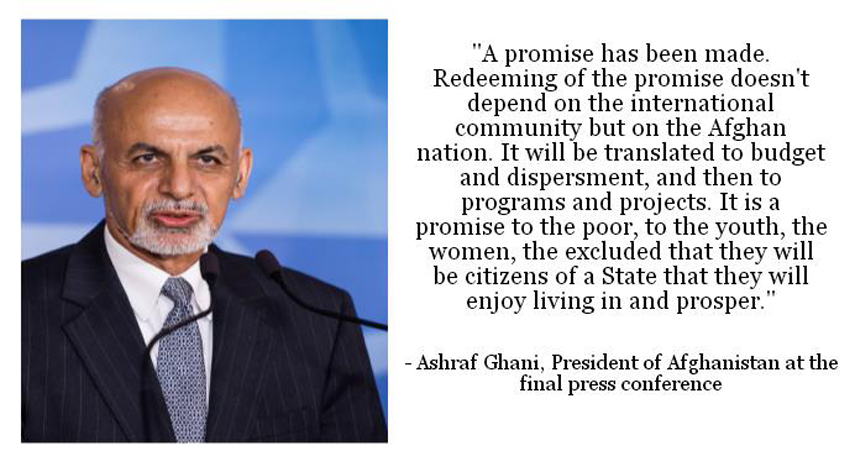
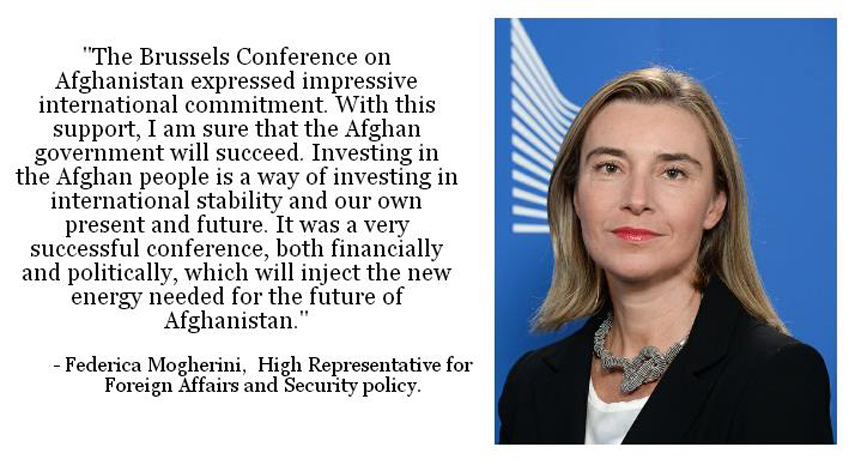
The Conference was concluded with closing remarks by Chief Executive Abdullah Abdullah, High Representative Federica Mogherini and European Commissioner for International Cooperation and Development Neven Mimica.
Main Results:
The 75 countries and 26 international organisations participating in the Brussels Conference issued a communiqué, renewing the partnership for prosperity and peace between the National Unity Government of Afghanistan and the international community. They underlined their collective commitment to deepen and strengthen their cooperation to achieve Afghanistan’s self-reliance in the transformation decade (2015-2024) and to create a political, social and economic environment that will allow Afghanistan to consolidate peace, security, sustainable development and prosperity. They noted that important progress has been achieved on Afghanistan’s way to a functioning, accountable and increasingly sustainable state, but the substantial challenges that the country still faces require further efforts to safeguard and build on these joint achievements. To foster this progress, they reaffirmed their commitment to the following three pillars over the transformation decade:
- Afghan-led state and institution building as outlined by the Afghanistan National Peace and Development Framework and the Self Reliance through Mutual Accountability Framework (SMAF);
- Sustained international support and funding at or near current levels through 2020 with increased aid effectiveness;
- Regional and international support for ending violence to foster economic development and improve regional economic cooperation, and for a political process towards lasting peace and reconciliation.
The Reform Agenda
The international community welcomed the new Afghanistan National Peace and Development Framework (ANPDF) setting out Afghanistan’s strategic policy priorities towards achieving self-reliance and the presentation of five new National Priority Programs – the Citizens’ Charter, Women’s Economic Empowerment; Urban Development; Comprehensive Agriculture and National Infrastructure.
They noted the successful completion of the International Monetary Fund’s Staff Monitored Program (SMP) and took note of the recent agreement between the Afghan government and the International Monetary Fund on the Extended Credit Facility supported arrangement that aims to preserve macro-financial stability and sets out a structural reform agenda with a focus on institution building, fiscal and financial reforms, and measures to combat corruption.
“We acknowledge the significant progress being made by the Afghan government to increase domestic revenue collection and implement the public financial management roadmap, which coupled with economic growth, are key to realizing self-reliance over the longer term.
“We welcome the government’s commitments to undertake additional reforms to promote higher and more inclusive growth and maintain financial stability,” the communique read.
It also stated that credible, inclusive and transparent elections will lead to greater political stability, and strengthen sustainable democracy in Afghanistan.
While some progress has been made, concrete steps will be taken by the government to implement in 2017 the essential electoral reforms and prepare for elections to further restore trust and confidence in the electoral process and its institutions, read the communique.
“Effective democratic and inclusive governance in accordance with the Constitution remains essential for our partnership,” the partners said.
They also welcomed Afghanistan’s move to make fighting corruption a priority – a problem that remains a major obstacle to development and stability.
They said the international community welcomes the establishment of the High Council on Rule of Law and Anti-Corruption and the Anti-Corruption Justice Centre and looks forward to their effective operation.
But they underscored the urgency of reducing poverty in Afghanistan by creating employment and addressing particularly widespread problems such as child malnutrition, food insecurity, poor sanitation, and conflict related impoverishment.
“This requires specific actions and inclusive reform approaches in sectors such as agriculture, infrastructure, and rural and urban development as envisioned in the new National Priority Programs,” they said.
According to the communique, the international community recognizes the Afghan leadership in community based development and endorses the proposed investments for improved delivery of essential public services to poor rural and urban communities, in particular for women and girls.
“We stress the importance of strengthening the rule of law and pursuing important judicial reforms to strengthen state legitimacy, while protecting the safety and security of judges, prosecutors and defense attorneys.
“Of particular importance is ensuring all Afghan citizens have access to a formal justice system that is fair and respected in its application of the law. Institution building remains central, including police and civilian policing, the Attorney General’s Office, the court system, and the provision of legal aid,” read the statement adding that the protection and implementation of the constitutional rights and international human rights in Afghanistan remains essential.
They also indicated that special consideration needs to be given to the rights of women and children, including measures to prevent violence against women and children and forced marriages, and to combat torture or ill treatment as well as discrimination.
Development Partnership
The alignment of international support with Afghanistan’s national priorities as outlined in the ANPDF is essential, read the communique.
As set out in the Tokyo Declaration (2012) and reaffirmed at the London Conference on Afghanistan (2014), international partners remain committed to providing significant but gradually declining financial support towards Afghanistan’s social and economic development priorities throughout the Transformation Decade, as the Afghan government continues to deliver on its commitments as part of this renewed partnership under the mutual accountability framework.
“We note the exceptional development support, which Afghanistan has received and continues to receive from international partners.
“We reaffirm that the renewed partnership depends upon the principle of mutual accountability and on both sides delivering on their commitments. Donors are committed to build on the gains that have been made by the Afghan people with international support since 2002 and to provide effective assistance including through close alignment with the ANPDF,” read the statement.
The international community said that building on the donor community’s achievement of Tokyo commitments to increase the level of development assistance channeled through the National Budget of the Afghan Government, they are committed to further increase aid effectiveness.
“We recognize the need to promote a high degree of Afghan ownership through use of country systems and joint programming, and in line with the commitments under the Global Partnership for Effective Development Cooperation.
“In addition to bilateral agreements and based, amongst others, on implementation of the agreed reforms, in particular progress on the Public Financial Management (PFM) roadmap, we will explore possibilities for different forms of flexible on-budget assistance, including State Building Contracts and expanding programs in support of Afghan development priorities, notably through the Afghanistan Reconstruction Trust Fund (ARTF) and related incentives or reimbursement schemes. On-budget support will continue to be contingent on improvements to accountability and audit mechanisms.
“We strongly welcome and equally value all other development assistance and project support that Afghanistan receives from its international partners to support Afghan National Development Priorities,” the communique stated.
They stated that for the period 2017-2020, international partners commit and confirm their intention to provide $15.2 billion USD in support of Afghanistan’s development priorities.
“We particularly welcome the contributions from new donors to Afghanistan as well as other announcements of bilateral assistance.”
They also stated that they recognize the role of civil society and media in Afghanistan’s development.
Afghanistan’s potentially large extractive (mining) industry reserves should build the economy and benefit national development. The Afghan government will take further steps to implement its commitment to the Extractive Industry Transparency Initiative and supports the efforts to improve mining governance and transparency that are presented in the ANPDF.
The Afghan government highlighted plans to combat illegal mineral extraction and to ensure fully transparent tendering for mine development so that the Afghan people benefit in full from natural resource development.
Peace, Security and Regional Cooperation
On this issue, the international partners stated that a secure, stable, and prosperous Afghanistan is vital to peace and stability in the region as a whole.
They said development and security are interconnected challenges for Afghanistan’s state-building process, and need to be underpinned by genuine political support at the regional level.
“We remain determined to counter all forms of terrorism and violent extremism as fundamental threats to international peace and stability.”
Stability and security in the region are not divisible. They can only be achieved and maintained with an approach that promotes security for all states in the region, read the communique.
“The international community welcomes the undeterred willingness of the Afghan government to engage with all armed groups in a political process without preconditions,” read the communique.
“The only way to a durable end to the conflict in Afghanistan is through a lasting political settlement,” it stated.
“In order to reach a peace settlement, we remain fully committed to supporting an Afghan-led and Afghan-owned peace process representing all Afghan citizens and their legitimate interests that preserves Afghanistan’s unity, sovereignty, territorial integrity and equal rights of all Afghans under the Constitution of Afghanistan.”
Stressing that the stability of Afghanistan affects the stability of the entire region, they said they are committed to preserving the independence of Afghanistan as a democracy, bound to the rule of law and the respect of human rights as enshrined in the Afghan Constitution.
Noting the increasing number of civilian casualties, they said they condemned all attacks targeting civilians or civilian facilities, which must be protected.
“We recognize the sacrifices and achievements of the Afghan National Defence and Security Forces (ANDSF) as well as the sacrifices made by the international partners.”
“We underline the importance of close and effective cooperation in the field of irregular migration and of the multilateral, regional and bilateral processes and political agreements in this regard, including the Joint Way Forward on Migration Issues between Afghanistan and the European Union.
“We are committed to effectively addressing the growing pressure of irregular migration in accordance with international commitments and obligations, including the human rights and legal rights of all migrants as recognized in international laws.”
We welcome the important initiatives for regional connectivity, notably in the frameworks of the Regional Economic Cooperation Conference on Afghanistan (RECCA) and the Heart of Asia Confidence Building Measures to further improve transit, transport and energy corridors and facilitate increased trade throughout the region.
“We welcome continued efforts on implementing the Afghanistan-Pakistan Transit Trade Agreement and welcome the progress on projects such as CASA-1000, TAPI gas pipeline, and important regional railway infrastructure projects.
“We welcome the signing of the Chabahar Agreement by Afghanistan, Iran and India and welcome the agreement on the Lapis Lazuli Transit Trade & Transport Route,” the statement read.
Side events
High-level events on women empowerment in Afghanistan and on regional economic cooperation took place on Tuesday 4 October.
- Women Empowerment — Empowered Women, Prosperous Afghanistan: This event was meant to send a strong signal about the high priority attached by the government to the protection and empowerment of Afghan women. The Government outlined progress and plans on the protection and empowerment of women. The SMAF identified the protection and empowerment of women as a top development priority. The NPP on the Economic Empowerment of Women will launch in advance of the Conference.
- Regional Economic Cooperation – The focus was on the role of regional cooperation and economic integration to promote stability and prosperity for Afghanistan and its neighbors. Considering CASA-1000, TAPI and the Chabahar projects as examples of such tangible steps, these initiatives are meant to bring Afghanistan and the region closer, and provide financial, socio-economic, political and security benefits for the entire region. Regional economic cooperation was seen as a platform for the region’s interests to converge, build confidence and provide incentives for peace.
Direct links:
- Brussels Conference on Afghanistan, partnership for prosperity and peace: communiqué of the participants
- The Afghanistan National Peace and Development Framework (ANPDF)
- Realizing Afghanistan’s economic potential and reinforcing the role of women
Previous Conferences on Afghanistan:
In January 2002, more than 60 countries and 20 international organizations participated in the Afghanistan Recovery and Reconstruction Conference in Tokyo, pledging more than USD 1.8 billion for the year 2002 and USD 4.5 billion over the ensuing five years to rebuild Afghanistan, according to the United Nations Development Programme. In December 2011, The International Conference on Afghanistan in Bonn was held.
On 08 July 2012, a decade after the first Tokyo Conference in 2002, governments, international organizations and other stakeholders re-convened in that same city to pledge assistance to Afghanistan for the remaining transition years and beyond. At the Tokyo Conference in 2012, it was agreed that a series of ministerial meetings on Afghanistan will be held to support progress in Afghanistan. Financial commitments made at the Tokyo Conference in 2012 were projected until 2016. The first one was the London Conference on Afghanistan in 2014 where 59 countries reaffirmed their commitment to support Afghanistan to become a secure and stable nation. The Brussels Conference on Afghanistan (2016) is the second of these meetings. The Brussels Conference secured commitments until 2020 but Afghanistan must also keep its SMAF commitments.
Since 2001, Afghanistan and its partners have made significant investments. There are still a lot more that needs to be done. Afghanistan remains fragile; there are significant political, security and economic challenges. Strong partnerships are required to make sure reforms takes hold and Afghanistan succeeds in its goal of achieving self-reliance in the Transformation decade. The risks are real and strong commitments from our international partners are need to make sure that we root out terrorism and violent extremism; and that we build strong institutions that are able to deliver quality basic services to all Afghan citizens.
For the Afghan Government it was an opportunity to set out its vision for the future by presenting the Afghanistan National Peace and Development Framework and to showcase its track record on reforms.
For the international community it was an occasion to send a strong political and financial message in support of peace, state-building and development in Afghanistan and to reaffirm its commitment to Afghanistan’s future peace, stability, prosperity by keeping support at or near current levels.
Direct Links to Previous Conferences’ Joint Communiques
Afghanistan Recovery and Reconstruction Conference in Tokyo (2002)
The International Conference on Afghanistan in Bonn (2011)
Tokyo Conference on Afghanistan (2012)
London Conference on Afghanistan (2014)
The Brussels Conference on Afghanistan (2016)
Sources:
http://mfa.gov.af/en/page/the-brussels-conference-on-afghanistan http://www.consilium.europa.eu/en/meetings/international-summit/2016/10/05/
http://www.tolonews.com/en/afghanistan/27660-communique-signed-at-brussels-conference-on-afghanistan