



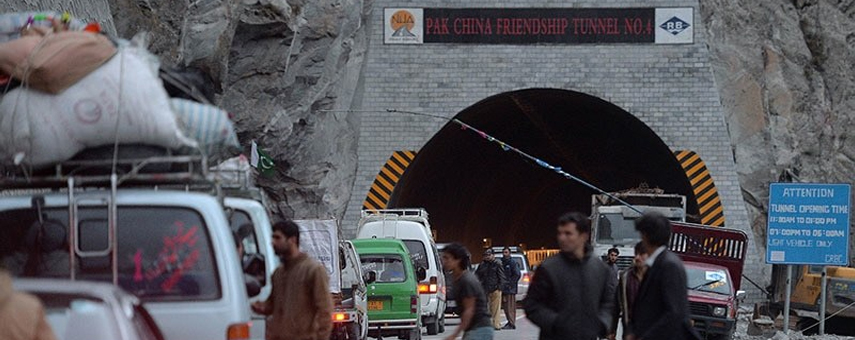
Since its inception in 1951 the Sino Pakistan relationship, after some initial coughs, has always been on a rising curve. The strength in their ties comes from mutuality of strategic interests, tested interdependency in moments of despair and need, willingness to transform relations to meet new and emerging challenges and finally unstinting public support in both countries for each other. In this context, each of the tired cliché used for Sino China relations are not far off from reality, and thus the relations remain an envious model of inter state relations. No other country including Saudi Arabia enjoys this kind of undivided support in Pakistan.
Out of the six decades of friendship, two decades were mostly utilized to deepen mutual perceptions to secure each other’s trust and how best they could help each other at the regional as well as global level. This period was utilized to establish the rock solid foundation to bilateral relations. The remainder decades, starting from mid 70s, witnessed physical manifestation of commitments and vows emanating from strategic understanding in the earlier phase.
The depth of the conflict free multidimensional bilateral relations defies historic trends. Between two neighbors such deep relations are an exception rather than a norm. No change in government or leadership in either of the two countries, or the demise of the Cold War era and its associated alliances or subsequent readjustments affected their relationship. As time passed, the friendship assumed the status of strategic permanency.
Both iron friends are now looking beyond the status quo, as their legitimate interests demand, in parallel with strategic partnership, to ensure a tangible improvement in trade, mutual access to economic factors beyond the region and connectivity with other countries. Beijing is pursuing its visionary project namely “one belt-one road” (OBOR). President Xi Jinping’s dynamic vision of prosperity through connectivity is re-defining the concept of world order, making it clear that the New Silk Route, both overland and maritime, will change the way major powers deal with small countries.
CPEC is part of the grand OBOR project that aims to develop infrastructure in Pakistan. The deal will also provide China the Arabian Sea route for access to economic materials. It will also boost intelligence sharing between the two countries and Chinese Naval presence in Indian Ocean to thwart any import blockade.
The entire Pakistan views this project as another consolidating factor in the already strong bilateral relations. If the US $ 46 billion project is implemented in full, it may raise Pakistan’s GDP by 2 % or more, (estimates vary). In this ideal situation, all segments of the society, all provinces and regions in Pakistan will benefit (A bumper crop after a good early harvest concept). CPEC will help narrow Pakistan’s energy gap, while boosting investment activity and infrastructure in the country.
CPEC as an umbrella package is a great opportunity for both countries. Expectations in Pakistan are high. Will it continue without risk of loosing the critical steam needed to clinch its anticipated goals? Recently, some doubts have been cast among political circles in smaller provinces and in Gilgit & Baltistan.
Internal and regional imperils:
CPEC is unlikely to have a “plain sailing” due to the complexity of securing the Gwadar to Kashgar corridor and the ragging internal differences among provincial governments on the composition of the package under CPEC. A number of power projects under CPEC have already hit a number of roadblocks. The Matiary to Lahore Transmission Line is in doldrums. The Tharparkar power project in Sindh has become controversial to the extent that a few don’t see it feasible. There are problems with the Quaid-e-Azam Solar Park. Some power generation projects in Punjab including coal fired Kallar Kahar power plant have been scrapped. Litigation has already started over use of coal-fired technology for power generation. The security costs due to unavoidable involvement of military and the complaint of CPEC being heavily tilted in favor of Punjab have become hot political issues in Pakistan.
It is unlikely that China will change its current policy to support CPEC as a priority project, but the increased cost of security is likely to weigh heavily on the Chinese leadership to assess CPEC as economically reliable corridor, especially in an emergency such as military blockade of Melaka Strait for Chinese imports. China has already sunk US $ 14 billions in the projects (The Chinese Embassy resources). It wants backing from regional countries to connect its west to Iran, Turkey and Gulf region through a shorter route, which seems missing despite Pakistani mantra that CPEC is a game changer for the region and many regional countries have shown interest in CPEC.
China’s ship-borne trade currently amounting to $5 trillion may triple over a decade, much of which will be passing through Gwadar-Kashgar route. Undeniably, Gwadar not only is promising for Pakistan and China, but also at least potentially for Central Asia whenever peace returns to the region. However, there are huge slips between the cup and the lip. The threatening regional geostrategic developments must be taken into account before making such outlandish claims. The best course is to be pragmatic. Both Pakistan and China should be ready to brace themselves for “potential setbacks”.
The Chinese imports are worth around $500 billion per year. Pakistan’s share is a meagre $5.5 billion despite geographical proximity. The business leaders, already unhappy with China-Pakistan FTA, are not only scared of massive dumping of goods bound for export to areas beyond Pakistan but also smuggling of goods from China. Chinese investment in special economic zones is another issue of concern. Pakistani media has started highlighting negatively about African experience with China.
The troublesome issue is that the government of Pakistan has oversold a commercial deal branding it a political project. Further it claimed that its failure or half success will threaten the strategic bilateral partnership exposing Pakistan to easy manipulation by more economically powerful India and its new patron, the US. Any criticism of the commercial deal was also declared as an unpatriotic act by the Military.
CPEC is a clever combination of business and diplomacy on the part of China. In deference to the diktat of friendship, the Chinese government has extended loans and has chosen credible as well as high performing state corporations to undertake CPEC projects in Pakistan. But these corporations are expected to make reasonable profit and not indulge in charity. There is nothing wrong with this approach as in business no one makes money for others. There was no need to present CPEC as a political or strategic move only. Rather the essential need to introduce financial transparency and distribution of CPEC projects among all provinces were ignored. With Afghanistan not in a mood to provide transit facilities to Pakistan, and Iran only making diplomatic declarations that Chabahar and Gawader are sister ports, CPEC is limited to benefit China and Pakistan.
The Chabahar port is a key Indian initiative that needs sustained effort to develop it into a viable alternative for Afghanistan’s external trade, effectively displacing Karachi as the port of choice. The economic corridor is not a challenge to India. Their worry is the more invigorated Pakistan-China equation because of it and stiffer monitoring of Indian subversive activities in Baluchistan. After the Quetta attack, the Pakistani establishment claimed that it was directed against CPEC.
Beijing’s decision to proceed with the CPEC will remain sensitive to the Indian government’s twin decision to ally India more closely with Washington, including in the South China Sea dispute, and its refusal to participate in China’s “One Belt, One Road” initiative of which the CPEC is a part. China does not take India’s claim on Gilgit- Baltistan seriously and tends to support Pakistan’s principled position on the Kashmir Dispute.
The US comes into the big picture. Albeit for different reasons and as of now not yet publicly, the US is as bitterly opposed to CPEC as is India. This is because CPEC would have strategic value for Beijing, providing it with a means of partially circumventing the economic blockade that the Pentagon plans to impose on China in the event of a war or war crisis by seizing Indian Ocean and South China Sea “chokepoints.”
The China Pakistan relations are not static. CPEC is an invaluable fresh input. China seems all set and fully determined to implement the cluster of projects in the package. It has the capacity to surprise the world. Do we have the matching resilience to overcome our internal differences to meet half way with our Chinese friends to execute a commercial deal with high strategic content for both sides with the requisite business insight?
The writer, Mian Sanaullah, is a former Ambassador, political analyst and Advisor to CRSS, an independent think tank. (mian.sana@gmail.com)