



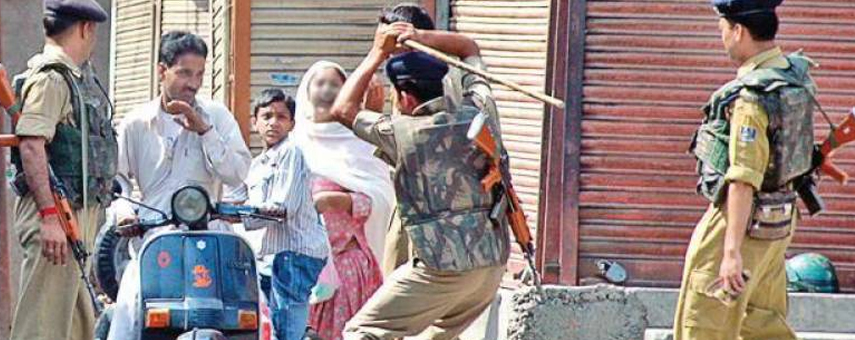
Despite the ongoing unprecedented oppressive Indian brutalities against Kashmiri youth and women in the Indian Occupied Kashmir (IOK), major global powers have not condemned the Narendra Modi government. So far, the killing of over 100 persons, blinding of hundreds of young people and injuring of over 4000 young and old people have largely failed to receive world attention and sympathy. The indifference is disquieting. Is it because of the economic power of India that the world has chosen to ignore the massive violence of human rights or the international community is not fully convinced that Kashmiris have the inalienable right to decide about their future. In Pakistan, successive governments have been accused of not pursuing consistent global support campaign to flag the Indian cruelty against the Kashmiri youth.
While multiple factors exist for lapse on part of our successive governments, some basic elements, which caused sizeable global support for similar human rights violations, are missing in case of IOK agitation. In this context, it will be interesting to delve into the important elements posted by Clifford Bob in his essay entitled The Merchants of Morality (Foreign Policy 129(2002): 36-45) to identify what factors have impeded the genuine suffering of Kashmiris from reaching a broader audience in the “harsh Darwinian marketplace” of “global injustices”. The notion that a cause must compete for the World’s sympathy, money, and attention represents a troubling and perplexing irony, in the words of Bob (2002), because the most dire and troubling crises are never the ones with the most widespread reception, lest they “distort their principles” and “alienate their constituencies” to appease “self-interested donors”.
Bob cites the prominence of the Tibetan cause as opposed to that of the Uighurs, wherein both nations are allegedly subsumed by China, but only one of these two, which is personified by the Dalai Lama, draws large media reception and resonance. Bob draws a similar analogy in the contrast between East Timor, far more generously received by a donor audience, with other movements such as the Acehnese (Indonesia) and Irian Jayans (between Indonesia and Malaysia) virtually unknown beyond their immediate regional neighborhood. Of perhaps greater (and yet ironically lesser vis-a-vis a donor audience) import is the examination of the much longer-standing crisis that has simmered in Indian-held Jammu and Kashmir.
Despite its cursory mention in Bob’s analysis, the tragedy of Kashmir aptly engages with the crux of his argument: that the most deserving causes simply “languish in obscurity”. Why should the plight of Kashmir, perhaps the oldest unresolved issue on the United Nations agenda (Pakistan Permanent Mission to the United Nations- 2010), dating back to the independence of Pakistan and India from colonial rule, not pervade the ethos of a global audience of altruists? This question warrants investigation because it has been the cause of two wars between now nuclear-armed large nations, India and Pakistan, but with no advancement towards resolution beyond a temporary detente.
Bob theorizes that a multiplicity of factors impede aggrieved movements from harnessing the requisite global attention. These include inter alia notions of internal strife, low-intensity conflict, the lack of ‘charismatic’ (Western-palatable) leadership, funding, international peace fora, and nuanced non-simplification. Bob also surmises that there are two basic strategies that movements can follow: either by pitching the cause internationally, or by speaking to the universalism of their traits to enhance their appeal.
IOK does not fall neatly into either of the above-mentioned characteristics. Human rights NGOs such as Human Rights Watch [HRW] do share their horrific findings in Kashmir, such as the use of rape as an instrument of war, in the public domain (1993a; 1993b), and countries such as Pakistan use multilateral fora to draw attention to the plight of IOK (PPMUN 2010), while the United States government is acutely aware of human rights violations in IOK (United States Department of State [USDS] 2012). All of this is of no avail because the Kashmir cause does not clearly follow one of the basic two strategies outlined by Bob. The Kashmiri people cannot match the public relations juggernaut that India wields. Nor can the Kashmiri people manage to universalize their suffering in an audience of Western donors where even a remote association with Islam can trigger Islamophobic knee-jerk reactions.
Internal strife within Kashmiri freedom fighters is also a notable element within the Kashmir case. Bob remarks that the most democratic and participatory movements may actually receive the least international assistance because they may be perceived as harboring internal strife. In the case of IOK this phenomenon is highly relevant in the splintering of society along levels of active resistance to Indian occupation, ranging from servile officials who are generally seen as having “betrayed Kashmiri interests” (HRW 1993a, 21) to a swathe of militants who launch insurgencies against the government. As HRW has noted, these militants also engage in reprisal tactics that result in human rights abuses (HRW 1993a; 1993b). From the perspective of self-interested external donors, such violence and complexity of views within the community weakens the marketability of the cause. Bob’s assertion that nuances are the enemy thus proves correct in this instance.
Bob observes that often a cause can only garner sufficient attention in the short term if it tallies horrific death tolls, enough to shock transnational institutions by their sheer magnitude. In the case of IOK, this is not the case because of its long-simmering nature that has made it into mostly a low-intensity conflict premised more using rape as an instrument of war (HRW 1993b) or suppressing publicity of killings. This propaganda belies that the Kashmir dispute is the nuclear flashpoint. Nonetheless, the comparatively low but continuous death toll in Kashmir muddles the urgency of the cause in a world where horrifying genocidal events continue to erupt.
Bob theorizes that accessibility to the outside world is a major determinant of the success of such causes. In cases such as the Zapatistas where access is remote, sympathetic journalists help to bridge the gap. By contrast, the Kashmir struggle is hampered by a lack of access to the outside world. Human Rights Watch notes that even the Red Cross is not allowed access into Kashmir, while the accessibility of HRW and other NGOs such as Amnesty International is severely hampered (HRW 1993a, 10).
Funding disparities also hamper the dissemination of the Kashmiri perspective to a broader international audience. Bob theorizes that funding and deep pockets are a core determinant of success in the Darwinian marketplace. East Timor had long term benefactors in Portugal and Australia, but Kashmiris do not have any benefactors in the developed world. Their brethren in Pakistan are constricted in their funding capabilities not only by their low per-capita income, but also drawn away in terms of resources by engagement on their western frontier due to instability in Afghanistan. Bob remarks that international peace prizes also draw remarkable attention from Western donors, which in the case of the India-Pakistan relationship is not awarded on the Kashmir issue but rather on domestic education initiatives (Malala Yousufzai in 2014). No advocate of the Kashmir cause has ever won the Nobel Prize.
What is perhaps odd in the case of the Kashmir struggle is that the large “gatekeeper” NGOs that are most interested in having the torment inflicted on the Kashmiris brought to light (HRW 1993a; 1993b); but despite their comparative influence and reputation, even these transnational NGOs cannot lift the veil on human rights abuse in Kashmir, certainly not to the extent of drawing a captive audience of international donors.
The simplification and universalization of the Kashmiri cause is also made difficult by the variety of “endgame” options that the Kashmiris must wrestle with. As an Urdu-speaking Muslim people, the Kashmiris identify very strongly with Urdu-speaking Muslim Pakistan, but whereas many do urge accession to Pakistan, some Kashmiris would simply make do with being free of India, in a separate country (HRW 1993a, 20). This sort of complexity is highly indigestible for the Western NGO community.
Furthermore, the Western NGO community has an almost feverish obsession with the promotion of democracy in many, if not most, of its engagements. In the South Asian context, India is the longest-running democracy and therefore plays strongly into the natural vernacular of Western NGOs, so much so that the legitimacy of the Kashmiri struggle is derailed as decision-makers in the international audience draw parallels with the American democracy (as an example) fighting an Islamist insurgency (USDS 2012).
Perhaps most crippling of all, and in line with Bob’s assessment, IOK has no ‘charismatic’ leaders for sale – no pliant poster-children akin to Che Guevara of yore. The separatist movement in Kashmir valley is headed by Syed Geelani, who while being popular in Srinagar and somewhat recognizable in Pakistan, lacks the pliant Western-digestible image that the audience requires. Western donors would find the image of Syed Geelani less palatable than many of the competing global causes, and it is not clear that he could articulate to a global audience the message of Kashmir self-determination with the vigour that he can employ in Urdu. In short, with no personality to embody the Kashmiri aspirations, the international donor community fails to find sufficient personification of the Kashmiri struggle.
In sum, the myth of the “global meritocracy of suffering” that Bob dismisses as a farce, finds stark resonance among the disenfranchised people of IOK who struggle tirelessly for their self-determination. A further two-part question that emerges from this paper as a continuation of the aforementioned case study is as follows: if “in a context where marketing trumps justice” the cause of Kashmir is unheeded by “self-interested donors”, should the Kashmiris fashion themselves into a “public relations machine” against their “well-heeled opponent”: a nuclear-armed country of more than 1 billion people. If so, what are the major “distortions of principles” that they would need to commit?
In the light of above arguments, questions arise whether the envoys, being sent abroad by Islamabad to sensitize the world about the Indian continued gross violations of human rights in IOK, are well equipped to convey the sentiments of the Kashmiri people and, when challenged, have the ability to untie the complexity of the Kashmir dispute in a language that is easily understood by international opinion makers. Also, is Pakistan in a position to advise the Kashmiri leaders on winnable “distortion of principles” – a euphemism for change in their current tactics to effectively leverage with the world to ensure that India ceases brutalizing freedom fighters in IOK?
By Ajar Sana, IR Department, Australian National University, Canberra