



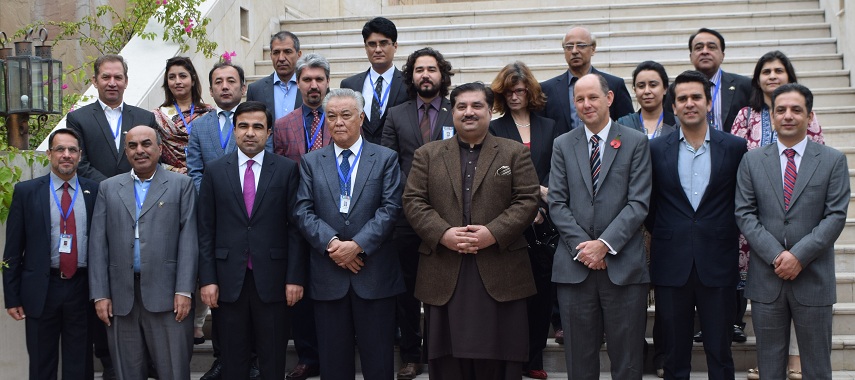
The Center of Research and Security Studies (CRSS), in partnership with its Afghan counterpart organization DURAN Research and Analysis, launched a major Pakistan-Afghanistan Track 1.5/II project “Beyond Boundaries” (BB). The initiative, launched in the second week of November, is a part of the efforts to help improve relations between Pakistan and Afghanistan. BB will be implemented in close coordination with the Government of Afghanistan, and the Government of Pakistan. The endeavor is anchored in workshops that feature eight representatives from Pakistan and Afghanistan each, engaging in an open discourse about narratives, grievances and the way forward. The workshop sessions comprise of two working groups; Regional Security Group (RSG), and Regional Civil Society Group (RCSG). Both groups are slated have three meetings each in Islamabad and Kabul, followed by a concluding meeting in Islamabad.
The key objectives of the initiative are:
- expanding the peace constituency through friendship groups in both countries;
- improving support for better Afghanistan-Pakistan relationship through enhanced dialogue among the influential stakeholders of both sides;
- encouraging dialogues at various levels through official and unofficial communication channels; and,
- informing policy makers through forums, policy documents and media.
Initiatives like BB will bring together influential government and non-governmental stake-holders who can help reduce tensions, address misconceptions, and revive some level of confidence. The ultimate objective is to eventually urge both governments and key stakeholders away from the mutual vitriol and antagonism, and towards a more trusting and collaborative approach that enhances peace, security, and regional cooperation.
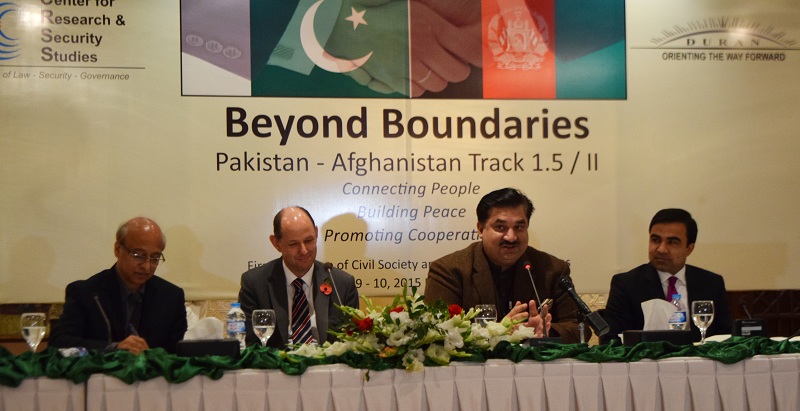
The first meeting of the RCSG working group was held in Islamabad from November 9-10, 2015 against the backdrop of a politically grim environment. The inaugural session was chaired jointly by the Federal Minster for Commerce, Khuram Dastgir Khan, the Honorable British High Commissioner, Philip Barton, and the Afghan Ambassador, His Excellency Janan Mosazai. Following this, the two day workshop sessions addressed:
- Pakistan and Afghanistan Narratives – Role of Civil Society and Media;
- Education as a connector in the peace and trust building process;
- Economic Integration and Development; and,
- Afghan refugees.
A concluding session wrapped up the proceedings and was jointly chaired by Lt. Gen. (retd) Talat Masood, and Senator Syed Mushahid Hussain. The two working groups on RCSG drafted and agreed upon a joint declaration of policy recommendations, which is reproduced below.
Speaking at the inaugural session the Afghanistan Ambassador Janan Mosazai said: “It is important to advance the goals of mutual cooperation on a state level. Enhancing people to people relations is not a side priority but a core priority of relations with Pakistan”. He underpinned the need to build on the commonalities that exist between the two nations.
Federal Minister for Commerce Khurram Dastagir also spoke on the occasion, saying it was Prime Minister Nawaz Sharif’s strong desire to end years of hostility between Pakistan and Afghanistan: “There is a need to steer the stakeholders towards negotiations. It is important to bring together civil society and media people from both the countries to help improve the perceptions of each other”. British High Commissioner Phillip Barton said the British government was happy to support the initiative while underscoring the need to have better bilateral relations for both the countries. He noted: “Dialogue is always important and this is the best time for Track II intervention”. Imtiaz Gul, Executive Director CRSS, said: “Recognizing ground realities governing relations between the two countries can help the peace talks”.
The session on “Pakistan and Afghanistan Narratives – Role of Civil Society and Media” was chaired by senior journalist and columnist, Mr. Mohammad Ziauddin, where Mr. Barry Salaam and Ms. Gulmina Bilal presented the Afghan and Pakistan narratives. The second session on “Education as a connector in the peace and trust building process” was chaired by former Ambassador Ms. Seema Baloch, where Dr. Huma Baqai made a presentation on the role of academia and importance of education exchanges and scholarships between the two countries.
On the second day, the initial session was on “Economic Integration and Development” and was chaired by senior economist, Dr. Muhammad Zubair. Prominent lawyer and human rights activist, Mr. Ahmer Bilal Soofi, gave a presentation on the bilateral and multilateral treaties that have been signed by the two countries, and have to be adhered to and implemented. Dr. Zubair briefed delegates on bilateral trade relations. He observed that trade potential between both countries was so significant that if national interests were truly considered; they would overlook all other issues.
The session on “Afghan Refugees” was chaired by former Ambassador Mr. Shahzad Chaudhry, where the UNHCR Pakistan Assistant Representative, Ms. Jeanette Zuefle, briefed the two groups on the role of the UNHCR, and the latest statistics on the Afghan Refugees.
Speaking at the concluding session as the chief guest, Senator Mushahid Hussain said: “Pakistan wants its relations with Afghanistan to be on equality and reciprocity. Without peace and stability in Afghanistan, there cannot be peace and stability in Pakistan”. The Pakistan of 2015 does not distinguish between good and bad Taliban, he added.
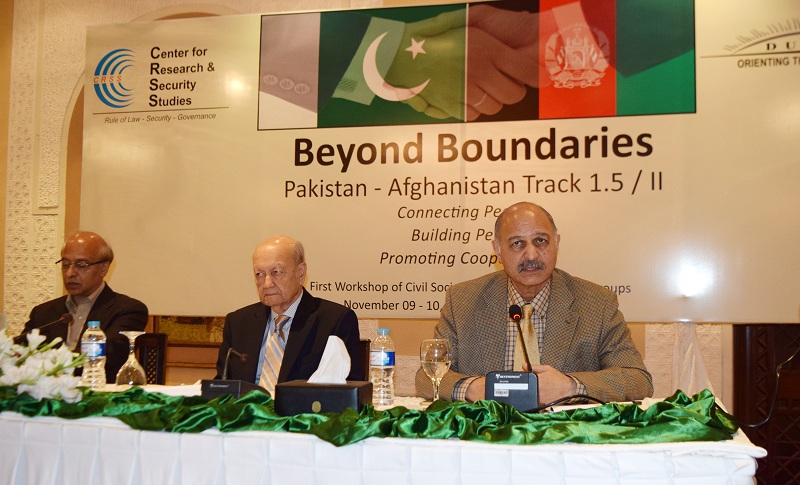
The concluding session of the dialogue was attended by members of civil society, media, intelligentsia, government officials and diplomats. Chairing the concluding session, Lt. Gen. (retd) Talat Masood noted that it is the responsibility of both countries to work together to resolve differences and actualize potential. Pakistan and Afghanistan must continue dialogue to lower trust deficit, he said.
The two day workshop ended with the Pakistan and Afghanistan RCSG working groups drafting and unanimously approving a joint declaration of policy recommendations (reproduced below). The next meeting of the groups on Regional Civil Society will take place in Kabul during the start of December, 2015.
The following is a joint declaration from the regional civil society group, November 10, 2015, Islamabad:
- Civil society on both sides unanimously condemns all acts of terrorism in either side of the border.
- Both parties affirmed that civil society representatives should act and talk independently, representing their own views as members of civil society and the aspirations of their respective nations.
- Civil society of both countries urges their respective governments to prioritize security and peace as a key milestone in providing conducive environment for mutual cooperation.
- Both countries shall strive to review their educational curriculum in order to raise the new generation of both Afghans and Pakistanis with a peaceful perception of each other, promoting peace education, civic education, tolerance and peaceful co-existence.
- Both Afghan and Pakistani civil society organizations are committed to transforming the prevailing negative narrative in respective countries by increasing people to people and civil society exchanges and confidence building measures.
- A realization of the importance of emphasizing that peace is essential to the region and civil society and other non-state actors in both countries can contribute to promoting dialogue on peace.
- In keeping with UN Security Council Resolution 1325, and following resolutions, we jointly re-affirm our commitment to ensure the equal representation of women in all delegations working towards peace, including civil society groups, youth, media, political representation and government representation.
- Civil society in both countries urges their respective governments to collaborate on the implementation of their international and mutual commitments under bilateral and multilateral conventions and treaties.
- On the educational collaboration front, the civil society in both countries urges their governments to develop a comprehensive and transparent program for scholarly exchange between two countries. These include, scholarships (up to PhD level), visiting scholar programs and alumni networking on both sides.
- Economic cooperation is the best way forward for cementing ties. Trade forms a common link between the two countries.
- The civil society of both countries urges their respective media to promote a culture of peace and contribute to transforming the negative narrative as a multiplier of the peace process.
- It is recommended that human rights be protected of Afghan Refugees with special emphasis on facilitating their voluntary repatriation to their homeland.