



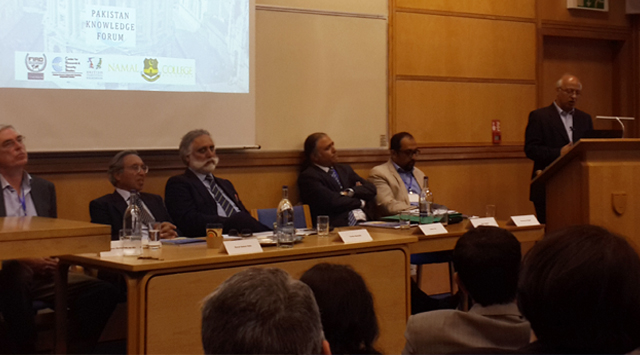
Below is the summary of a paper that Mr. Imtiaz Gul, Executive Director CRSS presented at the International Conference ‘Pakistan: Opportunity in Crisis’ on “Executive, Judiciary, Parliament and the Military:Rebalancing of Powers in Pakistan” held at Asian Studies Centre, St Antony’s College, Oxford University from 10-11 May, 2014.

Introduction:
March 9, 2007 was a defining moment for Pakistan: Regardless of CJ Iftikhar Chaudhry’s motives, his defiance of General Pervez Musharraf, the Supreme Commander and his close associates at the virtual Army House in Rawalpindi south of Islamabad, turned out to be a watershed in the senior judiciary’s role in Pakistan. What we have seen since is the emergence of the senior judiciary as an ever-assertive and at times unnecessarily interventionist state institution which has been challenging both the military and the civilian leadership – albeit with limitations.
Judiciary Use of Doctrine of Necessity vis-à-vis the Military, Parliament & Executive
A look back at the 67 years of political history of Pakistan shows five extra-constitutional emergency or martial law regimes where the constitution was either entirely abrogated or partly or wholly suspended. Martial laws were declared in Pakistan in 1958, (by Iskandar Mirza who appointed General Ayub Khan as the Chief Martial Law Administrator), 1969 (by General Yahya Khan himself), 1977 (by General Zia-ul-Haq) and in 1999 and 2007 (by General Pervez Musharraf).
All first four Martial Laws in Pakistan were legitimized by the Supreme Court of Pakistan using the ¿Doctrine of Necessity– which was introduced by Chief Justice Muhammad Munir in Supreme Court of Pakistan jurisdiction in the mid-1950s. He drew support for the ¿law of necessity– from Braxton maxim which stated, ‘That which is otherwise not lawful is made lawful by necessity’, and the Roman dictum, ‘the well-being of the people is the supreme law.’
In all of the above martial laws, it was always the when there was increasing political turmoil in the country that the military generals seized the opportunity to intervene in politics, basing their legitimacy to do so on the grounds that it was for the well-being of the nation. There were also several post-facto rulings of the Supreme Court where the previous military dictator martial law was either declared invalid or the military ruler was called a usurper, however, these did not deter the next martial law in the least.
Then came General Musharraf military coups of 1999 and 2007. Like General Zia-ul-Haq, General Musharraf also had the sitting Prime Minister tried in a court of law. In 2000, he had the judges take the new oath under the Provisional Constitutional Order. Justice Saeeduzzaman Siddiqui was notably the only Justice who refused to take the new oath and voluntarily resigned. In his place, Justice Irshad Hasan Khan took the new oath and, in doing so, legitimized General Musharraf coup d–├âŒtat ‘on the touchstone of the doctrine of state necessity and the principle of salus populi suprema lex (meaning ‘Let the good of the people be the supreme law’). After remaining the president of the country from 1999 till 2007, he imposed another emergency rule on November 3, 2007 and enacted PCO No.1 when his winning in the presidential election of October 2007 was challenged by the Supreme Court of Pakistan.
Several events beginning from 2005 triggered the onset of the independence of the superior judiciary in Pakistan.
1. Justice Iftikhar Muhammad Chaudhrybecame the Chief Justice of Pakistan replacing Irshad Hassan Khan in 2005. Although, Justice Iftikhar had been on all those benches that validated General Musharraf coup in the first place as well as those that approved of his extra-constitutional referendum to become the president and his amendments to the constitution, he would defiantly challenge the dual role of Musharraf as the President and the Army Chief of Staff. He also began exercising the court suo moto judicial review powers. Two major cases in which he exercised SC suo moto jurisdiction while General Musharraf was the president were the Pakistan Steel Mills Case (where he exposed the economic mismanagement and the failure to abide by rules and patronage of the businessmen involved in securities fraud in the government circles) and the missing persons– case (who were allegedly detained by the army and the intelligence agencies without legal process).
2. Lawyer Movement for Chief Justice Restoration (2007-09)
After President General Musharraf declared emergency rule on November 3, 2007, enacted PCO no.1, stating it was for effectively fighting ¿War on Terror– and suspended the constitution as well as the Parliament which allowed him to rule without judicial oversight like some of his predecessors, this time judiciary did not respond in the way it always had before. Unlike the 2000 PCO, this time the Supreme Court issued a restraint order which prohibited the judges to take oath under PCO 2007. Almost 2/3rd of Pakistan 97 senior judges refused to accept the imposition of the emergency rule; an unprecedentedly bold move by the judges in the history of Pakistan. Even after CJ Iftikhar Chaudhry was house arrested in addition to 60 other judges who supported his reinstatement in SCP July 2007 ruling, the lawyers, judges and social activists of the country were not deterred by this.
A lawyers– movement had begun in the country following the CJ suspension in March 2007, culminating later in ¿Long March– from Karachi to the Parliament House, Islamabad, in June 2008. The Lawyers– Movement was a popular mass protest of approximately 80,000 lawyers who, despite their traditional Pakistani political divides, aligned to reinstate the Chief Justice and restore judicial independence in the country. As it grew, it also included many human rights activists, media persons and students. The movement came to be called ‘Adliya Bachao Tehreek’ (Save the Judiciary Movement). Several lawyers and judges were arrested in this movement by Musharraf, but it did not subside until Musharraf impeachment was initiated in the parliament in 2008 and the judiciary was restored by the next President in March 2009.
3. Charter of Democracy (2006), signed between former political opponents, PPP and PML-N, while they were both in exile, stated that the military dictatorship and the nation could not co-exist as the former had continued to cause enough damage to not only the economy but also the defence capabilities and democratic institutions of Pakistan. It was time political parties in Pakistan coalesced with each other to remove the loopholes in Pakistan politics that were hindering the process of democratization and allowing military rulers to intervene time and again. Although, in the process, one of the parties signed a very controversial document with the military dictator, called the National Reconciliation Ordinance (which granted amnesty to bureaucrats, politicians and political workers who were accused of murder, money laundering, corruption, embezzlement and terrorism), it was later annulled by Supreme Court in 2009 after the Chief Justice was restored.
The landmark ruling of the Supreme Court which marks the true independence of judiciary as a state organ came on July 31, 2009 when it declared the 3rd November 2007 announcement of the emergency rule by General Musharraf extra-constitutional and illegal. The court also vowed that no judge of the superior judiciary would ever validate any abrogation or usurpation of the Constitution by anyone again. Chief Justice Iftikhar Muhammad Chaudhry stated that the judiciary would now completely refrain itself from endorsing any constitutional deviation in the future.
4. 18th Amendment (2010)
The PPP government formed a Constitutional Amendment Committee which aimed to restore the 1973 Constitution to its original form and remove all the amendments done in it by different military dictators (8th amendment in the 1973 Constitution by General Zia in 1985 and the Legal Framework Order 2002 and 17th amendment by General Musharraf). Enacting the 18th amendment was considered essential for parliamentary sovereignty and the independence of the legislature which would ultimately strengthen the democratic structure of the country. An important reform in the 18th Amendment was the expansion of the definition of ‘high treason’ under Article 6 of the Constitution. With the amendment becoming a law now, anyone suspending the constitution or holding it in abeyance or attempting to do so would be considered guilty of high treason.
The Beginning of Judicial Assertion/Activism in Pakistan (2009 ´ to date)
Since judiciary restoration in Pakistan, the Supreme Court of Pakistan started a frequent exercise of its judicial powers in all sorts of matters ranging from political, social, and economic to foreign direct investment (FDI). More specifically, it used its ‘suo moto’ jurisdiction. The powers of taking suo moto action, i.e., ‘on its own motion’, is vested in the Supreme Court by Article 184 (3) of the Constitution which reads as the following:
‘Without prejudice to the provisions of Article 199, the Supreme Court shall, if it considers that a question of public importance with reference to the enforcement of any of the Fundamental Rights conferred by Chapter I of Part II is involved, have the power to make an order of the nature mentioned in the said Article.’
The Supreme Court even extended the scope of public interest litigation (PIL) which expanded the constitutional fundamental rights of individuals. In the expansion of the fundamental rights, it was held that,
‘any case which raises a matter of constitutional interpretation and enforcement regarding the composition, processes and powers of the legislatures is thus by its very nature a case of public importance, as it affects the rights of the public at large, and also affects the Fundamental Rights of the citizens.’
The apex court, under Chief Justice Iftikhar Chaudhry, has taken hundreds of suo moto actions since 2009 which include actions against army personnel, politicians, government officials and even several media persons. Due to its suo moto actions in the last five years, it placed immense pressure on not only the military but also the elected parliament and the federal government, claiming that the Supreme Court possessed overriding powers of suo moto actions conferred on it by the Constitution. The popularity of suo moto actions even encouraged High Courts of other provinces to exercise this authority on extremely insignificant issues. The extent of judicial activism has been such that the parliament and the executive have now become uncertain about what they can even do or cannot do. In June 2012, the Supreme Court of Pakistan, for the first time, disqualified a Prime Minister from holding a seat in the parliament. Prime Minister Yousaf Raza Gilani had been convicted for contempt of court and the Supreme Court disqualified him retroactively from April 2012 in June 2012.
Other than repealing the National Reconciliation Ordinance in 2009, the apex court compelled the legislature to legislate in a certain way by bringing the 18thamendment in 2010 and enacting the Contempt of Court Law Act in 2012. It even annulled several statutory provisions and commercial deals involving billions of dollars of foreign direct investment. This way, the Supreme Court exercised its authority even in those matters which normally fall under the prerogative of the legislative and executive organs of the State. Some prominent ones include the Privatization of Pakistan Steel Mill Case, Missing Persons– case, Musharraf Case, the Rental Power Plants Case, Reko Diq Gold and Copper Mines Project Case, Haj Corruption Case, NICL Corruption Case and Shahzeb Murder Case. The year 2013 witnessed the highest number of suo moto cases by the Supreme Court. Most of the suo moto actions the Supreme Court and the Provincial High Courts took dealt with acts of corruption committed by members of the Parliament, bureaucrats, executive or other government offices.
The Human Rights Cell of the Supreme Court that works under Chief Justice Iftikhar Chaudhry also attempted to give relief to the common man without charging any expense from him. Unquestionably, it generated a high degree of trust and confidence of the general public in the superior judiciary of Pakistan. However, at the same time, it allowed the courts to convert a simple application into a petition by bypassing regular procedural requirements, and summon any State functionary to appear in court and respond to the said application. In doing so, the superior judiciary further strengthened the notion that other state organs had indeed lost their credibility and the trust of people should be in judicial activism as the only remedy available to revive democracy and the rule of law in Pakistan.
On a positive note, these developments have led to a considerable curtailment of the persistent tradition of misuse of authority by the government officials to violate the constitution and invade upon the fundamental rights of the weakest class of Pakistani citizens. Pakistan traditional legal system had not been capable enough to fill the gap between the poor citizens and the elite class. In this regard, Public Interest Litigation helped support the gradual shift from mechanical justice in Pakistan to a form of human welfare justice in the shape of the recent suo moto actions by the Supreme Court.
The new Chief Justice Tassuduq Jillani statements on various occasions and his remarks during hearings, however, show indications of a conscious judiciary that is gradually departing from activism to a kind of ¿guarded pragmatism– and realigning its role as an essential pillar for the enforcement of the rule of law as is laid out in the Constitution. He took oath as the CJ of Pakistan in December 2013. In his address at the inaugural session of International Judicial Conference in April 2014, he stated that, ‘the Supreme Court needs to ensure that in its zeal to do good, it does not neglect to define appropriate limits for the exercise of its jurisdiction under Article 184 (3).’ He went on to say, ‘anything short of that would be tantamount to encouraging frivolous and motivated petitions and subverting the purpose of Article 199, which would in turn negate the underlying intention and rationale of Article 184 (3).
Consolidation of Democracy with an Ever-Asserting Judiciary?
Certainly, an active role by an independent judiciary is seen as a democratic and constitutionally justifiable means to strengthen a developing democratic country. To assess the impact of an assertive judiciary in Pakistan on the prospects of consolidation of democracy, Center for Research and Security Studies, Islamabad, conducted a focus-group discussion in April 2014, inviting various renowned journalists, politicians, lawyers and media persons.
Impact of Judicial Activism on the Balance of Relations between Various State Organs
Here, the various state organs include the military, executive, parliament and the judiciary itself. According to participants from the military, civil society as well as the judiciary, the recent judicial activism in Pakistan had been a major instrument in breaking the monopoly of power that the military had exercised for a long time. It had created a fear in not only the politicians, bureaucrats but also the military and asserted the fact that it could no longer be taken for granted by any state institution. After all, judicial oversight over other state institutions falls into the judiciary role. Certain participants were of the view that judicial activism indicated a very bright future in Pakistan. The way the Supreme Court was trying to correct the institutional balance between different state organs showed the judiciary was moving in the right direction. The fact that the judiciary managed to bring a former military dictator in court was definitely unprecedented and indicated the changing position of the judiciary in Pakistan.
Some participants also believed that the political institutions in Pakistan had already been headed towards a collapse and needed massive structural reforms. There was a contention regarding the use of the word ‘activism’ for the recent actions of the judiciary where the participants believed the judiciary was merely being assertive of its role in the country affairs. Regarding the role of the media, there was a consensus that it had played a very powerful role in the restoration of the judiciary. While for some, the judiciary was interfering with parliamentary proceedings too much was not correctly following the proper ethics of judicial conduct. There, it created a question mark on the extent of independence it can enjoy. Matters within the domain of the executive should remain there and the judiciary should not interfere there.
Politicians– Maturity to an Assertive Judiciary
Whether the politicians were taking advantage of the increasing assertiveness of the judiciary and whether it had brought some form of maturity in their conduct or not, the response was in the affirmative. The politicians were believed to have become mature and definitely benefiting as a consequence of judicial activism. According to some, the Parliament had become not only more effective but also more assertive. Now the common policy among the politicians has now become to stand strong against the military and focus on strengthening democracy in the country. One democratically elected government succeeding the other in 2013 has been a sign that the military has been gone from the country politics.
Military Reaction to an Ever-Asserting Judiciary
While according to some of the military generals present in the discussion, there had been a qualitative change in the military and the military left power in the interest of the people of Pakistan. While participants from the civil society claimed that the military was not reacting to an assertive judiciary but rather ‘gloating gleefully’ and ‘standing back and watching the show’. Sitting back, it was still controlling the defense and foreign policies of Pakistan. Some were of the view that the military needed to stay within its institution and not step into something for which they had no training. Some views criticized the judiciary activism, stating that it needed to remain confined to its own area of duty and not engage in personalized attacks against individuals.
The Impact of an Assertive Judiciary on Political Governance
To this question, some of the participants stated that even though judicial activism had made the legislators very cautious in their political decision-making power, it had almost added to the indecisiveness of the state. The executive has now started taking refuge in not performing for the people. As a result, there has been no positive outcome on the political governance in the country. One of the drawbacks of the increasing judicial activism in Pakistan is that the judiciary has lost a lot of precious time in frivolous issues which has resulted in neither enhancing the writ of the state nor in improving governance in any way.
How can judicial activism help improve the rule of law in Pakistan in general?
Recommendations:
This question asked the various military generals, social activists, journalists and political analysts present to suggest solutions for how judicial activism/assertion could improve the rule of law in Pakistan. One of them suggested that there is a need to shift the judiciary focus towards provision of speedy justice in the lower courts to the common man. The lower courts need to become more functional than they are right now. There is a huge backlog of cases in the lower courts while both lower and higher courts can be primarily characterized by corruption and inefficiency. The failure of the ‘trial court’ is producing chaos at the ground level. There is also a need for a far better and sustained oversight of lower judiciary by the higher judiciary. Doing this would require introducing a smart set of judicial and legal reforms that would aid the process of speedy justice and align Pakistan rule of law and legal framework with a democratic, pluralist and tolerant state and society.
Some stated that judicial activism was a way of checking the politicians, bureaucrats and the security agencies and thus can promote the rule of law. However, it needs to be used discreetly as too much of it can be counter-productive which can negatively impact the performance as well as impede the decision making of the state. The judiciary, thus, needs to serve the role of a ‘neutral’ party in the realm of politics. Its visible alliance with one political faction or the other is not going to help improve governance or the rule of law in the long run.
To enhance the rule of law and the governance in Pakistan, the judiciary needs to actively target all those age-old public and private institutions and individuals who pose as stumbling blocks in the enforcement of the rule of law. These include the feudal and tribal class people, the Jirga system, the religious clergy and the various non-state actors that pose this threat. The parallel judicial systems in Pakistan (i.e., Panchait, Jirga etc) are one of the main reasons that hamper the process of providing speedy justice to the common man and hence improvement of the lower courts was suggested as a solution. However, according to some, for the rule of law to be strengthened in any society, the laws first need to be respected. One view also stated that when people would have respect for the law, only then they would become aware of it and follow it.
Also, the judiciary should also not restrict itself to just political matters. It needs to address the serious issue of the poor socio-economic governance which is closer to the public heart. The complicated political matters should be left to the Parliament to resolve. An independent and assertive judiciary would add to the check and balance of the institution, increase the credibility of the state in the eyes of the populace and improve and strengthen civil society. It would also seek to provide for basic human rights and improve the status of minorities and the under-privileged and disadvantaged segments of the society. Ultimately, all of this would enhance the rule of law in general.
Concluding Remarks
Despite all allegations of judicial adventurism on the part of the superior judiciary, judicial activism poses hopeful prospects for consolidating democracy in Pakistan. For democracy to flourish in any state, there is need for an institutional balance and restraint. That restraint is now being imposed by the newly independent judiciary in this politically unstable and economically deteriorating country. As discussed earlier in this paper, it has been conditions created by poor governance and political instability that allowed the military to seize the opportunity to intervene in Pakistani politics. Therefore, to acquire and maintain a consolidated democracy, the political and state institutions in Pakistan would need to agree to work together within a democratic constitutional framework. As a guardian of the constitution, the judiciary has a significant role to play in this.